Instructions for use of Film Capacitor Copper Busbar for Electric Vehicles: Follow proper operating procedures to ensure safe high-voltage transmission
Apr 18, 2026
In the high-voltage power drive system of new energy vehicles, the Film Capacitor Copper Busbar for Electric Vehicles is a core conductive component, often referred to as a film capacitor-specific composite or laminated bar. It is primarily used to connect the high-voltage power battery, film capacitors (DC-Link capacitors), and the inverter/motor control unit. Its proper use directly affects the efficiency and safety of vehicle power transmission. This bar is specifically designed for extremely high voltage and high current scenarios, enabling efficient and rapid energy transmission while meeting the core requirements of miniaturization and lightweighting of electric vehicles. It is a crucial guarantee for the stable operation of the new energy vehicle power system. As a core category of EV Capacitor Busbars, its standardized usage requires close attention.
Prerequisites
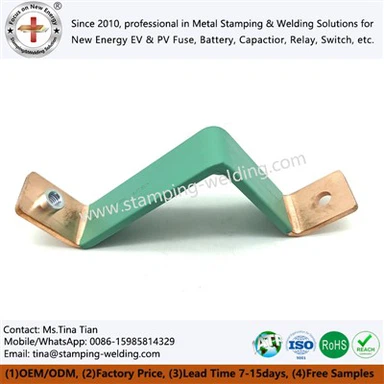
Before use, it is essential to understand the product's structural characteristics to lay the foundation for standardized operation. This copper busbar adopts a positive and negative electrode stacked structure, with high-voltage, high-insulation-performance insulating material (such as PET or PI film) sandwiched between the copper conductors. This conforms to the core insulation standard of Automotive Bar PET Insulation. This design minimizes self-inductance (ESL), meeting the ultra-low inductance requirements of modern electric vehicle 800V high-voltage platforms. After optimization, the self-inductance can be reduced to below 6nH, reducing voltage overshoot during switching. In terms of appearance, it is a long, rectangular or chamfered rectangular conductor with a highly compact structure. Compared to traditional cables, it can carry high electrical loads in a very small space. When using it, it is necessary to consider the installation space dimensions and confirm the compatibility of the busbar specifications with the installation environment to avoid improper installation due to space constraints, which could affect subsequent performance.

Functional advantages
Mastering the core functions and advantages of the product allows for better utilization of its value while mitigating usage risks. This busbar boasts high-efficiency energy transmission; as the "blood vessels" of high-voltage transmission, it can transfer battery energy to the inverter with extremely low impedance and low heat loss. Combined with the excellent conductivity of copper (low resistivity, good thermal conductivity), it effectively reduces energy loss and improves the overall vehicle energy efficiency. It has ultra-high voltage operating capability, adapting to 800V and above high-voltage platforms, and safely withstands DC high voltages above 1000V. During use, it must be strictly matched to the vehicle's high-voltage system specifications, and operation beyond the rated voltage range is strictly prohibited. Furthermore, its lightweight and compact structure reduces the weight of related connectors by more than 30%, saving internal space in the battery pack. During installation, its structural advantages should be fully utilized, and the installation location should be rationally planned. Its high-temperature resistance (-55°C to 115°C), shock resistance, and strong self-recovery characteristics allow it to adapt to the harsh operating environment of electric vehicles; however, prolonged exposure of the busbar to extreme temperatures or severe vibrations should still be avoided to extend its service life.

Installation Specifications
Clearly defining application scenarios and installation specifications is crucial for ensuring the normal operation of the product. This busbar is mainly used in three core scenarios, and its operation must be standardized according to the characteristics of each scenario: In the DC-Link stage, it needs to be installed across the film capacitor to absorb high pulse currents and stabilize voltage in the motor control system, corresponding to the scenario requirements of Copper Bar for DC link EV Film Capacitor. During installation, ensure a tight fit with the capacitor interface to avoid potential overheating due to poor contact; In the inverter and motor connection scenario, the DC-Link capacitor, power module (IGBT/SiC), and DC input terminal need to be precisely connected. As an important component of Automotive Power Connectors, the connection must be secure to prevent loosening that could lead to circuit failure; Inside the battery pack, it is used to connect battery modules in series to achieve low-resistance current connection. During installation, pay attention to the connection spacing with the battery modules to avoid short-circuit risks. It can also be used with EV battery busbar components to improve connection stability.

Maintenance points
Key performance indicators require close monitoring and regular maintenance to ensure safe operation. The core performance indicators for this busbar are resistance and low inductance (ESL): resistance must be controlled below the milliohm (mΩ) level to ensure low heat dissipation. Resistance should be checked regularly during use; any abnormal increases should be investigated promptly to identify poor contact or bar losses. Low inductance (ESL) is a crucial indicator for high-frequency operation; the lower the value, the better. Improper installation should be avoided to prevent increased inductance, which could affect the stability of high-voltage transmission. Furthermore, this bar employs an insulated design, conforming to the standards for Insulated Bus Bars. The surface insulation layer must be protected during use to prevent scratches and damage that could lead to insulation failure. Regular cleaning of dust and debris from the bar surface is also necessary to prevent impact on heat dissipation and conductivity.
Summary of usage
In summary, the standardized use of Film Capacitor Copper Busbar for Electric Vehicles requires a focus on four core dimensions: structural understanding, functional matching, scenario adaptation, and performance monitoring, strictly adhering to installation and maintenance specifications. As a key component for connection, filtering, and power distribution in the power drive system of new energy vehicles, its standardized use not only fully leverages its advantages of high efficiency, high voltage, and lightweight design, but also effectively avoids circuit faults, ensures the stable operation of the vehicle's power system, and provides solid support for the safe driving of new energy vehicles. Furthermore, its use can be further enhanced by incorporating relevant adaptation standards such as Film Capacitor Bar for HEV / EV Motor Control Unit.
Contact Us
If you have any questions about Film Capacitor Copper Busbar for Electric Vehicles use or specification compatibility, please feel free to contact us for professional guidance and solutions.