Laminated flexible aluminum busbar: full analysis of core characteristics, structural processes, and industry applications
Mar 26, 2026
Core definition and structural composition of Laminated aluminum busbar
Laminated flexible busbar is a connecting component made by alternately stacking multiple layers of conductive materials and insulating materials through vacuum lamination process, also known as composite busbar, sandwich busbar, low inductance busbar, etc. Its core function is to achieve efficient transmission and distribution of power. Its structure mainly consists of three parts: the electrode layer is made of highly conductive materials (such as copper and aluminum), responsible for transmitting current; The insulation layer is used to isolate each electrode layer and prevent short circuits; The coating layer serves to protect the electrode layer and isolate the external environment, ensuring safe use.
According to the requirements of conductivity and insulation level, the electrode layer can be made of materials such as copper, aluminum, etc. The synergistic effect of each part endows the Laminated bar with the core advantages of low impedance, anti-interference, and good heat dissipation.

Material selection and production process of Laminated flexible aluminum busbar
The performance of Laminated bus bar for telecom is closely related to its material selection and production process. The material of the electrode layer directly determines the conductivity, and commonly used materials include copper, aluminum, etc. Among them, copper has high conductivity, while aluminum has the advantage of lightweight and can be flexibly selected according to the application scenario; The insulating layer material shall have the characteristics of high temperature resistance, aging resistance and high insulation strength.
In the production process, the key step is vacuum lamination, which removes interlayer air through a vacuum lamination device to ensure that each layer is tightly adhered and has no gaps, avoiding hidden dangers such as partial discharge; Equipped with comprehensive quality inspection and alarm mechanisms, timely warnings are issued in case of deviations during the suppression process to ensure consistency of the Motor drive laminated bus bar for power electronics.
In addition, surface treatment is an important step in improving performance. Common methods such as tin plating, silver plating, and nickel plating can respectively enhance welding performance, conductivity, and corrosion resistance, and adapt to different working conditions.
Production key and application scenarios
In the production of Laminated bus bar for high current inverters, the vacuum laminating device plays a core role. The equipment consists of a heating and cooling system, a vacuum system, and a hydraulic laminating system, which can remove interlayer air, ensure that the insulation layer is tightly adhered to the electrode layer, and improve the insulation performance and mechanical strength of the product; The production process is also equipped with comprehensive quality control and alarm mechanisms to ensure the product qualification rate.
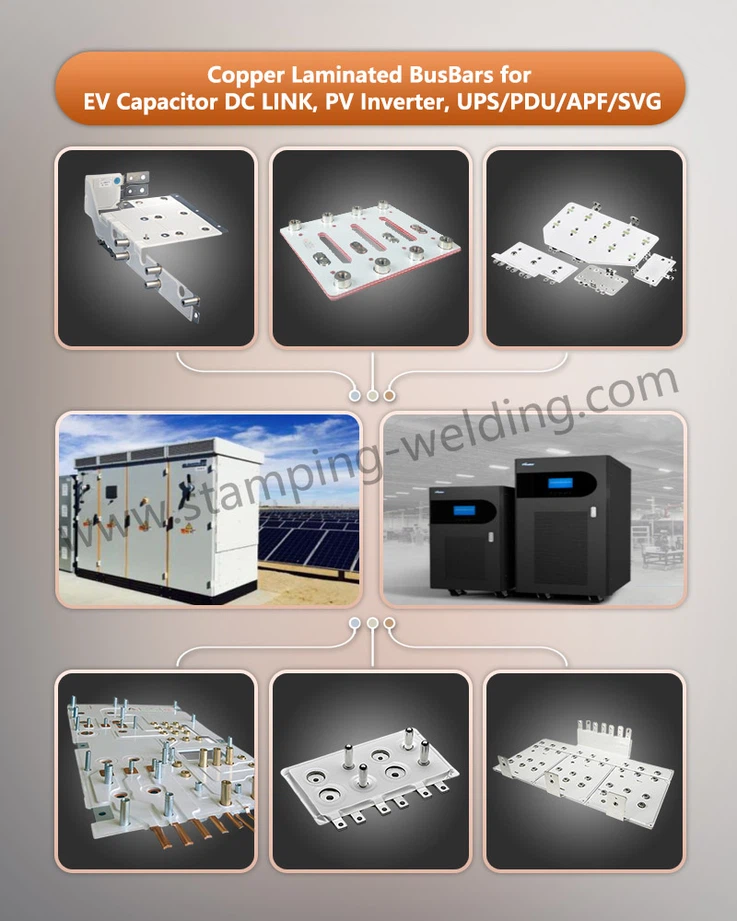
Its application scenarios are very wide, in the field of power conversion, it can be used for devices such as solar inverters and wind energy converters to achieve efficient current transmission; In the field of transportation, the Laminated bus bar for mounting structure of capacitor bank is suitable for power distribution of locomotives, electric vehicles, and electric ships; In the field of communication and computer, it is used for power connection of base stations, servers, and large hosts; In the industrial field, supporting the stable operation of servo systems, welding equipment, etc. is an indispensable key component in electrical systems of various industries.
Surface treatment and structural classification
The surface treatment of Busbar for electric locomotive needs to be selected according to the working conditions. Tin plating is suitable for batch welding scenarios, silver plating is suitable for high-precision and high current scenarios, and nickel plating is suitable for harsh corrosive environments. Different treatment methods can be targeted to improve conductivity and corrosion resistance. Structural classification can be divided into three dimensions: process, electrical characteristics, and assembly methods. In terms of process, there are types such as lamination, hot pressing edge sealing, and glue filling.
In terms of electrical characteristics, there are DC busbars, low inductance busbars, etc. In terms of assembly methods for Busbar for power electronics, there are categories such as simple and integrated components. Various classifications can flexibly adapt to the usage needs of different industries and working conditions, providing support for the efficient and stable operation of power systems.

Contact us
If you have any questions about the selection, structural customization, or process adaptation of Laminated flexible aluminum busbars, please feel free to contact us for consultation at any time. We will provide professional technical support and customized solutions based on your specific working conditions to assist you in efficiently applying laminated busbars.