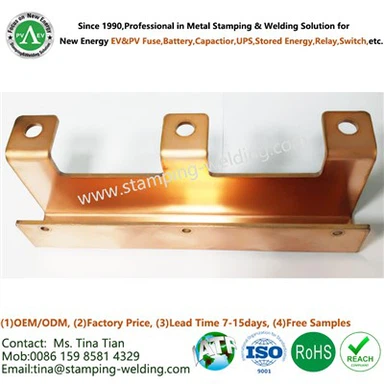
Material Selection in Busbar Design: Copper vs. Aluminum
Sep 24, 2025
Electrical Conductivity
- Copper: Copper is the undisputed benchmark for conductivity among non-precious metals. With an electrical conductivity rating of approximately 100% IACS (International Annealed Copper Standard), it offers the lowest electrical resistance for a given cross-sectional area. This high conductivity translates directly to higher efficiency, as less energy is lost as heat during conduction. For applications where minimizing power loss is paramount, such as in high-efficiency servers or sensitive power conversion equipment, copper's superior conductivity is a significant advantage.

- Aluminum: Aluminum has a significantly lower conductivity, rated at about 61% IACS. This means that, purely from a resistance standpoint, an aluminum busbar must have a larger cross-sectional area than a copper one to carry the same current with an equivalent temperature rise. Typically, an Flexible Aluminium Connections needs to be about 56% larger in cross-sectional area to match the ampacity of a copper busbar.

Key Takeaway: Copper wins in efficiency and power density. Aluminum requires more material to achieve similar electrical performance.
Weight and Density
- Aluminum: The primary advantage of aluminum is its low density. Aluminum is approximately three times lighter than copper (density of ~2.7 g/cm³ vs. ~8.96 g/cm³). Even when the larger cross-section is accounted for, an Aluminum Flexible Connections will still be roughly 50% lighter than its copper equivalent. This weight saving is crucial in applications like electric vehicles (EVs) and aerospace, where every kilogram reduced contributes directly to increased range, payload, and energy efficiency.
- Copper: The high density of copper makes busbar systems heavier. While this may be less of a concern in static installations like a factory switchboard, it becomes a significant drawback in mobile or weight-sensitive applications.
Key Takeaway: Aluminum is the clear choice for applications where weight reduction is a top priority.

Cost and Material Price Volatility
- Aluminum: On a per-kilogram basis, aluminum is significantly less expensive than copper. Despite requiring more volume, the total material cost for an tin plated aluminum bus bar system is almost always lower. This cost-effectiveness makes aluminum the preferred choice for large-scale projects and cost-sensitive applications, such as main power distribution panels and large-scale solar farm combiners.
- Copper: Copper is a more expensive commodity, and its price can be volatile. While the initial material cost is higher, it's essential to consider the total cost of ownership. The higher efficiency of copper can lead to lower energy costs over the system's lifetime, potentially offsetting the initial investment in some high-power, continuous-operation scenarios.
Key Takeaway: Aluminum offers a lower initial material cost, while copper may provide better long-term value in high-energy applications.
Thermal Management and Heat Dissipation
- Copper: Copper not only has higher electrical conductivity but also superior thermal conductivity (about 60% higher than aluminum). This means copper busbars can dissipate heat more effectively, leading to a lower operating temperature under the same load conditions. This superior thermal performance enhances reliability and can allow for more compact designs.
- Aluminum: While aluminum's thermal conductivity is lower, it is still considered a good thermal conductor. The larger surface area of an aluminum busbar (due to its larger size) can partially compensate for its lower thermal conductivity, aiding in convection cooling. However, for a given temperature rise, copper will generally manage heat more efficiently.
Key Takeaway: Copper provides superior thermal performance, contributing to higher reliability and potentially longer lifespan.

Mechanical Properties and Connection Reliability
- Copper: Copper busbars offer excellent mechanical strength and are more ductile (less brittle) than aluminum. They are less prone to "cold flow" or creep under pressure. Most importantly, copper forms a stable oxide layer that is relatively conductive, which leads to more reliable, low-resistance connections over time with proper hardware.
- Aluminum: Aluminum is softer and has a higher coefficient of thermal expansion than copper, meaning it expands and contracts more with temperature changes. This can lead to loosening of bolted connections over time if not properly addressed. The oxide layer that forms on aluminum is highly resistive and can lead to increased contact resistance and overheating. Therefore, specialized surface treatments (such as tin or silver plating) and specific connection protocols (using lubricated hardware and torque washers) are mandatory for aluminium flat busbars for switchgear to ensure long-term reliability.
Key Takeaway: Copper offers easier handling and more inherently reliable connections. Aluminum requires careful engineering and surface treatment to mitigate oxidation and creep issues.
A Balanced Choice for Specific Applications
Choose Copper when: Maximum efficiency, superior power density, best thermal performance, and high reliability in compact spaces are the primary goals (e.g., high-value electronics, compact inverters, critical power systems).
Choose Aluminum when: Cost-effectiveness, weight reduction, and large-scale distribution are the driving factors, and the design can accommodate the larger size and specific connection requirements (e.g., EV battery packs, large solar installations, main utility switchgear).
Contact us
Navigating the copper vs. aluminum decision is just the first step. At XIAMEN APOLLO, we engineer solutions that maximize the benefits of both materials. Our expertise ensures that regardless of your choice, you receive a busbar system optimized for performance, reliability, and cost.
For Copper Applications: Our precision-engineered copper busbars feature advanced electro-tin or silver plating to prevent oxidation and ensure perfect connections. We utilize state-of-the-art simulation tools to design for optimal ampacity and thermal management, perfect for your most demanding power electronics.
For Aluminum Applications: We specialize in manufacturing high-performance aluminum busbars with proprietary surface treatments that combat oxidation, ensuring long-term connection integrity. Our designs expertly manage the larger form factor to deliver lightweight, cost-effective solutions without compromising on safety or performance.
Facing a specific design challenge? Contact our engineering team today to discuss how our tailored busbar solutions can power your innovation.