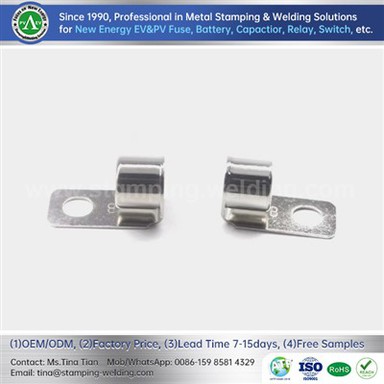
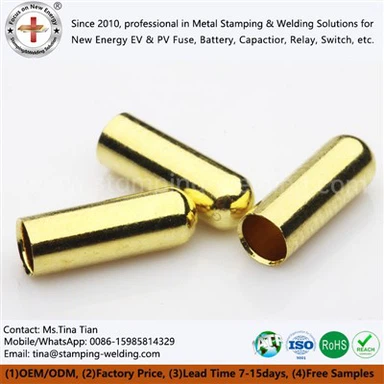
Overview of copper stamping industry knowledge
May 19, 2026
In the field of precision metal forming and processing, Pressing Copper Stamping Bending Connecting Parts have become an indispensable core structural component in many industrial sectors such as automobile manufacturing, electronic and electronics, new energy equipment and medical instruments due to their excellent electrical conductivity, thermal conductivity and good ductility. When many purchasing personnel select supporting suppliers, they often face practical problems such as unclear technical indicators and fuzzy selection logic. In fact, as long as the system masters the core technical parameters, material selection basis and whole-process quality control points of copper stamping parts, it can quickly establish a scientific and reasonable supplier evaluation system, thereby providing stable and reliable support for the company's product development and mass production.
The Stamping Copper Sheet process uses the synergy of high-precision molds and presses to plastically deform copper sheets into specific geometric shapes. It not only retains the inherent physical properties of copper, but also achieves one-time or step-by-step molding of complex structures. As a dual carrier connecting functional parts and structural supports, copper-based precision stamping parts undertake key functions such as current conduction, heat diffusion, mechanical fixation and signal transmission in the entire system. Their quality stability directly determines the operational reliability and service life of terminal equipment.

Material advantages
Copper has excellent electrical conductivity, and its conductivity is second only to silver. This allows Electrical Copper Stamping Parts to stably realize low-impedance current conduction in connectors, terminal blocks, relay shrapnel and charging pile conductive parts in the new energy field, avoiding equipment heating, energy loss and even shutdown caused by insufficient material conductivity or excessive contact resistance. At the same time, the thermal conductivity of copper is as high as about 400 W/(m·K), far exceeding that of aluminum and steel. This characteristic enables copper-stamped heat sinks to quickly dissipate operating heat in charging piles, inverters and power modules, ensuring long-term stable operation of equipment under high-temperature conditions and reducing the risk of thermal runaway.
In addition to the advantages of electrical and thermal conductivity, the ductility of copper is also significantly better than that of most ferrous metals. In complex stamping processes such as drawing, fine blanking, and rotary cutting and drawing, copper materials are not prone to defects such as cracking, wrinkling, or local thinning and can meet the molding needs of thin-walled deep cavities, special-shaped flanging, and high-precision structural parts. The Copper Sheet Stamping process can cover a wide range of specifications from 0.1mm ultra-thin spring pieces to several millimeters thick structural parts, and the molded parts have a high surface finish and good dimensional consistency. In addition, copper ions have natural antibacterial properties. This biological functionality gives copper stamping parts unique application value in contact instruments and structural parts of precision testing equipment in the field of medical machinery. It can effectively reduce the risk of cross-infection and comply with the strict hygiene and biocompatibility standards of the medical industry.

Application areas
In the automotive industry, Metal Stamping Parts Electric Copper is often used in key parts such as high-temperature gaskets around the engine, solenoid valve housings, sensor brackets, and battery pack conductive connectors. These components have been exposed to harsh working conditions of high temperature, high vibration, and oil pollution for a long time, which places extremely high requirements on the materials' high-temperature softening properties, fatigue resistance, and dimensional stability. Copper alloys such as beryllium copper and phosphor copper can significantly increase the hardness and elastic limit while maintaining excellent electrical conductivity through reasonable heat treatment processes, ensuring that automotive parts can still maintain precise assembly gaps and electrical contact pressures after millions of vibration cycles and avoid signal drift and sealing failure caused by looseness or deformation.
In the electronics industry, Custom Copper Stamping products are mostly used as the core structure of connector terminals, shielding covers, grounding shrapnel and micro relay contacts. Such components usually have small size, thin wall thickness, and strict accuracy requirements. The tolerance often needs to be controlled at ±0.01 mm or higher, and the cross-section is required to be burr-free and crack-free to ensure plugging and unplugging life and contact reliability. In the new energy industry, charging pile power module heat sinks, photovoltaic inverter busbars and energy storage system high-current connectors also rely on the high thermal conductivity and high-current carrying capacity of copper stamping parts. Their design must take into account heat dissipation efficiency, electromagnetic compatibility and assembly space constraints, and achieve a high degree of integration of function and structure through multi-station composite stamping such as bending, beading, and flanging.
In the field of medical machinery, the Copper Strip Stamping process is widely used in conductive slip rings of various precision testing equipment, micro-clamping structural parts, and electrode components of high-frequency surgical instruments. The products are required to have extremely low surface roughness, no magnetic residue, and dimensional errors controlled at the micron level to avoid interference with precision optical or electromagnetic detection signals. Flanges, valve gaskets, and hydraulic system connections in the field of industrial equipment are also often stamped and formed from copper or copper alloys. Such components need to have excellent pressure resistance, air tightness, and corrosion resistance at the same time. The softness and self-lubricating properties of copper make it excellent in high-pressure sealing, effectively reducing interface wear and leakage risks.

Production process
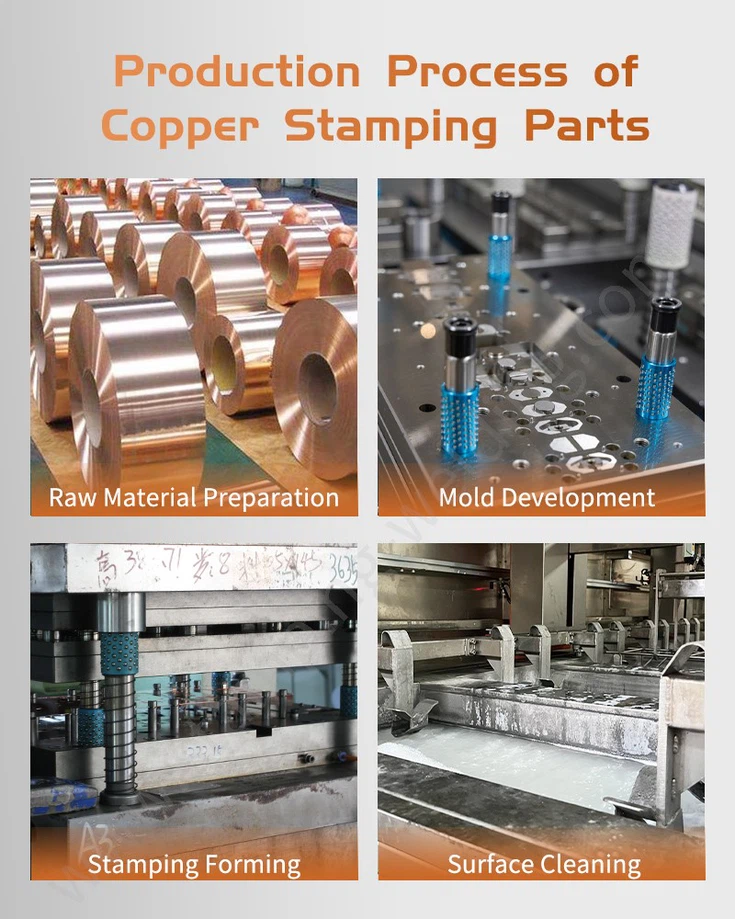
From a manufacturing process perspective, the core of Copper Stamped Components' production lies in the precise coordination of stamping dies and press systems. The stamping process essentially uses upper and lower dies installed on a press to apply external force to the metal sheet to cause plastic deformation or separation, thereby obtaining a predetermined shape and size. Molds can be divided into three categories: single-process molds, composite molds and progressive molds according to the complexity of the process: single-process molds only complete one stamping action for each set of molds, and are suitable for small batches and multi-variety non-standard trial production; composite molds can complete multiple actions such as punching and forming in one stroke, significantly improving processing efficiency and positional accuracy; progressive molds use a belt stepping feeding method to continuously complete more than ten or even dozens of processes in one mold, which is especially suitable for automated production of large-volume, ultra-thin materials. Mold design and manufacturing is a key link in determining the upper limit of the quality of copper stamping parts.
OEM Factory Customized Copper Metal Stamping Parts require mold engineers to intervene in customer demand analysis at the early stage of product development, and optimize the mold structure plan based on the usage scenario, stress state, assembly relationship and mass production scale of the parts. The gap between the convex and concave molds of ultra-precision molds is usually controlled between 5% and 8% of the material thickness. With mirror-level surface treatment and reasonable edge angle design, the proportion of bright strips on the punched section can be increased to more than 80%, significantly reducing the secondary deburring process. For complex molding features such as deep drawing, necking, flanging, etc., the mold needs to be equipped with nitrogen springs, polyurethane press plates and adjustable limit devices to achieve precise control of the material flow rate and prevent wrinkling and rupture.
contact us
We focus on providing customers with high-quality Copper Spring Contacts solutions. Relying on advanced precision mold design and manufacturing capabilities, we are able to meet the customization needs of various complex structural parts. Feel free to contact us at any time, and we will provide you with highly competitive customized products and technical support.