PVC Dipped Insulated Bus Bar Immersion Process: Process Analysis, Material Selection, and Industry Application Points
Jan 31, 2026
Definition of Process Core and Fundamentals of Scene Adaptation
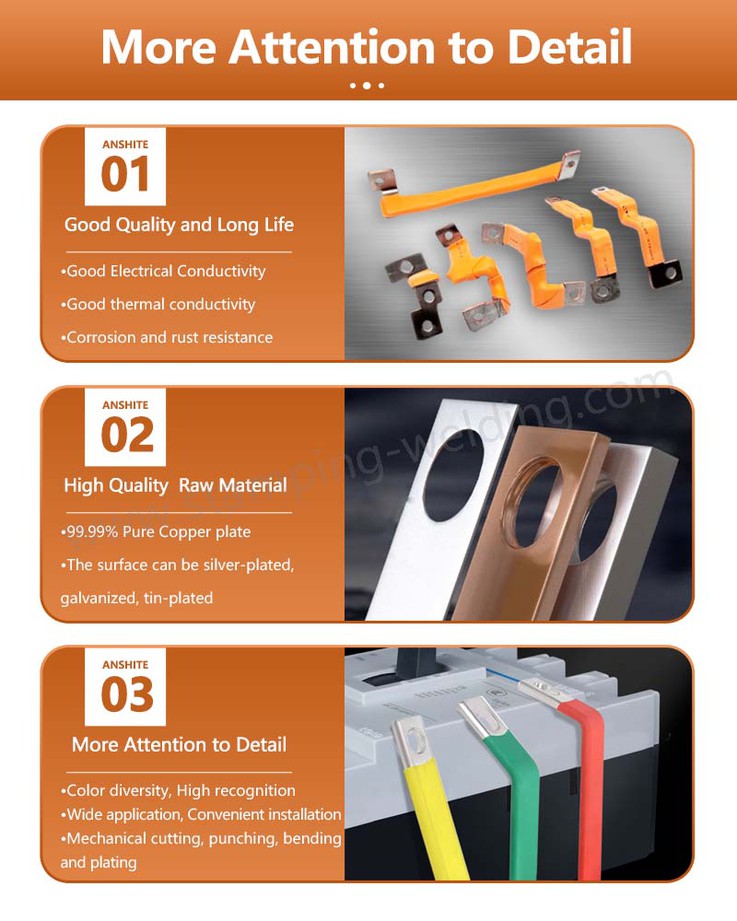
PVC Dipped Insulated Bus Bar dipping is a core processing technology that uniformly covers the surface of copper (or aluminum) bars with liquid adhesive insulation material through a specific process to form an insulation protection layer. It is widely used in the field of power transmission. Especially in power battery packs and energy storage systems, this process forms an insulation layer through molten plastic coating, which needs to meet multiple core requirements: in terms of insulation reliability, it is necessary to ensure uniform coating thickness (conventional 0.5-2mm), insulation strength of 20-28kV/mm, and withstand 4380V DC pressure resistance test; In terms of environmental adaptability, it is necessary to have excellent salt spray corrosion resistance (5% NaCl solution, no corrosion for 192 hours at 35 ℃), and the flame retardant level should meet the UL94-V0 standard; In terms of cost-effectiveness, compared to PI film coating technology, material costs can be reduced by 30%, making it more suitable for mass production needs. However, there are differences in the application of the Insulated Custom Copper Bus Bar with PVC Dipping process in different scenarios. In the field of power batteries, due to strong spatial sensitivity and high heat dissipation requirements, thickening the coating can lead to a thermal resistance increase of 20-31%, which limits its application; The energy storage system requires higher insulation performance than lightweight requirements, and the penetration rate of the immersion molding process is relatively higher.

Analysis of the entire process and key control points
The core of the immersion molding process is precise control of the entire process parameters, mainly including four key links: pretreatment, immersion, plasticization, and post-treatment. Pre treatment of the PVC Dipped Insulated Bus Bar requires completion of oil and grease removal, surface roughening, and preheating activation to ensure coating adhesion; Glue immersion requires strict control of the viscosity and immersion parameters of the glue solution to ensure uniform coating; Plasticization adopts a three-stage heating curve to ensure sufficient cross-linking of the polymer; The post-processing ensures the quality and safety of the Insulated Flexible Copper Bus Bar for Power Battery Pack through gradient cooling, laser trimming, and airtightness testing.
The core of the dipping process for Plastic Dipping Electric Copper Busbar Custom Made lies in the full process control. The precise control of parameters in each step directly determines the quality and effectiveness of the coating, which can be divided into four key stages: pretreatment, dipping, plasticizing, and post-treatment. The pretreatment process is the foundation for ensuring coating adhesion, which mainly includes three core operations: degreasing and oil removal using an alkaline solution with a pH of 10-12 for ultrasonic cleaning for 5-8 minutes, ensuring that the residual oil stains on the surface of the copper and aluminum bars are ≤ 0.1mg/m ²; Surface roughening is achieved by sandblasting 120 mesh alumina particles to control the surface roughness Ra between 1.6-3.2 μ m, thereby enhancing the adhesion of the adhesive layer; In the preheating activation stage, the preheating temperature of Plastic Dipping Copper Busbar should be maintained at 180-220 ℃, while that of aluminum busbar should be 150-180 ℃. The preheating time should be adjusted according to the thickness of the workpiece (such as 120 seconds for a 2mm thick copper busbar), and the overall temperature difference should be controlled within ± 5 ℃.

Core parameter control and failure prevention plan
The stable application of Dipping Busbar for Connection's dipping process relies on precise control of key control parameters and failure prevention. The core control items and corresponding requirements are as follows: the target viscosity value of the adhesive is 2000 ± 500cP. If the deviation is too large, it will cause sagging or incomplete coverage, and it needs to be sampled and tested every 2 hours through a rotary viscometer; In terms of preheating temperature, the target values for PVC Dipped Laminated Flexible Copper are 200 ℃ and for aluminum bars are 170 ℃. Temperature deviations can cause adhesion and peeling forces to be less than 4N/cm, which requires real-time monitoring using an infrared thermal imaging device; The target temperature for plasticizing constant temperature is 200 ± 5 ℃. Unstable temperature can lead to insufficient cross-linking, which can cause insulation failure. This can be detected by DSC differential scanning calorimetry; The cooling rate should be ≤ 5 ℃/s. If it is too fast, it can easily cause microcrack propagation, which can be controlled by recording the cooling deformation with a high-speed camera. A typical failure case shows that a certain energy storage project had uneven plasticization temperature (the temperature at the edge of the box was 15 ℃ lower), resulting in blistering and peeling of the coating after salt spray testing. Subsequently, the problem was solved by increasing the hot air circulation fan to optimize temperature uniformity.
Core Technology Applications and Future Development Trends
Overall, the impregnation process of PVC Coated Bus Bars is at the core of the application of power battery packs, balancing insulation reliability, heat dissipation compromise, and lightweight requirements. The achievement of this goal requires three core paths: firstly, refinement of work steps, implementing ± 5% precision management for key processes such as preheating activation, viscosity control, and gradient plasticization; The second is scenario customization, optimizing the process plan for the differentiated needs of local immersion molding of power batteries and full area thick coating of energy storage systems; The third is material innovation, which breaks through the performance limitations of traditional materials through methods such as adding nano fillers and developing low-temperature adhesives. In the future, with the gradual popularization of solid-state battery high-voltage platforms (800V+), the dipping process of Busbar Isolation will evolve towards ultra-thin coatings (<0.5mm) and functional composites (integration of insulation, thermal conductivity, and electromagnetic shielding), further adapting to the application needs of high-end power transmission scenarios.
contact us
Our team focuses on producing busbar series and has a professional engineering team. If you are currently in the PVC Dipped Insulated Bus Bar selection or technical evaluation stage, please provide project conditions and key parameters for engineering confirmation.