


Analysis of Application Scenarios and Technological Development of EV Bus Bars
Jan 29, 2026
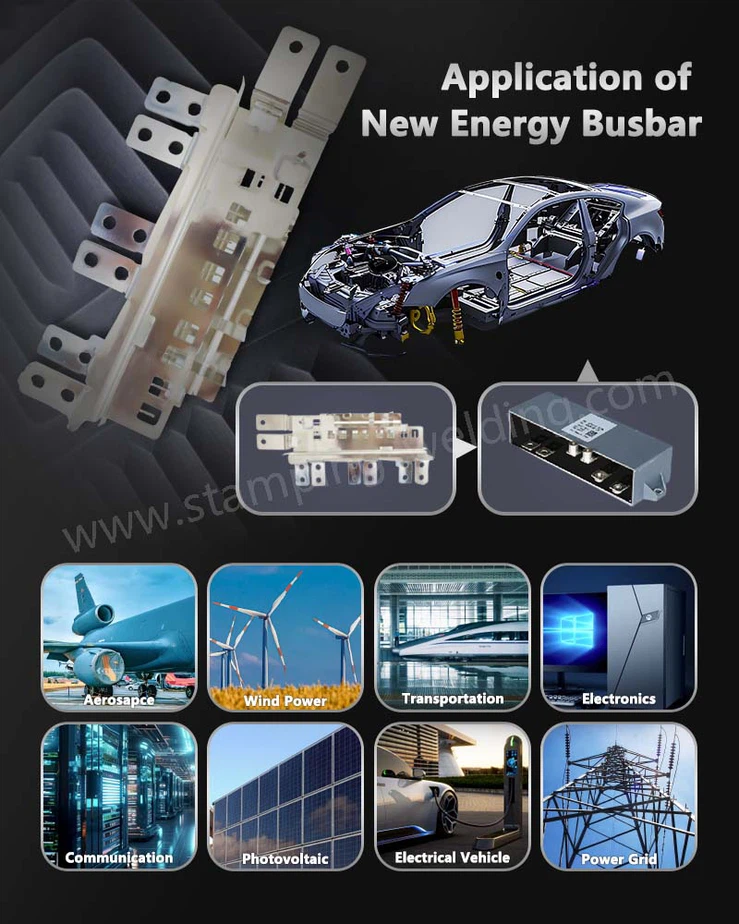
EV Bus Bars (also known as "copper bars" or "busbars") are the core transmission components of high-voltage electrical systems, playing an irreplaceable role in energy distribution and transmission. They are widely used in key scenarios such as battery packs, electric drive systems, and charging systems. Its performance directly affects the stability, energy efficiency, and safety of the high-voltage system of new energy vehicles. This article will be divided into five parts for systematic analysis based on dimensions such as core role, typical application scenarios, and future development trends, providing reference for industry practitioners.

The core positioning and role of EV Bus Bars
The core function of Automotive BusBar PET Insulation is to achieve efficient transmission of high voltage and high current. It usually uses high conductivity copper or aluminum as the substrate and is processed into a flat conductor structure, which is suitable for the working requirements of new energy vehicle high voltage systems (usually 300V-800V) and high current (up to 600A or more). Compared to traditional wiring harness connection solutions, Car Battery Bus Bar has significant advantages in space utilization, transmission efficiency, and operational reliability. In terms of space utilization, the flat structure can significantly reduce the wiring volume, better adapt to the compact layout environment inside new energy vehicles, and effectively save installation space; In terms of transmission efficiency, the conductivity loss of Auto Bus Bar is significantly lower than that of traditional cables, with a copper bar resistivity of about 0.017 Ω· mm ²/m. Compared to cables with the same cross-sectional area, the loss can be reduced by 15% -20%, which helps to improve the energy utilization efficiency of the entire vehicle; In terms of reliability, the integrated structure can effectively avoid potential risks such as loose connectors, while meeting strict protection standards such as IP67, and adapting to complex operating environments in vehicles.

Three typical application scenarios and technical requirements
One is the internal integration scenario of the power battery pack. In this scenario, Automotive Power Connectors mainly undertake the connection and power transmission tasks between the battery module and the Battery Management System (BMS), which is a key link to ensure the stable output of electrical energy from the battery pack. The current mainstream voltage platforms are mainly divided into two categories: 400V and 800V, which are suitable for the needs of new energy vehicles with different power levels. Considering that the battery pack needs to withstand complex working conditions in the vehicle environment for a long time, Busbar Automotive needs to have excellent high temperature resistance and vibration resistance performance. The typical operating temperature range needs to cover -40 ℃~125 ℃, and at the same time, it needs to meet the requirements of relevant mechanical impact testing standards to ensure stable connection and electrical performance even in the face of bumps, vibrations, and other situations during vehicle driving. In terms of technological optimization, through the integrated design of busbar, the number of internal structural components of the battery pack can be effectively reduced, the assembly process can be simplified, and the integration efficiency of the battery pack can be improved.
Secondly, the high-voltage interconnection scenario of the electric drive system. As the core of the power output of new energy vehicles, the electric drive system is mainly responsible for the high-voltage interconnection task between the inverter and the drive motor. In this scenario, the peak current can usually reach over 500A, which puts higher requirements on the transmission stability and low loss characteristics of the busbar. To reduce switch losses and improve the operational efficiency of the electric drive system, the Capacitor Busbar needs to adopt a low inductance design, usually requiring an inductance value below 10nH/cm. At the same time, to prevent oxidation of the conductor surface and ensure long-term stable conductivity, the surface of the busbar is usually treated with tin plating or silver plating. In addition, with the development of integrated electric drive systems, some solutions can significantly improve heat dissipation efficiency by integrating cooling water channels and other designs into the busbar structure, further ensuring the stable operation of the busbar under high current conditions.
Thirdly, the scenario of fast charging pile power distribution. In the DC fast charging pile system, the DC Capacitor Busbar is mainly used for the distribution and transmission of high-voltage electrical energy, which needs to adapt to high-power fast charging requirements. It usually needs to carry power transmission tasks of 480V/250kW or more, and in some scenarios, the instantaneous current can reach 600A, and the duration needs to meet the fast charging requirements of more than 10 minutes. Based on the working characteristics of high voltage and high current, the insulation layer of Busbar Insulation needs to have extremely high withstand voltage performance, usually requiring a withstand voltage of over 3000V and complying with relevant industry standards and specifications. To solve the problem of temperature rise during high-power transmission, liquid-cooled busbar technology has gradually been applied. Through liquid cooling, the working temperature rise of the busbar can be effectively controlled within 15 ℃, providing a guarantee for the efficient and safe operation of fast charging piles.
Technological challenges and directions under industry development trends
With the continuous upgrading of the new energy vehicle industry towards high-voltage, lightweight, and intelligent directions, EV Bus Bars technology is facing new challenges and development opportunities. In the future, there will be three main development directions: first, the performance upgrade demand brought by the popularization of 800V high-voltage platforms. Under the trend of high voltage, BusBar Cars need to have higher insulation strength. By optimizing insulation materials, increasing insulation protection layers, and other methods, safety risks such as high-voltage breakdown can be avoided to ensure stable operation of high-voltage systems. The second is the integration of intelligent monitoring functions. By integrating temperature, current, and other sensors on the New Energy Vehicle Film Capacitor BusBar, real-time monitoring of the operation status of the busbar can be achieved, timely warning of abnormal situations such as overheating and overcurrent, further improving the safety and reliability of high-voltage system operation.
contact us
Inquiry does not constitute a binding commitment to place an order. We sincerely welcome all kinds of inquiries about our products, prices, specifications, and related services, and will reply to you with professional and detailed information in a timely manner.


