Technical Standards and Logic for Industry Material Selection Of Lithium-ion Battery Packs
Jul 31, 2025
Amid the rapid development of the new energy industry, lithium-ion battery packs have become a core component supporting upgrades in electric vehicles, energy storage systems, portable electronic devices, and other fields. Their performance, safety, reliability, and manufacturing costs directly impact the technological evolution and market competitiveness of downstream industries. The aluminum casing, serving as the lithium cell battery Aluminum shell's "protective barrier," is a crucial factor in determining its overall performance. The following analysis analyzes key industry knowledge and technical highlights from the perspectives of material technology, performance standards, application requirements, manufacturing systems, and future trends.

Material selection for lithium-ion battery pack casings is a crucial step in balancing performance, cost, and safety. The current mainstream industry base material for battery aluminum casings is 3003-H14 aluminum alloy. This choice stems from the stringent material requirements of the new energy sector. 3003-H14 aluminum, which complies with the GB/T3880 standard, boasts a tensile strength of 145-195 MPa. It can withstand the mechanical shock and vibration of vehicle operation and equipment operation, while also exhibiting excellent corrosion resistance and adaptability to humid, dusty, and even mildly acidic and alkaline environments. The alloy's formability and weldability are particularly crucial. Through stamping and welding processes, casings in various sizes (width, length, and height) such as 54173, 36130, and 29135 mm can be precisely manufactured, meeting the customized size requirements of various OEM customers. This represents the crucial link between mass production and personalized applications.

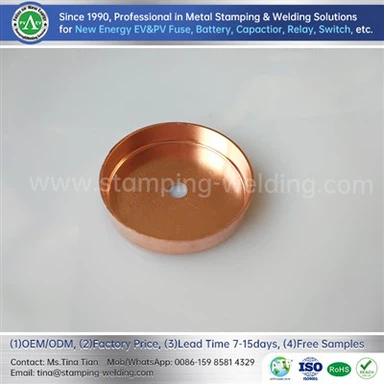
The material combination of the battery cover reflects the dual considerations of electrical performance and structural stability. The design utilizes a composite of 3003-H14 aluminum, T2Y2 copper, and injection molding materials. The T2Y2 copper must comply with GB/T5231 standards, with a purity of ≥99.99%, a conductivity of ≥97% IACS, a hardness of 80-110 HV, and a tensile strength of 245-345 MPa. High-purity copper maximizes current transmission efficiency and minimizes energy loss. The aluminum alloy provides structural support, while the injection molding material enhances sealing. These three elements work together to achieve the combined benefits of "high conductivity, mechanical stability, and environmental isolation." This is the core design principle for ensuring stable charge and discharge in high-end Prismatic Cell Cases in the industry.
The performance parameters of Battery Aluminum Housings are not isolated; they are precisely aligned with the technical requirements of downstream application scenarios. Taking aluminum casings as an example, the 0.5-3 mm thickness design holds a hidden industry secret: small portable electronic devices use 0.5-1 mm thin casings to achieve lightweight while providing basic protection; electric vehicle power batteries require 2-3 mm thick casings, which are reinforced to resist collision and crush risks. Behind this differentiated design lies the industry's in-depth exploration of the balance between protection performance and weight. Aluminum alloy's low density of 2.7-2.8 g/cm³ reduces weight by over 40% compared to traditional steel, directly contributing to an 8-12% increase in electric vehicle range. This is the core reason why the new energy vehicle industry favors aluminum casings.
Corrosion resistance and heat dissipation performance are key indicators determining battery pack lifespan. Industry standards require high-quality Aluminum Alloy Prismatic Battery Cases to pass hundreds or even thousands of hours of neutral salt spray testing to ensure corrosion resistance in high-humidity coastal environments and outdoor photovoltaic power plant environments. A thermal conductivity of 150-250 W/(m·K) ensures that heat generated by the battery during operation is quickly transferred to the outer casing and dissipated, maintaining stable performance in temperatures between -40°C and 60°C. In energy storage systems, this heat dissipation capability can reduce battery cycle degradation, extending the battery life by 2-3 years and significantly reducing end-user O&M costs.
In terms of electrical safety, the LiFePO4 Aluminum Case Battery Cell's insulating design complements the copper's conductive efficiency. Surface treatments (such as anodizing) achieve electrical isolation, preventing the internal electrodes from forming an unintended conductive path between the electrodes and the external environment. The low contact resistance of high-purity copper keeps current transmission losses below 0.1%, which is crucial for the energy conversion efficiency of photovoltaic energy storage systems. According to industry data, every 1% increase in conductivity efficiency reduces the energy storage system's cost per kilowatt-hour by approximately 0.02 yuan.

contact us