


The production process of Flexible Copper BusBar
Feb 26, 2026
Raw material selection for Flexible Copper BusBar
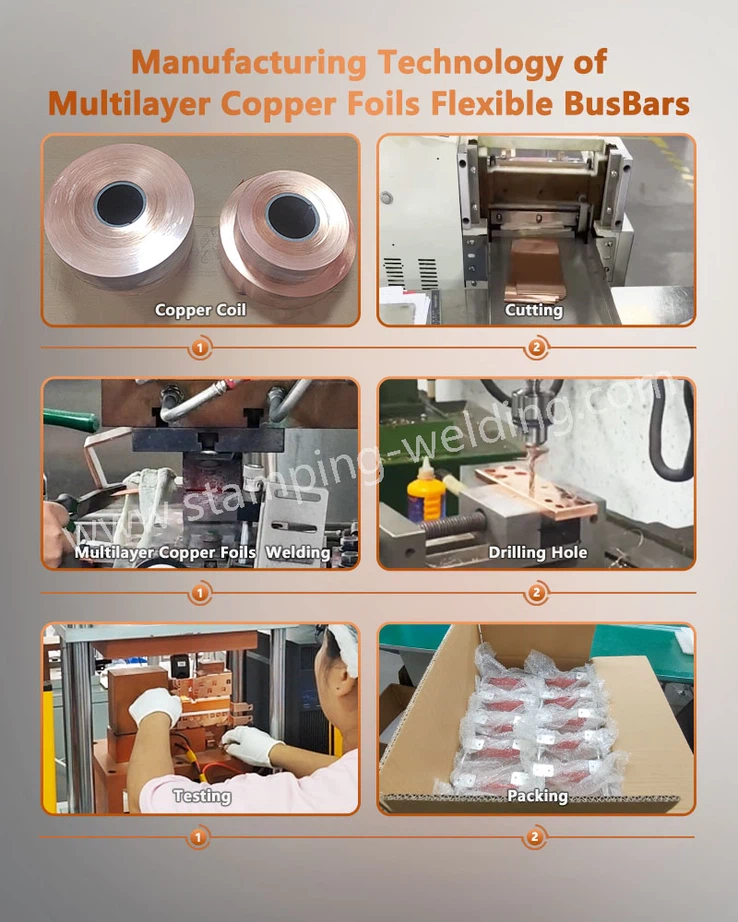
The performance foundation of Multilayer Copper Foils Flexible BusBars comes from the rational selection of raw materials, and high-quality materials are the key to ensuring the electrical and mechanical performance of the product. Products are usually processed using purple copper strips, which can be classified into different grades such as TU1, TU2, T2, T3, etc. according to copper content, and into N state, Y state, T state, etc. according to soft and hard states. In addition, the thickness of a single Copper Flexible BusBar directly affects the flexibility of the finished product and is an important parameter in the design and material selection stages. For different usage scenarios, corresponding copper material grades and states need to be matched. For example, in situations where high elasticity is required, hard copper materials can be used to improve the rebound and stability of the mechanism.

Copper foil cutting and pretreatment
Cutting is the first process of forming Flexible Copper BusBar, mainly completed by specialized cutting equipment. The operator clamps the copper foil that meets the width requirements of the drawing onto the equipment, sets the required length and number of layers in the control system, and the equipment automatically completes precise cutting. After the cutting is completed, a dedicated person will organize, stack, and fix the copper foil to ensure that the layers are neat and the size is consistent, providing stable and qualified semi-finished Flexible Insulated Copper BusBar products for subsequent welding processes.
Core Welding Process and Quality Control
Welding is a crucial step in determining the quality of Insulated Flexible BusBar. The principle is to apply pressure to neatly stacked copper foils and use a welding machine to output high current heating, causing the copper material to soften and melt at the molecular level. Then, with the help of a shaping mold, the width is controlled to form a stable integrated conductor. The welding process parameters directly affect the performance of the finished product: excessively long welding time and high temperature of Automotive Copper Busbar can cause excessive melting and thinning of the welding area, reducing the effective contact area and lowering the conductivity; Insufficient welding time and fusion can lead to defects such as insufficient interlayer bonding, low peel strength, surface blistering, and cracking.
Key points of process and quality assurance of finished products
The manufacturing of Multi Layers Copper Foil Flexible BusBar is highly dependent on process control and parameter matching. From material selection, feeding to welding, each step affects the conductivity, flexibility, and structural strength of the final product. Only with reasonable selection of raw materials, precise cutting dimensions, and stable welding parameters can Copper Laminated Foil Busbars with low resistance, high current carrying capacity, reliable connection, and long service life be produced, meeting the strict requirements of flexible conductive connections in industries such as power, metallurgy, and new energy.
contact us
If you need to further understand the process selection, customized solutions or technical parameters of Flexible Copper BusBar, please feel free to communicate with us at any time. We will provide you with professional technical support and adaptation suggestions to help your project run stably and efficiently.


