What is the relationship between the capacity of a capacitor and its voltage level?
Apr 26, 2023
The Advantages and Disadvantages of Capacitors
Capacitors are used in a wide range of applications, including electric power distribution and electronics. Their primary function is to store energy until it can be released in a useful way, like by generating electricity or storing a flash on a digital camera.
The capacitor is a passive circuit component that essentially stores electrical energy in the form of an electrostatic field, which is a potential difference between two conductive plates. It is one of the most important components in electrical engineering, and can be found in many electronic devices.
They are also used in many scientific experiments. For example, scientists can use a capacitor to test their ability to generate an electromagnetic field in a vacuum.
Capacitors are made of metal sheets separated by an insulating dielectric material. They are also available in a variety of shapes, sizes, and materials.
There are a number of different types of capacitors, each designed for a particular purpose. Some of these include multilayer ceramic, tubular ceramic, multilayer polyester film, polystyrene, and aluminum electrolytic.
The voltage level is a critical part of capacitor operation, as it determines the amount of charge that can be stored in the device. It is also responsible for determining the amount of current that can be passed through the capacitor, as well as for ensuring that the terminals are fully conductive.
Voltage is a measure of how much charge can be stored in a capacitor without damaging it. This is why it's so important to choose a capacitor that has the capacity that you need, and also has a voltage rating that matches your application.
Compared to batteries, capacitors are very efficient at storing charge. They can be charged up very quickly and then release all of that energy very rapidly, like when you push the button on a digital camera to snap a picture.
However, there are a few drawbacks to using capacitors in your circuits:
Capacitor Leakage
The dielectric of every capacitor is not perfect, and it will leak some tiny amount of current from one terminal to the other. This tiny current loss (usually less than a nanoamp) is called leakage and causes the energy to drain away.
Equivalent series resistance, or ESR for short, is a small amount of conductive material on the capacitor terminals that can actually resist current. This resistance is a big problem when you use a lot of current through your capacitor.
These types of leakage can lead to a large amount of heat and energy loss, so you must choose a capacitor with the maximum possible tolerance for your application.
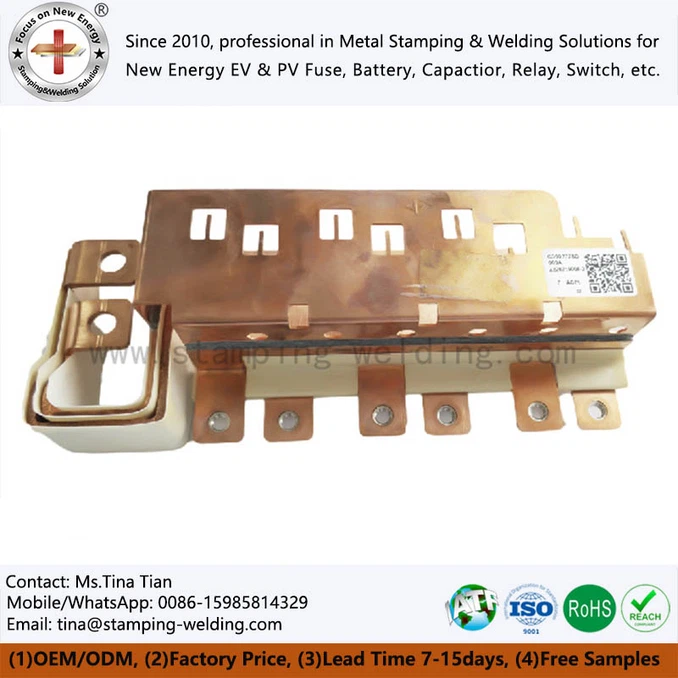
Capacitors can also be dangerous when used in parallel-to-series circuits, as they can store a huge amount of energy in very short amounts of time, which means that the voltage between each capacitor increases very fast. This is why new energy vehicle capacitors copper busbars are usually wired in series, rather than parallel.
This relationship between the capacity of a capacitor and its voltage level is a fundamental aspect of electrical engineering. It can be a bit intimidating to start experimenting with them, but once you know what to expect, it's not that hard to understand how they work!
contact us