

Metal Stamping Parts
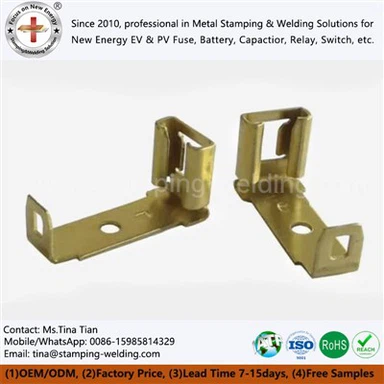
For electrical and mechanical components requiring repeatable geometry, Metal Stamping Parts are produced from brass sheet or coil through precision punching, blanking, bending and forming. Progressive dies and automatic coil feeding support stable mass production, while CMM inspection verifies critical dimensions. Xiamen Apollo provides OEM production from tooling and sample validation to batch manufacturing, with CNC, welding and plating available for integrated requirements.
- Fast Delievery
- Quality Assurance
- 24/7 Customer Service
Product Introduction
Metal stamping parts refer to components produced through a metal stamping process, a highly efficient and cost-effective method for creating intricate metal shapes and structures. This manufacturing technique involves pressing or stamping a metal sheet or coil into a specific shape using a die and a press machine. The resulting stamped parts find applications in a wide range of industries due to their versatility and precision.

Key features of Metal Stamping Parts
High-precision, high-efficiency assembly
Leveraging proprietary progressive dies and ultra-precision machining, the molds achieve micron-level accuracy, ensuring strict control over stamping dimensional tolerances and burr heights. Exceptional product consistency effectively prevents jamming during automated vibratory bowl feeding in downstream processes, significantly boosting assembly efficiency.
High conductivity and low loss
Premium high-conductivity brass coil stock is utilized in conjunction with selective tin, nickel, and silver plating processes. This combination significantly lowers contact resistance, minimizes energy loss and temperature rise during high-current transmission, and ensures operational stability under heavy loads for Metal Stamping Parts.
High-speed mass production for cost reduction
Production utilizes high-speed automated stamping lines integrated with servo-feeding and in-die monitoring systems. This setup guarantees rapid, high-volume delivery while maintaining superior process capability consistency, ultimately driving comprehensive cost reductions across the product lifecycle.

Quality Control & Automated Inspection of Metal Stamping Parts
3D CMM & Vision Measuring
Automated non-contact optical inspection verifies true position, hole centers, and complex bend radii against customer 3D STEP models for Brass Precision Stamping Parts.
Low Burr Edge Control
Continuous punch sharpening schedules maintain sheared edge burrs below micro-meter engineering thresholds, ensuring zero interference during automated socket insertion.
Plating Thickness & Adhesion
X-ray fluorescence (XRF) analyzers measure electroplated tin and nickel thickness, followed by thermal shock adhesion testing for Brass Stamped Parts Components.
Automotive PPAP Level 3 Delivery
Production lots ship with full documentation packages, including Process Capability Studies, Material Test Reports, and Gage R&R records for Brass Sheet Metal Components.

Frequently Asked Questions about Metal Stamping Parts
Q: How is plating thickness verified on Metal Stamping Parts?
A: For tin, nickel or silver-plated components, X-ray fluorescence (XRF) measurement can be used to verify coating thickness at specified locations. Thermal shock or adhesion testing can then evaluate coating integrity where required by the customer's electrical, mechanical or environmental specifications.
Q: Can these brass stamping parts support automated assembly?
A: Yes. Controlled part geometry, hole position, bend dimensions and edge conditions are designed for repeatable feeding and insertion. Consistent stamping output helps reduce jamming during vibratory bowl feeding and supports automated socket, terminal and connector assembly processes.
Q: How does automated stamping reduce the production cost of brass parts?
A: High-speed stamping lines with servo feeding and in-die monitoring reduce manual handling and maintain consistent cycle conditions. Progressive dies combine multiple operations in one production sequence, supporting higher output rates and lower per-piece processing costs for suitable volume programs.
Q: What inspection documents can be provided for automotive projects?
A: For applicable automotive programs, production lots can be supplied with PPAP Level 3 documentation, including process capability studies, material test reports and Gage R&R records. The inspection package can be aligned with customer control plans, drawing requirements and defined critical characteristics.
Q: How are complex bends and hole positions inspected?
A: 3D CMM and optical vision measurement can verify true position, hole centers, profiles and complex bend radii against customer 3D STEP models. Inspection methods are selected according to feature geometry, tolerance requirements and the measurement characteristics defined in the quality plan.

Contact Us
Send your 2D/3D CAD drawings, brass grade, material thickness and target production volume for a DFM review. Xiamen Apollo can evaluate tooling requirements, stamping processes, inspection points and production costs before sample development and batch manufacturing.

Hot Tags: Metal Stamping Parts,Brass Metal Stamping Parts,Brass Sheet Metal Stamping Parts,Custom Brass Stamping Parts,Brass Precision Stamping Parts,Brass Stamped Parts Components,Custom Metal Stamping Manufacturer,OEM Brass Stamping Parts Brass Stamping Parts Supplier,Progressive Die Stamping,Precision Punching and Blanking,Automatic Coil Feeding,Brass Electrical Components,Brass Mechanical Components,CMM Dimensional Inspection