Development Trend Of Automobile Stamping Technology in The Future
Jul 22, 2024
abstract
Modern automobile stamping production is increasingly showing the characteristics of large-scale production, multi-model co-production, large-scale and integrated body panels. The traditional rigid production line for processing a single variety is obviously no longer suitable for this feature and the requirements of the development of the market situation. The requirements of modern automobile industry production have promoted the continuous development of stamping technology towards flexibility and automation. At the same time, stamping forming technology is developing towards high-precision, multi-functional, energy-saving and emission-reducing, safe, reliable and clean production.
The development trend of stamping mechanization and automation
A large number of coils and strips are used to realize coil unwinding, leveling, shearing or blanking, and stacking; large body panel production lines are mechanized or automated, and robots, manipulators or crossbar transmission devices are configured between processes; progressive dies are used to produce small and medium-sized stamping parts; multi-station presses are selected, etc.
Main characteristics of development towards mechanization and automation
1. There are fewer types of parts fixed on a single machine and production line, and large production batches are important conditions for achieving mechanization and automation. The larger the production program, the fewer types of fixed parts, the fewer mechanization and automation auxiliary tools, the less auxiliary time for changing types, and the higher the equipment start-up rate.
2. Good processability of stamping parts is a favorable condition for achieving mechanization and automation. Most of the mass-produced body panels tend to be simplified in shape and shallow in drawing depth, thereby simplifying the process flow and reducing the difficulty of automation.
3. Large-scale automated stamping production lines and large multi-station presses are the two major trends in the development of automation technology for large-scale stamping equipment today.

Development towards servo press stamping process
In recent years, with the development of AC servo motor driven forming equipment technology, various AC servo driven presses with adjustable slider motion curves have appeared, which greatly improves the working performance and process applicability of the press, and the equipment is developing in the direction of flexibility and intelligence, adapting to the needs of fast stamping automated production lines.
Large servo presses combine servo motor technology and CNC control with presses. The flywheel and brake of the press can be eliminated. The operation mode of the press slide can be set arbitrarily according to the stamping object. The servo pressure pad is used instead of the traditional air cushion. It far exceeds the original ordinary press in terms of production efficiency, forming performance, precision and equipment stability. It also has the characteristics of energy saving and low noise. The servo press can realize the digital control of the slider stroke curve, which is more suitable for the stamping production of different products and achieves high efficiency. It is the future development direction of presses.
Development of internal high pressure forming process technology
1. Ultra-high pressure forming
In order to adapt to the more complex structural shape and precision of the formed parts, the greater wall thickness and higher material strength (ultra-high strength steel, titanium alloy and high temperature alloy, etc.), the liquid internal pressure needs to be higher, which will develop to 600MPa or even 1000MPa.
2. Hot internal pressure forming
High-performance light alloy materials such as aluminum alloy and magnesium alloy have low plasticity at room temperature and are difficult to form. Using heated and pressurized media to form special-shaped cross-section parts is an important direction for the development of internal high pressure forming. At present, heat-resistant oil can be used as a medium to reach a temperature of 300°C and a pressure of 100MPa, which can fully meet the needs of aluminum alloy and magnesium alloy pipe forming. The main problems of hot internal pressure forming are long forming time and low efficiency. For titanium alloy, it needs to be formed at a temperature above 600°C. The current heat-resistant oil cannot reach this temperature. Using gas as a high-temperature and high-pressure forming medium is a good solution.
3. Ultra-high strength steel forming
With the further increase in the demand for lightweight structures in automobiles, the strength of steel used on the body is getting higher and higher, and the plasticity of the material is reduced. For example, the strength of steel increases from 250MPa to 1000MPa and the plasticity decreases from 45% to 12%. The reduction in material plasticity leads to a serious tendency to crack and an increase in the difficulty of forming. In-depth research is needed on bending, preforming, internal high-pressure forming process, wall thickness distribution and lubrication.
4. Continuous development of new forming processes
The internal high-pressure forming of tailor-made welded pipes welds pipes of different thicknesses or different materials into a whole, and then uses internal high-pressure forming to process structural parts, which can further reduce the weight of the structure. Conical tubes with different diameters at both ends can be used to manufacture special structural parts, such as energy absorption structures when cars collide; double-layer tube internal high pressure forming can be used to manufacture double-layer exhaust pipes for cars, which can improve the three-way catalytic and purification effects of car exhaust gas; profile tubes with non-circular initial cross-section shapes can also be used as a preform to form parts required by the design; internal high pressure forming and connection processes can also be combined, and several tubes or preformed tubes are placed in the internal high pressure forming mold, and processed into a part through forming and connection processes. It can further reduce the number of parts and improve the integrity of the components.
Development towards multi-piece production process
Multi-piece stamping of stamped parts can improve stamping efficiency, improve material utilization and reduce the difficulty of mold debugging. Double-die stamping is to arrange two sets of dies for the left and right parts of the car body on the same press for stamping production, which has advantages over stamping with one set of dies for left and right parts. 4-piece simultaneous stamping means that a stamping die with one die and 4 pieces is used in one stamping process, and 4 door outer panels can be produced at the same time.

Our Products
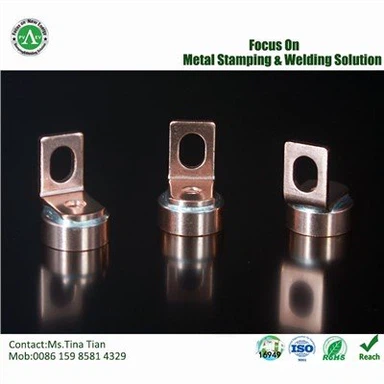
Our mental stamping product is specially designed for the development trend of automobile stamping technology in the future. The strength and durability of vehicle components are critical for safety and performance. Mental stamping helps in forming parts that are robust and capable of withstanding the stresses encountered during operation, such as impacts and vibrations.
https://www.stamping-welding.com/metal-stamping/

Contact Us