Fuses
Aug 07, 2023
INTRODUCTION
——
When a circuit malfunctions or is abnormal, the current continues to rise, and the rising current may damage some important components in the circuit, burn the circuit, or even cause a fire. If the fuse is correctly installed in the circuit, the fuse will fuse and cut off the current when the current abnormally rises to a certain height and heat, thereby protecting the safe operation of the circuit.

SHAPE
——
1. Filamentous. Early primitive fuses were directly locked with screws and used for various sizes of old-fashioned switches and sockets.
2. Flaky (bare flake). More convenient to use than traditional filiform.
3. Glass tube-shaped. There are several different sizes, commonly found in electronic products. 6.3 x 32 mm (diameter x length) 5 x 20 mm
4. ceramic tubular. There are several different shapes and sizes to avoid glass bursting.
5. Plastic sheet with metal sheet connector: automotive fuse.
6. Surface-mounted component (SMD) type.
7. Cylindrical, plug-in type: directly soldered onto the circuit board, used internally in the product.
WORKING PRINCIPLE
——
When current flows through a conductor, it will generate heat due to the presence of a certain resistance in the conductor. And the calorific value follows this formula: Q=I²RT; Where Q is the heat generated, 0.24 is a constant, I is the current flowing through the conductor, R is the resistance of the conductor, and T is the time for the current to flow through the conductor; Based on this formula, we can easily see the simple working principle of a fuse. When the material and shape of the fuse are determined, its resistance R is relatively determined (without considering its resistance temperature coefficient). When an electric current flows through it, it generates heat, and as time increases, its heat also increases. The magnitude of current and resistance determines the rate of heat generation, while the construction and installation of a fuse determine the rate of heat dissipation. If the rate of heat generation is less than the rate of heat dissipation, the fuse will not blow. If the speed of heat generation is equal to the speed of heat dissipation, it will not fuse for a considerable period of time. If the speed of heat generation is greater than the speed of heat dissipation, then more and more heat will be generated. And because it has a certain specific heat and mass, the increase in heat is reflected in the increase in temperature. When the temperature rises above the melting point of the fuse, the fuse will blow. This is the working principle of a fuse. We should know from this principle that when designing and manufacturing fuses, you must carefully study the physical properties of the materials you choose and ensure that they have consistent geometric dimensions. Because these factors play a crucial role in the normal operation of fuses. Similarly, when using it, it is important to install it correctly.
BASIC COMPOSITION
——
A general fuse consists of three parts: one is the melted part, which is the core of the fuse and plays a role in cutting off the current when blown. Fuses of the same type and specification should have the same material, geometric size, and resistance value as small and consistent as possible, and the most important thing is to have consistent fusing characteristics. Household fuses are commonly made of lead antimony alloy; The second is the electrode part, which usually has two important components that connect the melt to the circuit. It must have good conductivity and should not generate obvious installation contact resistance; The third part is the support part. The melt of the fuse is generally thin and soft. The function of the support is to fix the melt and make the three parts a rigid whole for easy installation and use. It must have good mechanical strength, insulation, heat resistance, and flame retardancy, and should not produce phenomena such as breakage, deformation, combustion, and short circuit during use.
CLASSIFICATION
——
1. Construction Type:
- Cartridge Fuses: These fuses consist of a cylindrical body made of ceramic or glass and are available in various sizes and current ratings. Cartridge fuses can be either fast-acting or time-delayed, depending on their intended applications.
- Blade Fuses: Also known as automotive fuses, they have a flat, blade-like design and are commonly used in automobiles and vehicles. They come in different sizes and current ratings and are easy to replace.
2. Voltage Rating:
- Low Voltage Fuses: These fuses are designed for low-voltage electrical systems typically found in residential, commercial, and industrial applications.
- High Voltage Fuses: These fuses are used in high-voltage electrical systems, such as power distribution networks and utility grids.
3. Current Rating:
- Micro Fuses: These fuses have low current ratings and are commonly used in electronic devices and small appliances.
- General Purpose Fuses: These fuses have moderate current ratings and are suitable for a wide range of applications in residential and commercial settings.
- High Current Fuses: These fuses have high current ratings and are used in industrial equipment, heavy machinery, and power distribution systems.
4. Application:
- Semiconductor Fuses: Designed to protect sensitive electronic components and semiconductor devices from overcurrent, they have fast-acting characteristics.
- HRC (High Rupturing Capacity) Fuses: These fuses are used in high-power applications and have a high interrupting rating to handle fault currents effectively.
- Time-Delay Fuses: These fuses have a delay in their response to overcurrent, making them suitable for circuits with temporary surges or inrush currents.
- Resettable Fuses (PTCs): Also known as Polymeric Positive Temperature Coefficient (PTC) fuses, this self-reset when the fault is removed, making them reusable.
5. Special Purpose Fuses:
- Photovoltaic Fuses: Specifically designed for solar power applications to protect photovoltaic systems and inverters.
- Electric Vehicle (EV) Fuses: These fuses are used in electric vehicles to protect the vehicle's electrical system and battery from overcurrent.
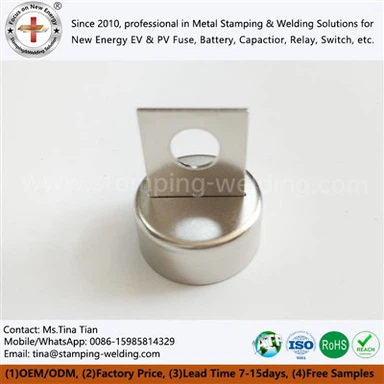
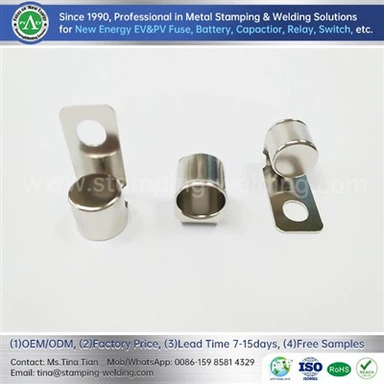
Our company is focused on top quality Copper End Cap, Fuse Terminal Contacts, (ELECTRICAL VEHICLE) EV Film Capacitor BusBar, (SOLAR POWER) PV Inverter BusBar, Laminated BusBar, Aluminum Cases for new energy batteries, Copper/Brass/Aluminum/Stainless Steel Stamping Parts, and other electrical products Metal Stamping and Welding Assembly for over 18 years in China. We started as a small operation, but now have become one of the leading suppliers in the EV and PV industry in China.
If you have any needs, please feel free to contact us and we will reply as soon as possible!