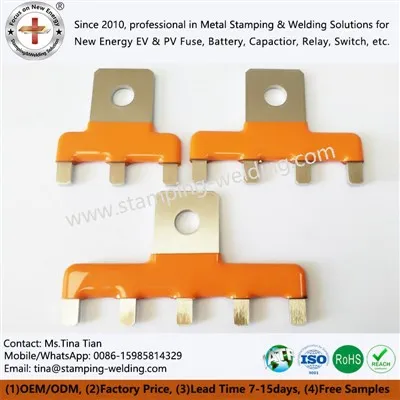
The Nickel-plated Busbar Industry Ushers in New Opportunities For Technology Upgrades And Market Expansion
Apr 23, 2025
With the rapid development of the global new energy industry, nickel-plated busbars, as core conductive components in the fields of electrical equipment, new energy vehicles, and communication base stations, are experiencing dual drives of technology iteration and market demand. Industry data shows that the global busbar market size is expected to grow by 22% year-on-year in 2024, of which new energy vehicle battery connection, 5G base station construction and other fields contribute the main incremental growth.

1. Technological innovation promotes the green transformation of the industry
Environmental protection processes are accelerating popularization: In response to increasingly stringent environmental regulations, industry leaders are accelerating the application of low-toxic and cyanide-free nickel plating technology. For example, a new project uses the "alkaline solution spraying + activated carbon adsorption" process to treat waste gas. After multi-stage chemical precipitation pretreatment, the nickel content of nickel-containing wastewater can be stably reduced to below 0.1 mg/L, meeting the requirements of the "Electronic Industry Water Pollutant Emission Standards". At the same time, chemical nickel plating wastewater treatment technology has made a breakthrough. The HMC series of agents achieve efficient removal of nickel and phosphorus through chelating precipitation and homogeneous co-precipitation technology, and the amount of mud is reduced by more than 60% compared with traditional processes.
Intelligent production improves efficiency: Intelligent manufacturing technology is gradually implemented in the production of Nickel Plated Copper Busbars. A company transformed the electroplating production line and introduced an automated control system to achieve nickel plating thickness accuracy within ±0.01μm, increasing production efficiency by 30%. In addition, the application of laser welding technology optimizes the battery module connection process, and the welding strength is 20% higher than that of traditional resistance welding, and it can achieve precision welding of 0.1mm ultra-thin nickel-plated copper foil.

2. Diversified market demand drives growth
Explosion of demand in the new energy vehicle field: The reliability requirements of power battery modules for conductive connections have increased. Nickel Plated Bus Bars have become the preferred material for battery connectors due to their high conductivity (≥58MS/m) and corrosion resistance (salt spray test ≥1000 hours). In 2024, the global market size of nickel-plated busbars for power batteries is expected to exceed 12 billion yuan, of which the 46 series large cylindrical batteries will drive the demand for nickel-plated aluminum composite strips to grow by 35%.
Synchronous expansion of communication and industrial fields: 5G base station construction drives the demand for Nickel plated Copper Bus Bar for high-frequency communication equipment, and its high-frequency signal transmission loss is 15% lower than that of traditional materials. In the industrial field, photovoltaic inverters, energy storage systems and other scenarios have higher requirements for the weather resistance of busbars. Some companies have launched high-temperature resistant (≥150℃) and anti-sulfurization nickel-plated copper busbar products, and their market share has increased to 28%.

3. Policies and industrial chains work together to reshape the industry landscape
Policies guide green development: China's "14th Five-Year Plan for the Development of Circular Economy" clearly requires the electroplating industry to implement clean production transformation and promote nickel-plated busbar companies to adopt low-toxic raw materials and resource recycling technologies. In 2024, the central budget investment special project supports the technology upgrade of heavy metal-related industries. A company has reduced volatile organic compounds (VOCs) by 50 tons per year by transforming its nickel-plating production line, and received a policy subsidy of 800,000 yuan.
In-depth synergy between upstream and downstream of the industrial chain: On the upstream nickel raw material supply side, domestic enterprises reduce external dependence by deploying Indonesian nickel ore resources; on the downstream application side, battery manufacturers and Nickel Plated Copper Busbars enterprises jointly build joint laboratories to develop customized products. For example, the nickel-aluminum composite belt developed by a cooperative project has reduced its weight by 25% while ensuring conductivity, and has been applied to the new generation of power battery modules.
4. Challenges and future trends
Price fluctuations of raw materials are under pressure: In 2023, the price of nickel fluctuated by 40%. Enterprises locked in costs through futures hedging and long-term agreements. Some enterprises replaced pure nickel with nickel alloys, reducing material costs by 12%-15%.
Global competition intensified: International leading enterprises accelerated their layout in the Asia-Pacific region, and domestic enterprises improved their competitiveness through technology exports and overseas factory construction. It is expected that by 2030, the export share of China's Nickel Plated Copper Busbars will increase from the current 20% to 35%, and Southeast Asia and Europe will become the main growth markets.
Technology frontier exploration: The industry is exploring cutting-edge technologies such as nano-nickel plating and 3D printing. The nano nickel coating developed by a research and development institution is only 1/3 of the thickness of the traditional process, and the wear resistance is improved by 50%. It has entered the pilot stage.
Conclusion
The Nickel plated Copper Bus Bar industry is in a critical period of technology upgrading and market expansion. Green manufacturing, intelligent production and diversified applications will become core competitiveness. With the continuous increase in new energy industry policies, the industry is expected to achieve a compound growth rate of 18% by 2030 and become an important force supporting global energy transformation.
contact us