Analysis of diffusion welding and automated processing technology for Flexible BusBar
Jan 23, 2026
Flexible BusBar is widely used in fields such as power transmission and new energy, and their processing quality directly affects the stability and reliability of equipment operation. This article will provide a detailed analysis of the principle of diffusion welding of Flexible Copper BusBar and related technologies for automated production and processing, helping industry practitioners to gain a deeper understanding of relevant core knowledge.
Core process: Principle and characteristics of polymer diffusion welding
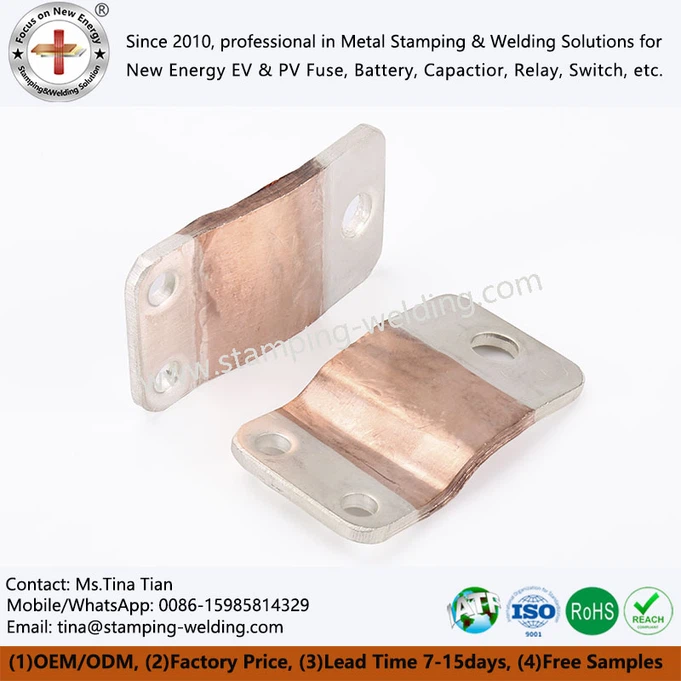
Polymer diffusion welding, as the core process of Flexible BusBar processing, is essentially a solid-state welding method. The core process of this technology is to tightly adhere the surface of the workpiece to be welded in a vacuum or protective atmosphere environment, then heat it to a specific temperature range below the melting point of the base material, and apply stable pressure. After a certain period of insulation treatment, the atoms between the contact surfaces diffuse and the interface migrates, ultimately achieving metallurgical bonding of the parts and achieving reliable welding results.
From the interface changes during the welding process, the entire process can be divided into three core stages. The first stage is the physical contact stage, during which the micro protrusions on the surface of Copper BusBars undergo plastic deformation, and the surface oxide film is broken, forming a tight initial contact surface and laying the foundation for subsequent welding; The second stage is the diffusion reaction stage, where as the temperature increases, atoms at the interface gain sufficient energy and begin to diffuse between the contact surfaces, gradually forming tiny binding zones; The third stage is the growth stage of the bonding layer. The small bonding zone formed in the early stage will continue to expand, eventually forming a metallurgical bonding layer that is close to the properties of the base material, ensuring that the Multilayer Bus Bar joint has excellent mechanical and electrical properties.
The polymer diffusion welding process has significant technical advantages, as it does not require the addition of filler metal and avoids the influence of filler materials on the performance of the welded joint. During the welding process, the base material does not overheat or melt, effectively protecting the performance of the base material itself. At the same time, the welded part has the characteristics of high precision and small deformation, especially suitable for welding Flexible Bus Bar Copper with complex structures and large thickness differences. It plays an irreplaceable role in the high-end manufacturing field.

Specialized automation equipment: Copper Foil Connector cutting and welding integrated processing
In addition to specialized cutting and welding equipment, the automatic production system for copper and aluminum foil strips is also an important component of Automotive Copper Busbar's automated processing. The core of the system consists of a transfer robot, an automatic metal foil cutting and sorting device, a high-frequency spot welding machine, a cooling device, and a power distribution control cabinet, achieving fully automated production from raw materials to finished products. The processing flow is clear. Firstly, the coil material feeding, precise cutting, counting, and stacking are completed through the cutting and sorting device. Then, the robot accurately transfers the workpiece to the spot welding machine for the welding operation. After welding is completed, it is cooled by water cooling spray to effectively prevent oxidation of the workpiece and ensure the stable quality of the Multi-Layer Copper Foil Flexible Bus Bar.
The fully automated production system for soft-pack copper bars is designed to meet the processing requirements of Copper Laminated Coil Busbars, achieving full process automation and closed-loop production. The system consists of seven core parts that work together: feeding mechanism, cutting mechanism, laminating mechanism, welding mechanism, cooling mechanism, die-cutting mechanism, and polishing mechanism. It covers all processing steps from unwinding, cutting, laminating, and welding of soft copper sheets into Press-welded Flexible Copper Connections, to subsequent cooling, die-cutting of both ends into specified shapes, and polishing of acute angles to obtuse angles. The system performs excellently in precision control and compatibility, effectively ensuring machining accuracy through precise guidance design, positioning fixtures, and other structures. The feeding guide roller can be flexibly adjusted along the groove, and the modular fixture design can adapt to different processing requirements, achieving efficient switching and meeting diverse laminated BusBar production scenarios.

Summary: Technical Core and Development Value of Automation
Overall, polymer diffusion welding is the core technology of Flexible BusBar processing, and its excellent welding performance provides a basic guarantee for the reliable application of soft copper bars. The application of various automated processing equipment and production systems not only realizes the rapid mass production of soft copper bars, effectively reduces labor and manufacturing costs, and controls comprehensive costs within a reasonable range, but more importantly, ensures product consistency and processing accuracy, meets the strict requirements of the high-end manufacturing field for Flexible Insulated Copper Busbar Soft Connections, and promotes the standardized and efficient development of the soft copper bar processing industry. Based on these core technological advantages, our Copper Shunts also adhere to the high standard processing concept, adapting to the needs of multiple application scenarios such as new energy vehicles, rail transit, industrial automation, and power equipment, and helping customers achieve stable equipment operation and efficiency improvement.
contact us