Analysis of five major processes for Automotive busbar insulation layer
Mar 09, 2026
Application and Material Characteristics of Automotive Busbar
Busbar automotive, as a core component for high current transmission, is widely used in fields such as power, communication, energy storage, military, and new energy vehicles, especially indispensable in battery and inverter systems. According to their materials, copper bars and aluminum bars can be divided. Common materials include copper, aluminum alloy, tellurium copper, brass, etc., which differ in density, conductivity, and thermal conductivity; According to the stress release characteristics, it can be divided into soft busbars and hard busbars. Among them, soft busbars, also known as laminated busbars, are made of copper foil or copper sheets stacked and welded together, and have good bending and twisting adaptability. Soft and hard busbars are widely used in new energy vehicles.
Compared with traditional cables, Automotive ground bus bars can achieve diversified structural designs such as L-shaped, U-shaped, and long strip shapes. By bending and optimizing spatial layout, they are more suitable for the installation needs of the entire vehicle. Different structures and usage scenarios also require differentiated insulation layer processes.

Heat shrink tubing processing technology
Heat shrink tubing insulation is the most commonly used insulation treatment method for Automotive busbars, which uses polyolefin material heat shrink tubing to wrap the surface of the busbar, and after heating and shrinking, it is formed. This process is easy to operate and can flexibly adjust material properties according to needs, suitable for Busbar cars with simple structures and bending forms. After processing, the surface of the insulation layer is flat, with uniform shrinkage, no defects such as burning, fading, bubbles, cracking, etc., and no obvious wrinkles at the bending position, meeting the basic insulation and protection requirements.
Immersion and spray coating processing technology
Immersion molding is a commonly used insulation process for special-shaped Auto bus bars, which has the characteristics of short development cycle and low mold cost. Only a male mold is needed to complete the molding, and the product surface is smooth, the color is uniform, and the insulation performance is good. However, due to the limitations of the process characteristics, it is difficult to control the uniformity of the insulation layer thickness, and the tolerance is relatively large.
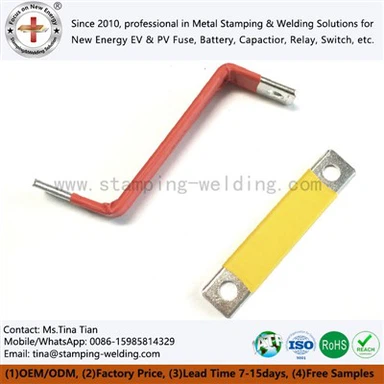
Spray coating is made from epoxy insulation resin powder as raw material, which is treated by electrostatic spraying. It is not affected by the specifications and shape of the EV busbar, and defects such as wrinkles and pores are less likely to appear at the bending points. The spray coated busbar retains the original stiffness of the conductor and has advantages such as corrosion resistance, wear resistance, and high voltage resistance. It has low processing costs and is suitable for insulation treatment of various structural busbars.
Extrusion and injection molding processing technology
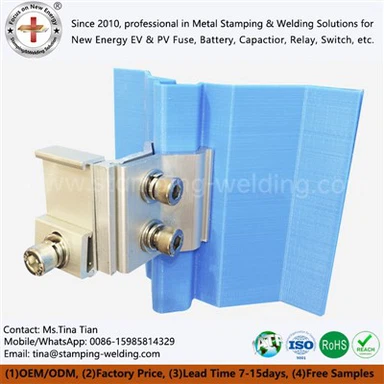
Extrusion molding is a mainstream innovative insulation process in recent years, which uses specialized equipment to continuously coat PVC, PA12 and other materials on the surface of New energy vehicle film capacitor busbars. It has high processing efficiency and is suitable for large-scale production, with better wear resistance than spray molding process. After being extruded, the multi-layer laminated soft busbar has outstanding current carrying capacity and is widely used in high current scenarios such as electric vehicle batteries, energy storage systems, and high-voltage power equipment.
Injection molding is suitable for laminated busbars with complex structures and high requirements for insulation appearance and materials. It is formed by a dedicated mold in one go and can use a wide range of materials, including PVC, TPE, TPU, etc. It can meet the insulation and structural integration needs of high-precision and high integration Automotive power connectors.
Summary of Process Selection and Application
The five insulation processes of EV battery busbar have their own applicable scenarios and performance characteristics, and heat shrink tubing is suitable for simple structures and cost sensitive scenarios; Immersion molding to adapt to irregular parts and meet rapid development needs; Spray coating balances cost and reliability; Extrusion molding is suitable for large quantities and high wear resistance requirements; Injection molding meets the requirements of high-precision and complex structural products. In practical applications, the Busbar for power capacitor structure, usage environment, cost, and performance goals will be comprehensively selected to achieve the optimal insulation effect and system reliability.
contact us
If you have any needs in the selection or customized processing of Automotive busbar insulation technology, please feel free to contact us at any time. We will provide you with professional technical solutions and efficient engineering support to help your project land smoothly.