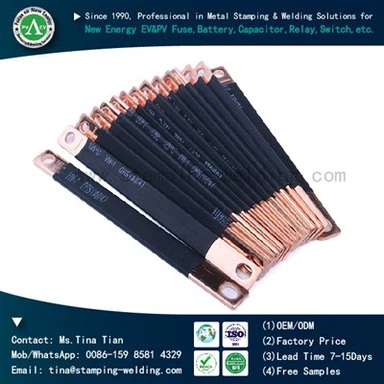
Analysis of the production process of copper braided soft connection
May 15, 2026
Raw material selection
The production of copper braided wire soft connections begins with the strict selection of raw materials, which directly determines the conductive performance and mechanical life of the final product. High-purity oxygen-free copper wire is usually used in production. Depending on the application scenario, bare copper or tinned copper can be used. For example, in outdoor or humid environments with high requirements for oxidation and corrosion resistance, Soft Copper Tinned Wires are usually preferred; while in conventional indoor power distribution, Soft Bare Copper Wires are more common. After entering the factory, the raw materials must undergo strict annealing to eliminate work hardening and ensure that the copper wire has excellent softness and elongation, laying a solid physical foundation for the subsequent weaving process.

Weaving technology and structural shaping
The braiding process is the core link in the manufacturing of soft connections for copper braided tapes, and is usually completed using a high-speed cylindrical braiding machine or a spindle braiding machine. The essence of this process is to interlock multiple strands of fine copper wire at specific braiding angles to form a mesh conductor with three-dimensional flexible deformation capabilities. The weaving density of Flat Copper Braids-that is, the number of cross-nodes per unit length-is a key indicator of the compactness of a Braided Copper Wire structure, usually expressed as a percentage of coverage, and engineering-grade products are required to reach more than 85% to ensure uniform current distribution and suppress local hot spots.
The pretreatment process before weaving cannot be ignored. The copper wire needs to be tension-aligned and surface cleaned to remove the remaining lubricating grease and oxide layer during the wire drawing process. For Grounding Braids Wire Tin Plated products, the thickness of the tin plating layer needs to be randomly inspected by an X-ray fluorescence spectrometer to ensure that the uniformity of the tin layer meets the requirements of the IEC 60343 standard. During the weaving process, the synergetic accuracy of the spindle speed, pulling speed and tension control system determines the dimensional stability of the product and the consistency of the contact resistance between strands. Any parameter drift may lead to uneven braiding density, which may lead to impedance fluctuations and local heating.
After the weaving is completed, the product needs to enter the shaping and cutting stage. The shaping process enables the braided tape to obtain a stable flat cross-sectional profile through hot pressing or rolling, which facilitates subsequent crimping and assembly with terminals or copper bars. The cutting process uses CNC shearing equipment to ensure that the length tolerance is controlled within ±1.0mm and the cuts are smooth and burr-free. For scenarios that require insulation protection, the Braided Copper Bus Bar Heat Shink PVC Sleeves process can heat-shrink the flame-retardant PVC sleeve on the surface of the braided tape to provide additional insulation isolation and mechanical protection.

Quality testing and performance verification
Copper braided soft connections must undergo multi-dimensional testing before leaving the factory to verify their electrical performance, mechanical performance and environmental adaptability. Electrical testing items include DC resistance measurement, current-carrying capacity temperature rise test and short-time withstand current test. The DC resistance value needs to be converted to the theoretical value of the nominal cross-sectional area at a standard temperature of 20°C, and the deviation shall not exceed ±5%. The temperature rise test continues to run to a thermal equilibrium state under rated current conditions. The temperature rise on the conductor surface shall not exceed the limit specified in the standard to ensure thermal stability in long-term operation.
Mechanical performance testing focuses on flexibility and fatigue life assessment. The bending test repeatedly bends the sample around a mandrel of specified diameter and records the number of cycles before fracture to evaluate the material's durability under dynamic stress. For Flexible Connectors used in vibration environments, vibration fatigue testing is also required to simulate the mechanical stress spectrum in actual working conditions and verify the structural integrity of the connection points under long-term vibration.
Environmental adaptability testing covers salt spray test, high and low temperature cycle test and damp heat aging test. The salt spray test is performed in accordance with the ASTM B117 standard to evaluate the protective effectiveness of the coating in a corrosive environment; the high and low temperature cycle test verifies the dimensional stability and conductive continuity of the material under drastic changes in temperature; the moist heat aging test simulates the impact of long-term humid environments on the insulation layer and metal interface. All testing data must form a complete quality traceability file to ensure that each batch of products can achieve full life cycle performance tracking.

Engineering applications
Copper braided soft connections have a wide range of application scenarios in the fields of electric power, new energy, rail transit and industrial automation. At the connection between the transformer and the switch cabinet, the Braided Flexible Busbar serves as a flexible transition section between rigid busbars, effectively absorbing relative displacement caused by thermal expansion and contraction or installation tolerances, and preventing mechanical stress from being transmitted to the equipment body. In the field of new energy power generation, Flexible Braided Copper Busbar is widely used for the DC side connection between photovoltaic inverters and combiner boxes. Its low inductance characteristics help suppress high-frequency switching noise and improve the electromagnetic compatibility performance of the system.
In electric vehicles and energy storage systems, Braided Flexible Busbars Customized products need to meet multiple constraints such as high current, high frequency and limited space. The customized design covers comprehensive optimization of cross-sectional size, braiding density, terminal form and insulation coating scheme. For example, for the compact layout inside the battery pack, ultra-thin flat braided tapes and laser-welded terminals can be used to achieve a balance between high power density and reliability. In rail transit traction systems, Low-to-medium Voltage Flexible Connectors need to pass stringent standard certifications such as EN 50343 to ensure long-term reliable operation in vibration, shock and wide temperature range environments.

contact us
We focus on the R&D and manufacturing of high-quality conductive connection solutions and are committed to providing customers around the world with Flex Connector products with excellent performance. Feel free to contact us anytime to discuss your project needs.