Copper Laminated Foils Connector — Industry Insight
Dec 13, 2025
With growing demand in power distribution, battery systems, industrial equipment and renewable energy installations for high-current capacity, compact layout, and reliable flexible connections, Copper laminated foils connector has emerged as a crucial solution for modern electrical systems. This article offers a systematic overview - from definition and manufacturing, to performance advantages and application scenarios - to help readers grasp its industry value.
Manufacturing & Processing
High-Purity Copper Foil & Layer Lamination
- Customized Tin Plating Copper Laminated Busbar typically uses electrolytic copper foil (≥ 99.9 % copper) as base material to ensure excellent electrical conductivity and mechanical reliability.
- Single-foil thickness often ranges from 0.03 mm to 0.50 mm (standard commonly 0.10 mm), depending on design requirements.
- Tin Plated Copper Bus Bar's multiple foils are stacked and then subjected to press-welding / molecular diffusion welding: under pressure (and sometimes high current heating), the individual copper layers are fused into a solid, unified conductor without filler metal.
Customization & Forming
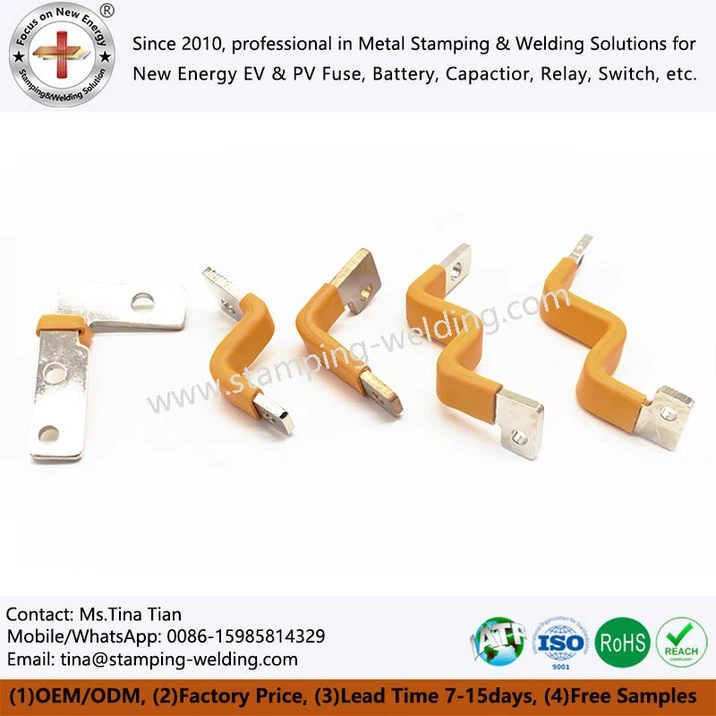
- After lamination, the Tinned Copper BusBar can be machined: cutting, punching holes, bending, shaping, fitting terminals or ferrules - tailored to the customer's drawings or installation needs.
- If required, the Tinned Foil Connector for Electrical Battery can be plated (e.g., tin, silver) or insulated (e.g., with PVC or heat-shrink tubing) to improve corrosion resistance, safety, and durability.
Quality Control & Performance Testing
- Ensure Flexible Laminated Copper Bus Bar welded layers have uniform bonding, no delamination - guaranteeing stable conductivity and mechanical strength.
- Copper Foil Bus Bar electrical testing: measuring resistivity, current-carrying capacity, contact resistance, and ensuring adequate performance under high current load.
- Mechanical/thermal durability tests: Copper Foil Resistance Diffusion Soldering Flexible Connection verifying stability under vibration, bending cycles, thermal cycling, ensuring reliability in demanding conditions.

Performance Advantages
High Conductivity and Large Current Capacity
- Due to the use of high-purity copper foil and laminated design, Flexible Insulated Copper Busbar Soft Connections supports high current densities, with superior conductivity and minimal resistive losses - suitable for heavy-duty power distribution.
Flexibility & Space Efficiency
- Unlike rigid busbars, these connectors can bend, twist or shape to fit into compact or irregular spaces, making them ideal for modern modular designs, battery packs, or equipment with complex geometry.
Vibration, Thermal Expansion & Mechanical Stress Resistance
- The Customized Tin Plating Copper Laminated Busbar structure and flexible nature help absorb vibration, thermal expansion/contraction, and mechanical stress - reducing fatigue or failure risk in environments such as EV battery packs, switchgear, or industrial machinery.
Customizability & Versatility
- Since the connector can be customized in thickness, width, shape, hole patterns, plating or insulation, Tin Plated Copper Bus Bar can meet specific requirements across diverse applications - from compact battery modules to large power distribution systems.
Improved Thermal Management & EMI Performance
- Laminated structure and increased conductor surface area aid in heat dissipation. Some Tinned Copper BusBar also help reduce inductance and electromagnetic interference (EMI), beneficial in sensitive or high-frequency applications.

Typical Applications & Industry Use Cases
Switchgear, Bus Ducts, Power Distribution Cabinets
As Tinned Foil Connector for Electrical Battery to breakers, modules, or distribution lines - ideal where rigid connections may be inconvenient or space-limited.
Transformer, Generator, Industrial Furnace, Welding Equipment, Heavy Machinery
For Flexible Laminated Copper Bus Bar capable of handling high currents, mechanical stress, vibration, temperature variations - ensuring reliable power transfer.
Battery Packs, Energy Storage Systems, Electric Vehicles (EVs)
In battery modules or EV systems, connectors need to adapt to compact 3D layouts, absorb vibration/thermal cycling, and reliably carry high currents - areas where Copper Foil Bus Bar excels.
Switching Devices, Inverters, High-Frequency or Sensitive Electrical Equipment
Due to low impedance, good thermal & EMI performance and flexible layout, Copper Foil Resistance Diffusion Soldering Flexible Connection are suited for inverter setups, frequency converters, data centers, and other precision/electronic systems.

Conclusion
As electrical systems evolve - toward higher power density, modular design, compact layout, and stringent reliability requirements - Copper laminated foils connector plays an increasingly critical role. It delivers high conductivity, large current capacity, mechanical flexibility, space efficiency, and durability under dynamic conditions. For any project calling for stable, high-current power distribution, compact design, vibration/thermal resilience, or flexible layout - choosing high-quality, well-designed copper laminated foil connectors is a smart, forward-looking design decision.
contact us