


Copper row industry knowledge analysis
May 21, 2026
With the accelerated popularization of 800V high-voltage platforms for new energy vehicles, the high-voltage copper and aluminum bars inside the battery pack have become "highways" for carrying current. Their performance directly determines the cruising range, fast charging efficiency and even the safety bottom line of the entire vehicle. As the core conductive component in high and low voltage electrical appliances, power distribution equipment and new energy battery modules, copper bar (also known as copper busbar or copper busbar) plays a key role in transmitting current and connecting various electrical units in electrical equipment due to its extremely low resistivity and excellent conductivity. Compared with traditional cables, copper bar has significant advantages in electrical performance and space utilization. Therefore, whether it is used in U, V, W phase busbars in industrial distribution cabinets, or High Voltage BusBar in the new energy field, its material purity (such as T1/T2 copper purity must be ≥99.90%) and cross-sectional design must be strictly considered to ensure that the system can still maintain stable operation under ultra-large current conditions.
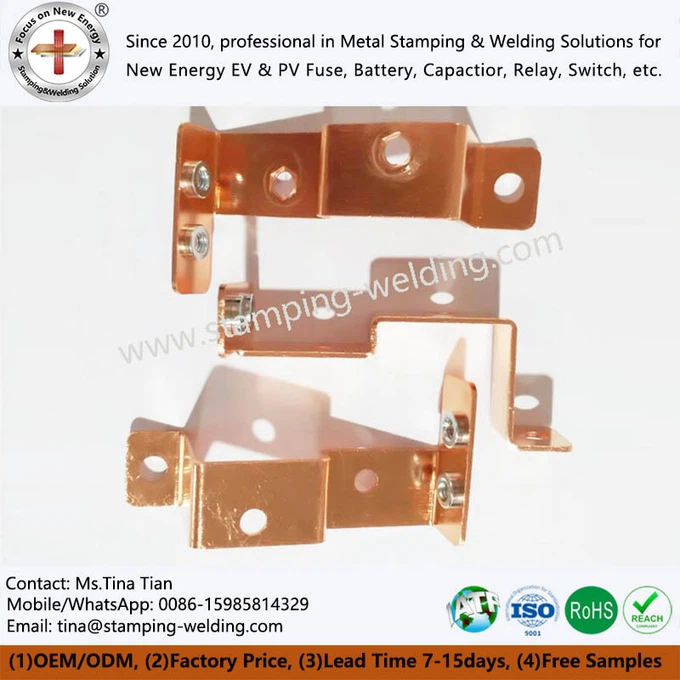
Material advantages
In terms of material processing, in order to take into account both electrical conductivity and corrosion resistance, the surface treatment process of the copper busbar is particularly important. Although pure copper has excellent electrical conductivity, in order to prevent the external environment from causing oxidative corrosion to the copper bars and improve the performance of the connection contact surface, processes such as tin plating, nickel plating or coating with protective agents are often used in the industry. For example, tin plating on the surface of copper bars can not only effectively prevent oxidation, but also utilize the alloy layer formed by the combination of tin and copper to enhance the adhesion of the coating while maintaining good welding performance. In the processing of soft copper busbars, dozens of layers of 0.05- 0.2 mm copper foil are often laminated through polymer diffusion welding technology. This structure can effectively reduce the skin effect of alternating current, while hard copper busbars are formed through processes such as cutting, punching, bending, and surface nickel plating. No matter which process is used, the ultimate goal is to create a Copper BusBar with excellent performance, so that it can meet the current carrying capacity requirements while having excellent mechanical strength and environmental adaptability.

manufacturing technology
In terms of manufacturing technology, there are significant differences in the processing procedures of soft copper bars and hard copper bars, which are mainly reflected in the welding and forming methods. The processing of soft copper strips starts with cutting copper foil or nickel foil. The thickness of the foil is usually between 0.05 and 0.2mm. The total thickness is determined based on the current carrying capacity and the number of foil layers is calculated. At the open-hole connection, nickel foil is welded to the surface of the copper bar to enhance corrosion resistance and wear resistance and prevent an increase in contact resistance after repeated disassembly and assembly. Laminated welding is then carried out, that is, dozens of layers of copper foil are stacked and then polymer diffusion welded to form a connection area with good conductivity. This welding technology uses high temperature and high pressure to cause atomic diffusion and bonding at the interface of multi-layer copper foils. It is a solid-phase welding method and is widely used in the manufacturing of soft connections for battery modules and power equipment.
After the welding is completed, the burrs, scale and oil stains are removed through pickling and surface treatment, and then the bolt connection holes are processed by punching equipment. In some scenarios where the contact area needs to be increased, lap welding is required at the connection to form the special-shaped copper bar. This process is simple, high-strength, low-cost, and suitable for high current, compact space and vibration environments. Finally, bending is performed to achieve a specific angle or shape of the copper bar. The key is to achieve plastic deformation without destroying the conductive performance. In terms of the processing of hard copper busbars, the process is relatively simple: the copper material is cut and blanked, the connection holes are punched, and then formed by a bending machine. Then the surface is treated to remove the oxide layer and oil stains. The connections are nickel-plated to improve corrosion resistance. Finally, the insulation layer is wrapped by winding a polymer PI film or dipping process. In the entire manufacturing system, the design concepts and manufacturing experience of BusBar System Manufacturers and PCB Bus Bars provide an important reference for the refined processing of copper/aluminum busbars, especially in multi-layer stack welding, insulation wrapping and precision bending.
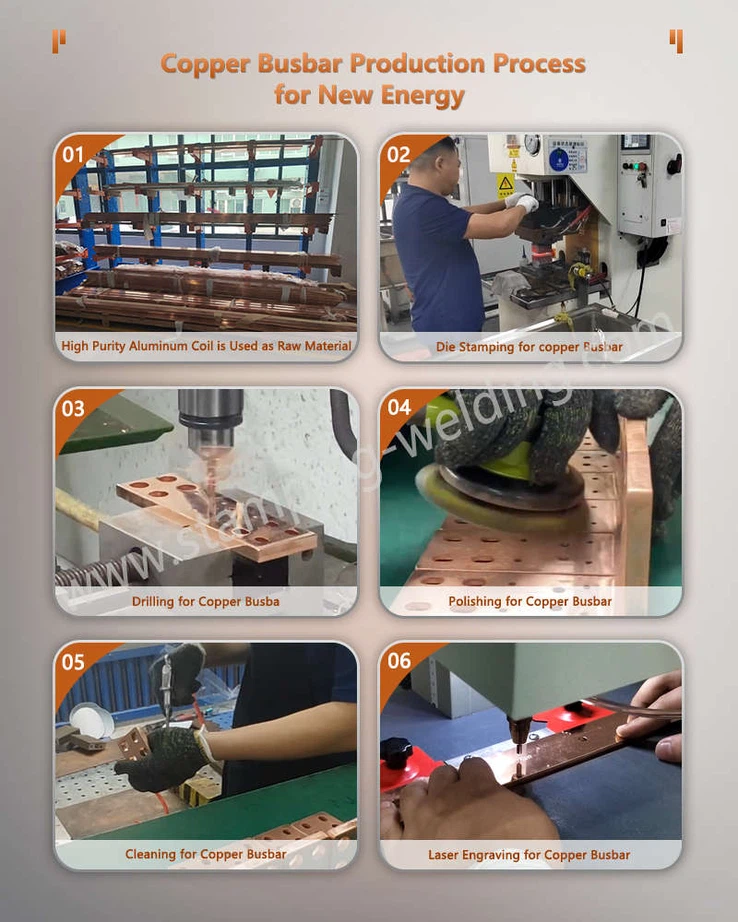
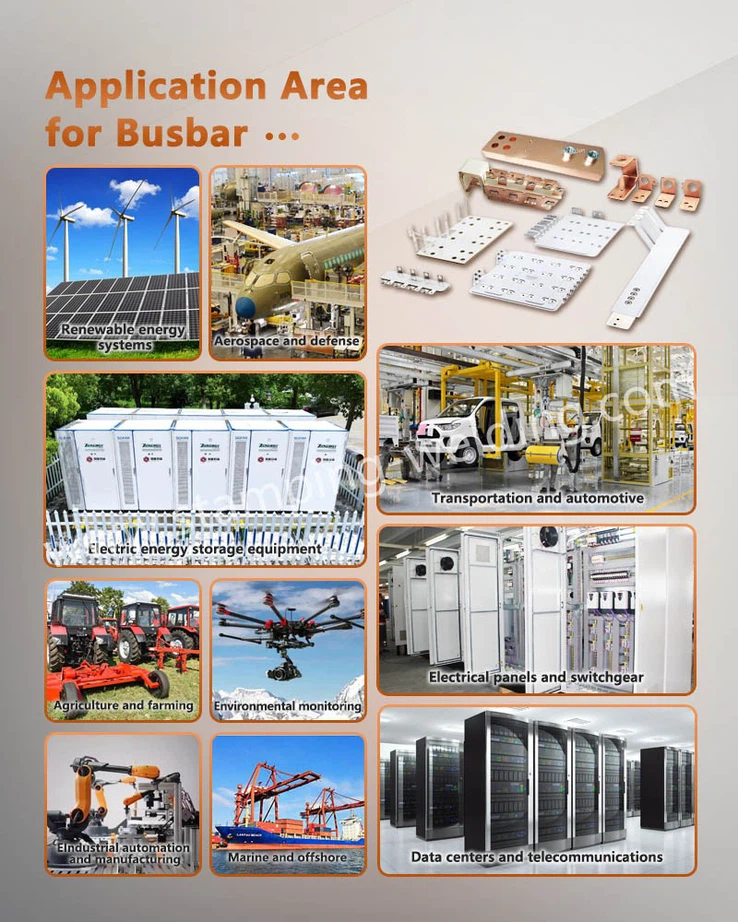
application scenarios
In actual installation and application scenarios, standardized assembly processes are the guarantee for long-term reliable operation of the busbar system. Gloves must be worn during the assembly process of copper bars to prevent surface contamination. Fasteners used for connection must be galvanized bolts that meet standards, and torque wrenches must be strictly used for tightening confirmation to prevent local overheating caused by poor contact. For two or more rectangular copper bars connected in parallel, a gap of no less than the thickness must be reserved during installation to ensure air convection and heat dissipation. With the miniaturization and integration of power electronic equipment, busbar application scenarios are becoming increasingly widespread, extending from traditional industrial power distribution to precision PCB busbars and various compact power modules. These application scenarios require the busbar not only to have large current transmission capabilities but also to achieve complex geometric molding in a limited space, which poses extremely high challenges to the accuracy of the manufacturing process.
contact us
If you need engineering drawing confirmation, sample trial production or batch supply, please contact our technical team. We will provide matching Copper Battery Bus Bar solutions based on your battery pack structure and electrical parameters.


