


Explaining the Dual Concept of Electronic Busbars: Enabling Efficient Connections in Strong and Weak Current Fields
Jan 20, 2026
In the field of electrical and electronic technology, "BusBar Solutions for Electrical Power Distribution" is a core term with a dual meaning, encompassing two major scenarios: high-voltage power transmission and distribution, and low-voltage signal connection. One is the copper or aluminum conductive busbar used for efficient power transmission and distribution in power systems; the other is the busbar assembly in the field of electronic connectors. Although their applications differ significantly, both focus on connection and transmission, supporting the stable operation of power systems and electronic equipment, respectively.

Production process
- Substrate Processing and Forming:High-purity copper or aluminum blanks are selected and cut to preset dimensions using shearing and stamping processes. They are then processed into basic shapes such as flat strips and rectangles using bending and stretching equipment. For laminated bus bars, the multilayer conductor substrate must be precisely cut simultaneously to ensure that the dimensional error of each layer is controlled within ±0.05mm, laying the foundation for subsequent lamination processes. After processing, the substrate surface is polished and degreased to remove oxide layers and oil stains, improving conductivity and material adhesion.
- Insulation Treatment and Lamination (for Laminated Busbars): Basic busbars can be insulated using methods such as epoxy powder coating and insulating film wrapping to ensure safety. Laminated Busbars, however, require alternating layers of conductors and insulation, placed in a specialized laminator and laminated at a preset temperature (120-150℃) and pressure (5-10MPa) to ensure tight bonding and create a bubble-free, delamination-free composite structure. Simultaneously, the insulation layer layout is optimized through the Laminated Design to enhance anti-interference capabilities.
- Precision Machining and Inspection: The formed busbars undergo precision machining such as drilling and tapping for installation, fixing, and equipment connection. Hole accuracy must match connector assembly requirements. Comprehensive testing is then conducted, including conductivity testing, insulation resistance testing, and appearance defect inspection. Laminated Inverter also require specific testing for temperature resistance and impact resistance to ensure the product meets industry standards and application requirements before being stored and shipped.
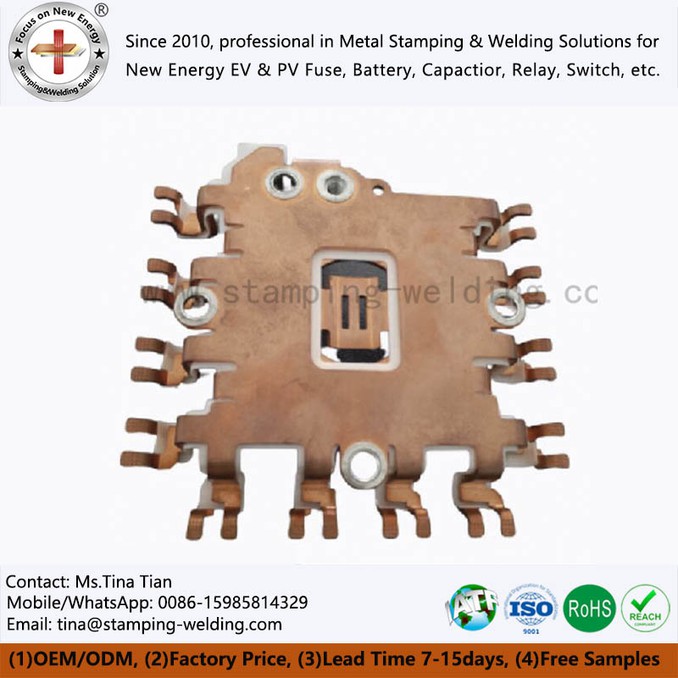
Attention to detail
The control of details in the production process directly determines the stability of the BusBar Solutions for Electrical Power Distribution performance, especially the lamination process of the laminated bus bar. The heating rate (5-8℃/min) must be precisely controlled to avoid aging of the insulation layer. After lamination, the material should be allowed to cool naturally to room temperature to prevent excessive temperature difference from causing the conductor and insulation layer to peel off. After the substrate surface treatment, it should be moved to the next process within 2 hours to avoid secondary adhesion of moisture and impurities in the air. The drilling process should be carried out with diamond tools to control the roughness of the hole wall to ≤Ra 0.8μm, and to eliminate burr residue that may affect conductivity and connection accuracy.

Application scenarios
- Industrial power distribution scenarios: Power and laminated copper busbars handle high current-carrying capacity, ensuring stable power distribution.
- New energy inverter scenarios: Laminated inverter and multi-level stacked busbars adapt to high-frequency power conversion requirements.
- New energy transportation scenarios: Dedicated stacked busbars adapt to vehicle drive systems, balancing high current transmission with space optimization.
- Industrial variable frequency drive scenarios: Variable frequency drive busbars improve equipment operating efficiency and stability.
- Electronic equipment integration scenarios: Busbar connectors enable low-voltage signal transmission between PCBs, adapting to equipment miniaturization requirements.

Summary
BusBar Solutions for Electrical Power Distribution are divided into two main categories with clearly defined functions: power and laminated busbars, with their precise manufacturing and superior performance, support efficient power transmission and distribution in the high-voltage field; while busbar connectors adapt to the integration needs of low-voltage systems. Both cover multiple application scenarios, balancing stability and adaptability, and provide core connectivity support for the high-quality development of the electrical and electronic industry.
contact us


