


Laminated busbar technology analysis and application guide
May 15, 2026
Product definition and technical principles
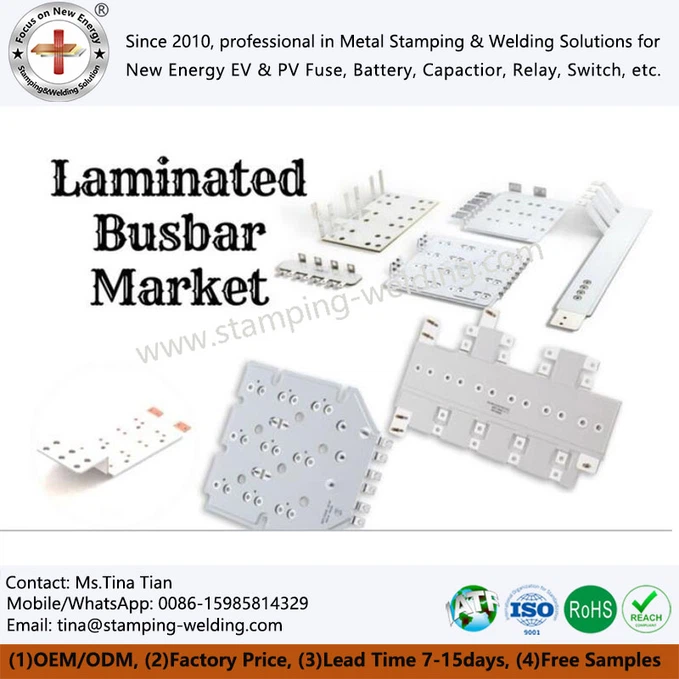
Laminated Busbar, also known as composite busbar and low-inductance busbar, is a high-power power connection component that is alternately laminated with copper or aluminum conductive layers and high-temperature resistant insulating films, and is integrally formed by vacuum hot pressing. This structure allows the positive and negative conductors to be arranged in parallel, which can offset each other's magnetic field interference. It has core advantages such as low stray inductance, low impedance, high current carrying capacity, compact structure and anti-interference. It can significantly reduce the switching peak voltage of power devices and reduce wiring failure points. Laminated Busbar Design uses a multi-layer composite structure to achieve electrical interconnection functions similar to "high-power printed circuit boards" and is a key power distribution component in high-end power electronic systems.
Manufacturing process
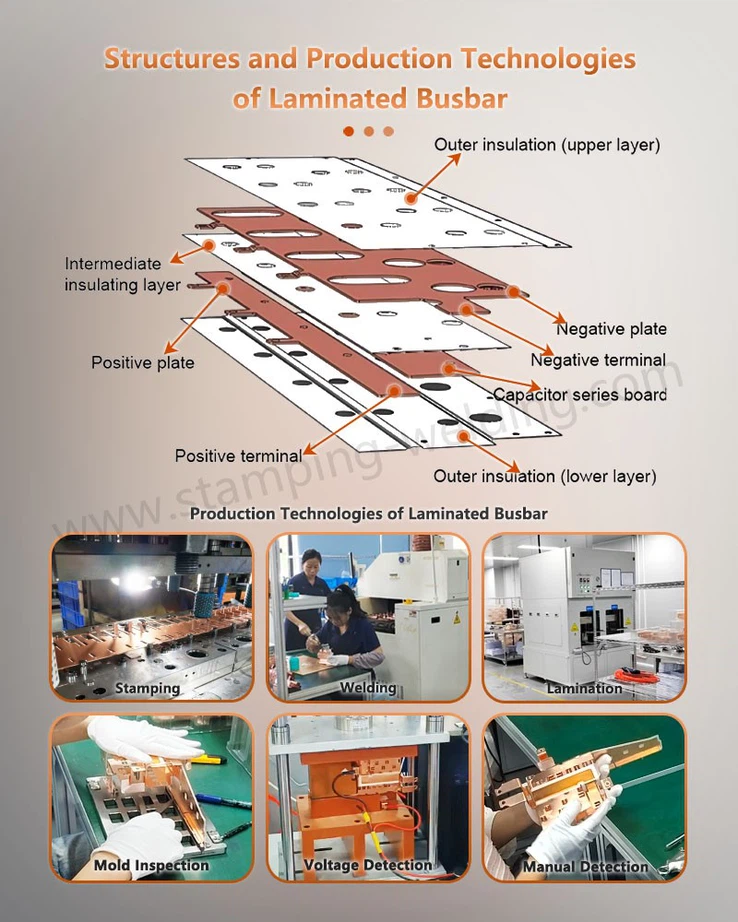
The manufacturing of laminated busbars is centered on precision molding and long-term reliability, and the process is divided into four key stages. The first step is material preprocessing: cutting oxygen-free copper or aluminum conductors and punching, bending and tin/silver anti-corrosion treatment, and simultaneously cutting high-temperature-resistant insulating films such as PI, epoxy or FR4 to ensure the dimensional accuracy of conductors and insulation parts. The second step is stack positioning: alternately arrange according to "conductor-insulation-conductor", and use positioning pins or fixtures to strictly control the alignment error between layers. The third step is vacuum hot pressing curing: the laminated structure is cured and bonded in a high-temperature and high-pressure vacuum environment to eliminate internal bubbles and improve the overall structural strength. The fourth step is post-processing and finishing: complete the shape processing through laser or CNC cutting, perform terminal welding, edge sealing and glue filling, and complete burr cleaning and size finishing. Under such process control, Laminated Inverter Busbars can ensure consistency and reliability in mass production.
Product Classification and Surface Treatment
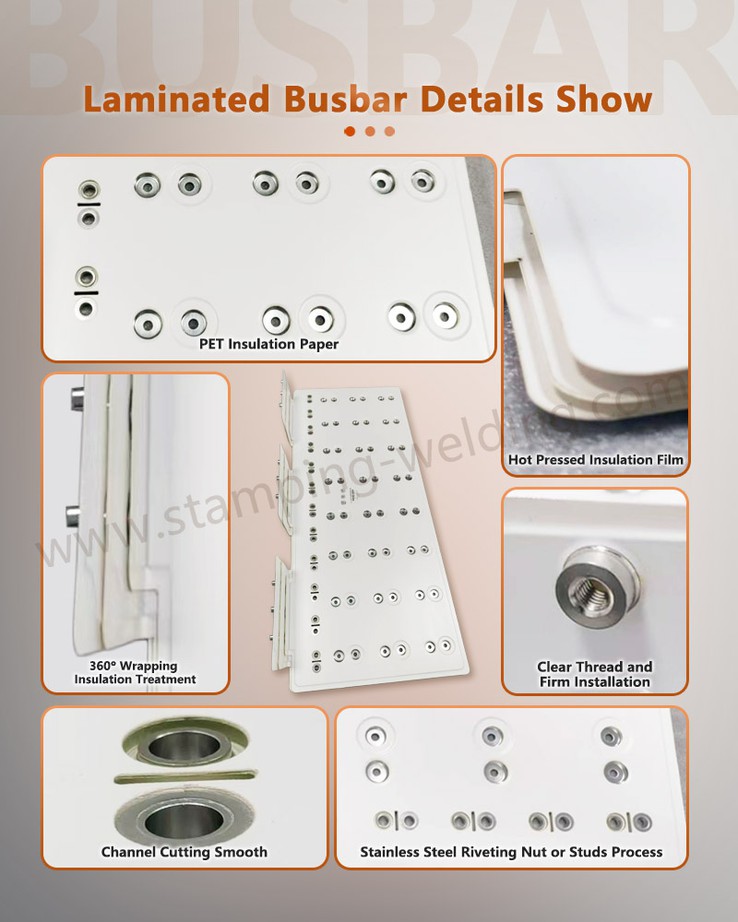
According to the degree of structural closure, laminated busbars can be divided into resin potting type, open edge type, edge sealing type and resin spraying edge sealing type. The edge-sealed structure is suitable for high humidity, salt spray or dust environments, and can effectively prevent creepage or moisture at the edge of the insulation layer. The surface treatment method depends on the conductor material: aluminum busbars are usually anodized or surface insulated spray-coated; copper busbars are tin-plated, silver-plated or powder-coated. As a high-current interconnection solution between modules, Laminated Busbar Connectors can select corresponding termination forms (such as screw terminals, crimp terminals or welding terminals) among different structural types to achieve standardized connections with components such as capacitors, IGBT modules and filters.
Performance advantages and engineering value
Compared with traditional wire harness wiring solutions, laminated busbars have significant technical and economic advantages. In terms of electrical performance, the distributed capacitance effect is formed by the close stacking of positive and negative electrodes, which effectively reduces stray inductance, thereby suppressing the turn-off peak voltage of power devices such as IGBTs, while carrying large currents of hundreds to thousands of amps with a lower voltage drop. In terms of structure and heat dissipation, the compact planar design can save the internal space of the equipment. The metal conductor layer is directly exposed to the air flow or the cold plate surface, which usually has a better heat dissipation effect and smaller temperature rise than cables. In terms of reliability and installation, Laminated Busbar Power Solutions adopts a modular customized structure, which can avoid on-site wiring errors, reduce failure points, and significantly improve the system mean time between failures.
contact us
The company specializes in the customized design and manufacturing of Partially laminated bus bar, mastering core technologies such as vacuum hot pressing, integrated molding, precision laminated positioning and edge sealing processing. Its products cover application fields such as new energy vehicles, photovoltaic energy storage, rail transit and industrial power supplies. Welcome to contact us for technical selection support or sample testing.


