Overview of manufacturing process for Power battery cover plate: design points and development history
Apr 07, 2026
Structural positioning and material advantages of Power battery cover plate
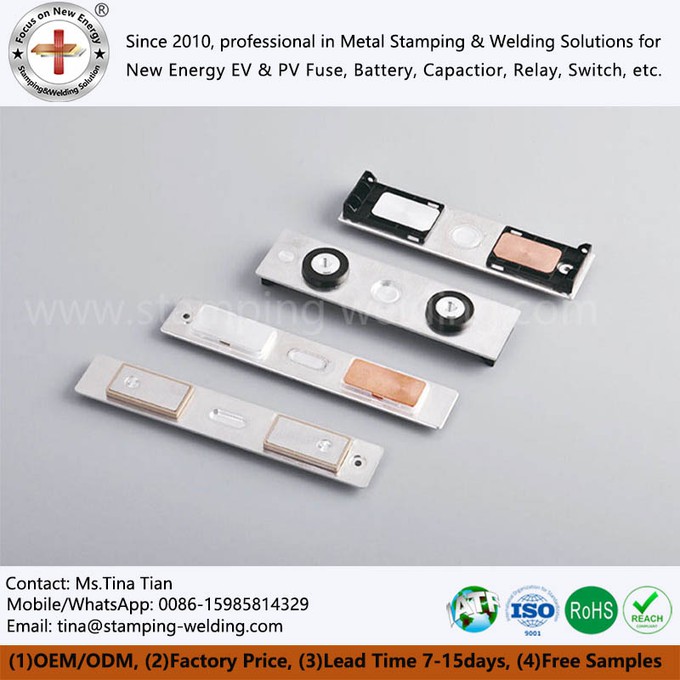
As a key component in the battery structure, the Battery aluminum safety cover set directly determines the overall performance and safety of the battery, while also meeting various process adaptation requirements during the production process. Compared with the traditional circular battery structure, the square battery cover adopts a compact design, with higher space utilization, easy stacking and module integration, and can flexibly adapt to the needs of different battery models and capacities, significantly improving battery assembly efficiency.
In terms of material selection, aluminum alloy has become the mainstream solution due to its excellent comprehensive performance. Aluminum alloy has good thermal conductivity and can quickly dissipate the heat generated during battery operation, effectively extending the battery's service life; The LFP safety cover set has high strength and corrosion resistance, which helps to resist adverse factors such as external impact and vibration, enhancing the long-term durability of the battery.
In addition, the copper aluminum bimetallic electrode plate with a tightly sealed structure can effectively prevent the leakage of electrolyte and gas inside the battery, and block the intrusion of external impurities, ensuring the safety, stability, and reliability of battery operation. The integrated positive and negative terminal design balances reliability and usability, and can withstand mechanical stress caused by long-term use and frequent plugging and unplugging. Lithium ion battery cover plates are suitable for various application scenarios such as electric vehicles, energy storage systems, and mobile devices, and support modular assembly to enhance manufacturing flexibility.
Appearance and Material Design Points of Power Battery Cover Plate
The structural design of Lithium battery top cap needs to strike a balance between practicality and environmental adaptability, with appearance and material selection being the fundamental steps. In terms of appearance, the square structure has significant space utilization advantages compared to traditional circular batteries. The compact shape facilitates reasonable layout in limited space, while improving stacking efficiency and adapting to module integration needs in various scenarios. The concise structure also provides convenient conditions for the integrated design of subsequent interfaces, seals, and other components. In terms of materials, aluminum alloy is the preferred material for the top cover of square lithium batteries, mainly due to its excellent comprehensive performance.
Good thermal conductivity helps to quickly dissipate the internal heat of the battery, avoiding performance degradation or safety hazards caused by local overheating; The high strength and corrosion resistance ensure the structural stability of Prismatic lithium battery lid under complex working conditions, thereby extending the overall service life of the battery. In practical applications, specific grades of aluminum alloys such as aluminum manganese alloys have become commonly used materials in the manufacturing of square Lithium battery top covers due to their good formability, strong high-temperature corrosion resistance, and excellent thermal and electrical conductivity. They can fully meet the performance requirements of the top cover during processing and use.

Key Technologies for Sealing Structure and Interface Design
Sealing performance and interface design are core components of square lithium battery accessories, directly related to the safe operation and normal use of the battery, and significantly affecting the reliability and service life of the battery. The goal of sealing structure design is to achieve comprehensive protection. Through rigorous structural design, Prismatic lithium battery canopy can prevent electrolyte and gas leakage, as well as prevent impurities such as dust and water vapor from entering the battery, thereby fundamentally eliminating safety hazards and ensuring long-term stable operation of the battery. In the specific structural design, by optimizing the sealing method and assembly process, selecting appropriate sealing components, it is possible to effectively avoid damage to the sealing interface, reduce residual impurities, and further improve the reliability of the seal.
In terms of interface design, the Prismatic lithium battery annex needs to integrate positive and negative interfaces as the core component for connecting the battery to external systems and devices. The interface design needs to balance reliability and operability, ensuring stable electrical connections while withstanding the stress generated by long-term use and frequent plugging and unplugging, to prevent the battery from malfunctioning due to loose or damaged interfaces. In addition, interface design needs to be coordinated with the overall performance requirements of the battery, optimize conductivity efficiency, reduce contact resistance, and ensure the stability of battery energy transmission.

The Development History of Laser Welding Technology
Laser welding technology is the core process in the manufacturing of Aluminum battery cover plates, which directly affects the structural strength, sealing performance, and production efficiency of the top cover. Its equipment and process level are constantly upgrading with the development of the industry, which can be roughly divided into three stages.
In the first stage (around 2015-2017), the new energy vehicle industry entered a period of rapid expansion under policy promotion, and the power battery industry began to develop on a large scale. However, the related manufacturing technology and talent reserves were still relatively weak, and laser welding technology was still in its infancy. During this period, the production efficiency requirements for square battery laser sealing welding equipment were relatively low. The equipment mainly used 1kW fiber lasers combined with ordinary laser welding heads, which were driven by servo platform motors or linear motors to complete welding. The welding speed was slow, about 50-100 mm/s.
In the second stage, the welding speed is increased to 100-200 mm/s, and the equipment performance and process accuracy are gradually optimized, which can basically meet the large-scale production needs of the Lithium-ion battery Top lid for prismatic battery cell industry. With the continuous iteration of industry technology, laser welding technology has entered the third stage, and the welding speed has been further increased to 200-300 mm/s. The equipment stability, process accuracy, and production efficiency have all been significantly improved, effectively adapting to the large-scale and high-quality production requirements of the power battery industry, and providing solid technical support for the mass manufacturing of Aluminum battery box cover.
Contact us
The above covers the complete technical path of the Power battery cover plate from material selection, structural design to sealing process and laser welding technology. If you need to further understand specific process parameters or obtain customized solutions, please feel free to contact us at any time. We will provide you with professional technical support and product services.