Knowledge analysis of the power distribution cabinet industry
May 19, 2026
Definition and classification
Power distribution cabinets specifically refer to the final equipment of power distribution systems such as power distribution cabinets, lighting distribution cabinets and metering cabinets. According to the classification of power supply levels, the first-level power distribution equipment is collectively called the power distribution center, which is installed centrally in the enterprise's substation or main distribution room, arranged close to the step-down transformer, and is responsible for distributing power to lower-level power distribution devices in different locations. This level of equipment has higher requirements for electrical parameters and larger output circuit capacity. It usually requires a frame circuit breaker and a complete protection unit.
Secondary power distribution equipment is the collective name for power distribution cabinets and motor control centers. Power distribution cabinets are suitable for sites with dispersed loads and few circuits, while motor control centers are oriented to production workshops with concentrated loads and complex control logic. The secondary equipment distributes the electric energy of a certain circuit of the upper-level power distribution equipment to the nearby load, and provides overload protection, short-circuit protection, operation monitoring and start-stop control for the load.
The third-level power distribution equipment is the final power distribution equipment, generally called the lighting power distribution box. It is arranged far away from the power supply center and is a scattered small-capacity power distribution equipment. It is commonly found in office areas, workshop workstations and public lighting circuits. The cable distribution cabinet is responsible for the connection function of incoming and outgoing cables in all levels of power distribution. The current carrying capacity and insulation coordination of its internal terminals are directly related to line safety.
types and selections
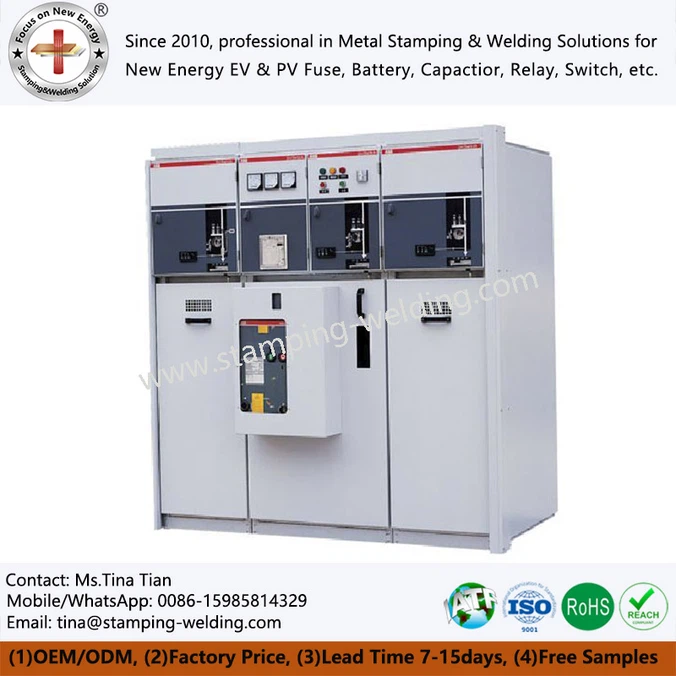
The main types of low-voltage switch cabinets include standard models such as GGD, GCK, GCS, and MNS, as well as XLL2 low-voltage distribution boxes and XGM low-voltage lighting boxes. The core difference between different types lies in the structural form and operation mode: GGD is a fixed power distribution cabinet, with internal components installed directly on the mounting beam, with a simple structure and low cost; GCK, GCS, and MNS are draw-out (drawer cabinet) structures, and each outlet circuit can be independently pulled out and replaced. It is easy to maintain and has a large number of outlet circuits. There are differences in the drawer advancement mechanism between GCK, GCS and MNS cabinets: GCS cabinets can only be used as single-sided operation cabinets, and the cabinet depth is usually 800mm; MNS cabinets can be used as double-sided operation cabinets, with a cabinet depth of 1000mm, and the space utilization rate is higher.
In terms of model selection, withdrawable cabinets (GCK, GCS, MNS) save space, are easy to maintain, and have many outgoing circuits, but are relatively expensive; fixed cabinets (GGD) have fewer outgoing circuits and occupy a larger area, and are suitable for scenarios that do not have strict space requirements and have limited budgets. The cable distribution cabinet with upper section adopts the structural design of an upper independent instrument room or busbar room, which has advantages in safety isolation and convenient operation and maintenance. It is common in industrial sites with high requirements for continuous power supply. In actual projects, if the space in the power distribution room is tight and there are more than 20 outlet circuits, it is usually recommended to use drawer cabinets; if the space is sufficient and the number of circuits is small, fixed cabinets are an economical and reasonable choice.
Application scenarios
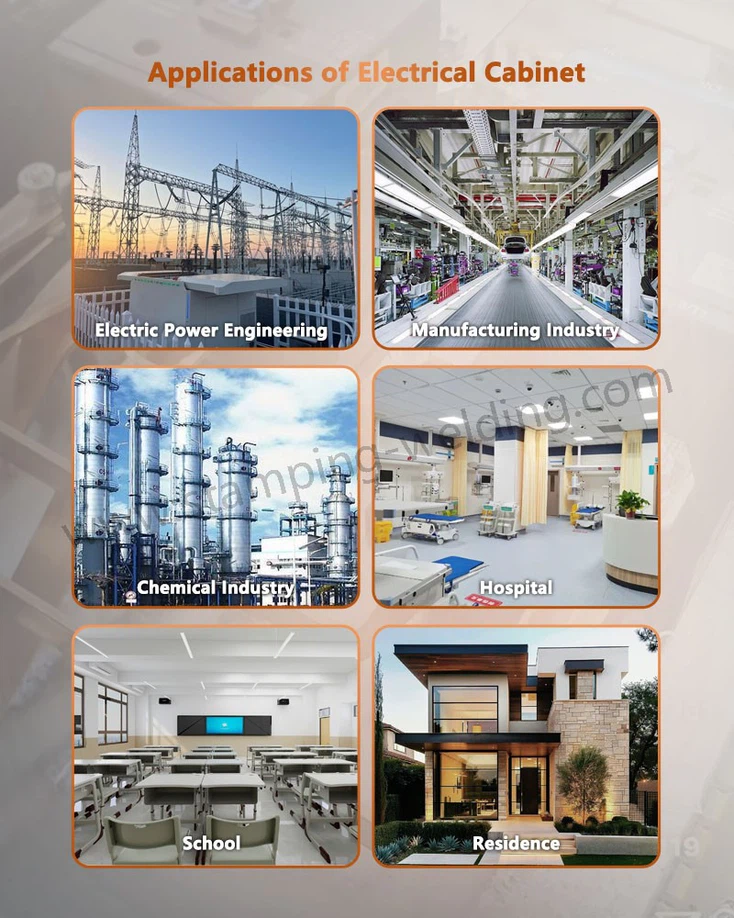
The operating procedures for electrical distribution cabinets reflect the strict requirements of the power system for safe operation. In special application environments such as ships, the power distribution cabinet serves as the power distribution center, and no unrelated personnel are allowed to operate the switches on the board without authorization. When the generator set is started, it needs to be manually accelerated slowly through the speed-up switch of the power panel. Only when the voltage and frequency reach the specified values can it be closed to send power. During parallel operation, the parallel operation must be strictly followed to avoid reverse power and parallel failure. When shutting down, the generator load must be cut off first and then stopped without load. Direct shutdown with load is strictly prohibited. The strict implementation of these operating procedures is an important guarantee for ensuring the safe and stable operation of the power distribution system.
The environmental adaptability design concept of outdoor optical fiber distribution boxes has been fully reflected in the "peak summer" work of power distribution cabinets. The impact of summer high-temperature weather on power distribution equipment cannot be ignored, and a complete prevention mechanism needs to be established. The operation and maintenance department should formulate a special work plan for high-temperature prevention in advance, focusing on checking the load status of main transformers, lines, busbars and other equipment, the oil and gas pressure status of oil-filled inflatable equipment, and the operating status of the cooling system. Through regular temperature measurement and comprehensive inspections, we can establish archives and records for equipment with large load circuits and high node temperatures, so that we can be aware of them and eliminate equipment safety hazards in high-temperature weather in a timely manner.
The 8-circuit three-phase four-wire distribution box is the terminal equipment of the power distribution system, and its quality control standards are directly related to the power safety of end users. The main control project requires that the cabinet test adjustment results comply with the construction specifications, the metal frame must be reliably grounded, and the panel markings must be clear and accurate. General projects focus on installation quality, including anti-loosening measures for bolted connections, neatness of wiring, flexibility and reliability of switches, etc. In particular, the leakage protection circuit is required to have an operating current of no more than 30 mA and an operating time of no more than 0.1 seconds to ensure that the power supply can be quickly cut off in the event of a leakage accident to protect personal safety.
details and maintenance
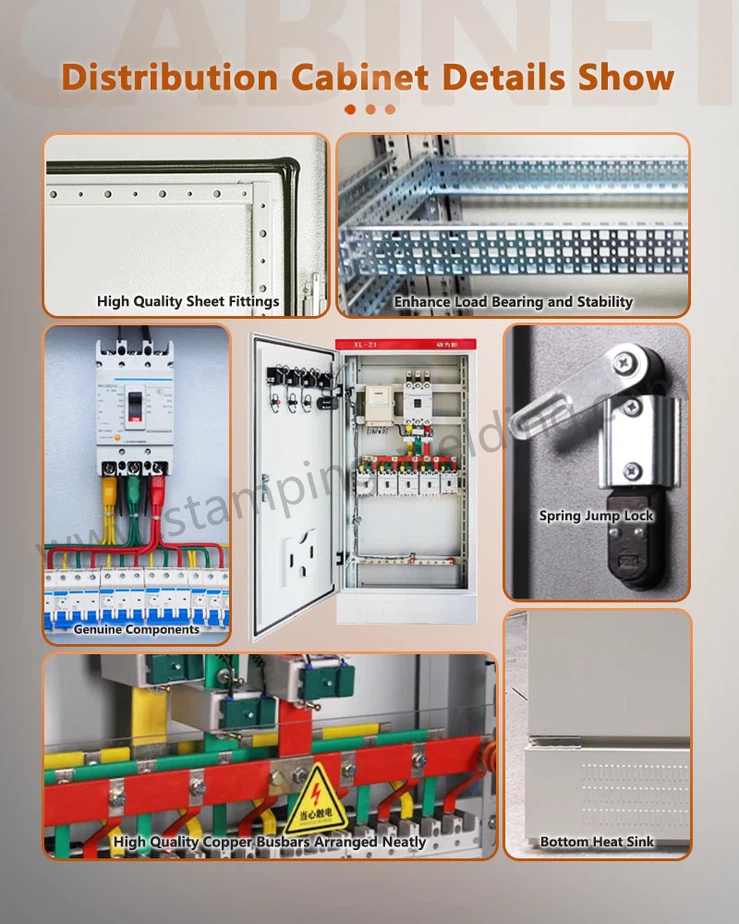
All electrical components and lines in the distribution board (box) should be in good contact and reliable, and there should be no serious heating or burning. Operators should regularly check the terminal temperature, circuit breaker operating status and protection device indications. The door body of the distribution board (box) should be in good condition, and the door lock should be kept by a dedicated person to prevent unauthorized operations. The circuit diagram of the distribution board is divided into a primary schematic diagram (main circuit schematic diagram) and a secondary schematic diagram (control circuit schematic diagram). The primary schematic diagram shows the main circuit wiring method from the incoming line to the outgoing line, including the connection relationship between circuit breakers, contactors, thermal relays and busbars; the secondary schematic diagram shows the wiring logic of the control loop, signal loop, measurement loop and protection loop.
During daily operation and maintenance, you should focus on checking whether the secondary terminal wiring is loose, whether the relay contacts are oxidized, and whether the indicator light is on normally. For withdrawable power distribution cabinets, the drawer unit should be pulled out regularly to check the wear of primary contacts and secondary pins, and oxidized or deformed parts should be replaced in a timely manner. Although an outdoor fiber distribution cabinet is mainly used for communication optical fiber wiring, its protection level (IP54 and above) and dustproof and waterproof design requirements are also of reference value for outdoor power distribution cabinets. Outdoor installed power distribution cabinets should be equipped with additional rainproof top covers and drainage holes.
contact us
We support full-cycle services from small-batch customized proofing to large-scale mass production. Engineering customers who have procurement needs for Distribution electric cabinet structural parts, electrical cabinets and power equipment casings are welcome to contact system integrators to obtain detailed technical specifications and customized solutions.