Technical topic on server cabinet U specifications: Detailed explanation of the 4U standard
May 19, 2026
In the construction of data center and computer room infrastructure, the height measurement of server cabinets adopts a unified "U" unit standard. The standard is formulated by the Electronics Industry Association (EIA). 1U is defined as 4.445 centimeters (approximately 1.75 inches). 4U is the height of four standard rack units, and the theoretical value is 17.78 centimeters. The core purpose of this size specification is to achieve rack compatibility of equipment from different manufacturers and ensure that servers, storage devices and network switching equipment can be uniformly deployed in 19-inch standard cabinets. Outdoor server cabinet also follows this U specification system in outdoor environments to ensure the versatility and ease of maintenance of the equipment. Compared with more compact 1U and 2U models, 4U servers provide more ample internal space and can support multi-channel CPU architecture, multiple PCIe expansion slots and large-capacity storage solutions. They are suitable for high-load business scenarios such as high-performance computing, cloud computing platforms, and financial trading systems.
Definitions and Standards
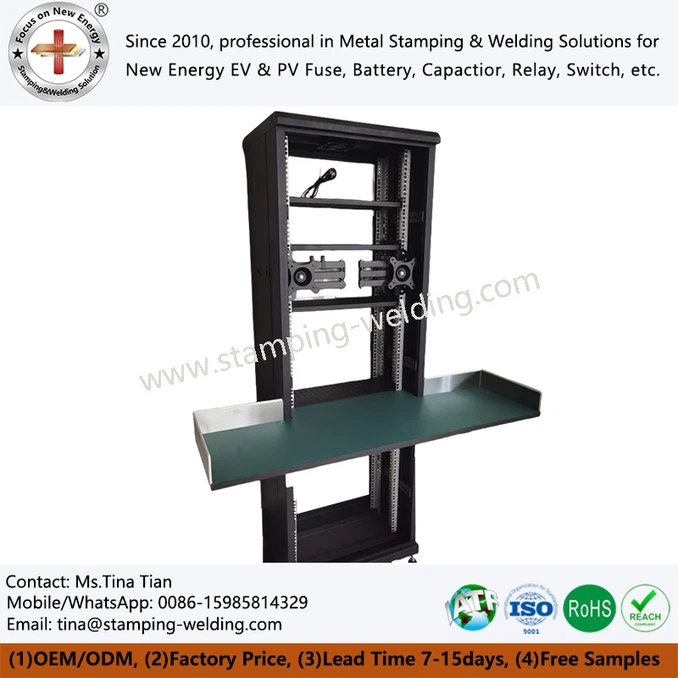
In core scenarios such as data centers and enterprise IT rooms, server cabinets are the core infrastructure that ensures the stable operation of server equipment and achieves standardized management. As the core size standard of server cabinets, 4U is widely used in the industry and is highly representative. 4U is a measurement unit for rack servers and cabinet heights established by the Electronics Industry Association (EIA). Its core conversion standard is that 1U is equal to 4.445 centimeters (1.75 inches). Therefore, the standard height of a 4U server cabinet is 17.78 centimeters (approximately 7 inches). This standard is formulated to unify equipment sizes, optimize rack space utilization, and balance equipment scalability and heat dissipation requirements. Network server racks are common rack types and often use this standard size to achieve equipment compatibility.
The core definition of the 4U server cabinet revolves around size standards and functional positioning. It is essentially a metal cabinet specially used to install, manage and protect servers and network equipment. Its 4U height design is different from compact models such as 1U and 2U. It can provide sufficient internal space to meet the installation needs of high-performance equipment. This unified standard formulated by EIA ensures that servers, switches and other equipment produced by different manufacturers are compatible with 19-inch standard racks, making it easier for enterprises to carry out centralized deployment, unified management and later maintenance, effectively reducing the cost of computer room construction and equipment operation and maintenance. As the core packaging form of the cabinet, the server rack enclosure provides a basic guarantee for the safe operation of the equipment.
Detailed design
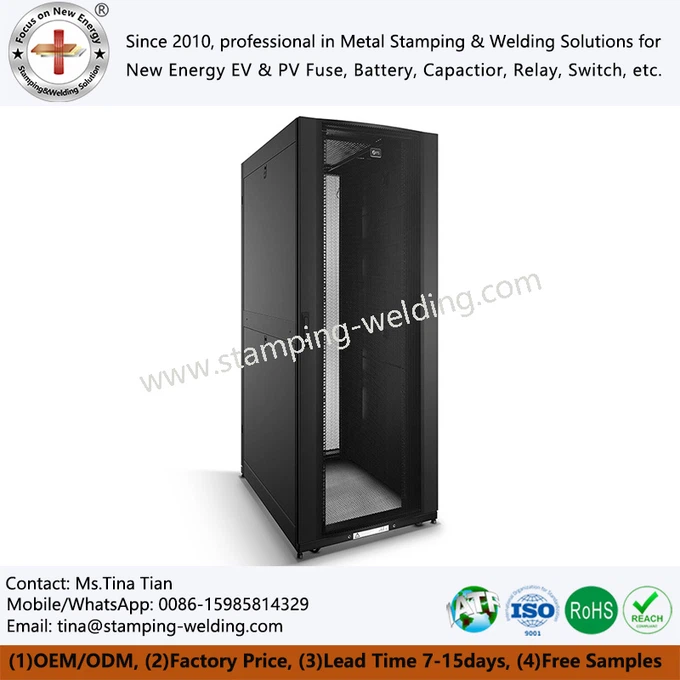
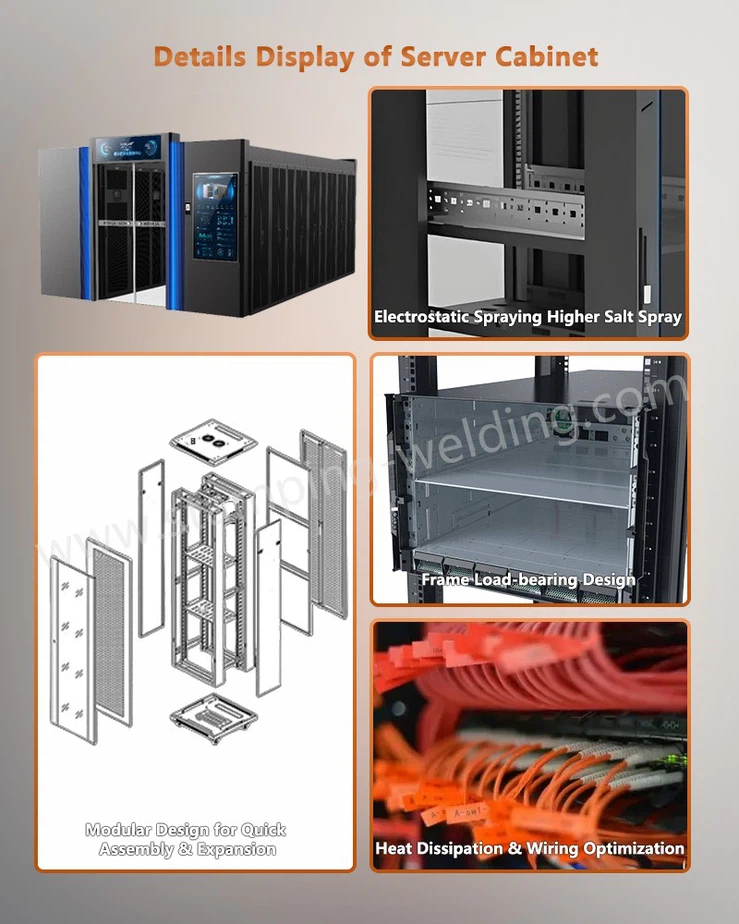
From the design characteristics, the 4U server cabinet has core advantages such as strong scalability, efficient heat dissipation, and reliable structure, and can fully meet the operation needs of high-load equipment. In terms of scalability, its ample internal space can accommodate multiple hard drives and multiple PCIe expansion slots, supporting the installation of high-performance graphics cards, storage controllers and other expansion components. It can also be flexibly adapted to server equipment of different specifications to meet the diverse IT deployment needs of enterprises; in terms of heat dissipation design, the cabinet is usually equipped with a professional server rack fans and ventilation holes to build an efficient heat dissipation system, which can effectively dissipate the heat generated when multi-channel CPUs and large-capacity storage devices are running, ensuring the stable operation of the equipment under high load conditions and avoiding equipment failure due to overheating. In terms of structural materials, the cabinet uses industrial-grade metal materials combined with modular design, which not only improves the durability and impact resistance of the equipment, but also facilitates later equipment installation, disassembly and maintenance.
The performance advantages of the 4U server cabinet are mainly reflected in configuration compatibility and operational stability, and its core performance adapts to the use requirements of high-load scenarios. In terms of processor support, the cabinet can accommodate server equipment with up to eight CPUs, which can meet the needs of scientific calculations such as molecular simulation and climate modeling, as well as complex computing tasks such as financial quantitative transactions and AI training. In terms of storage and network, the sufficient internal space can support large-capacity storage solutions and is compatible with 10G/IB network cards to achieve high-speed data transmission, adapt to I/O-intensive tasks, and ensure the efficiency of data processing and transmission. In addition, the standardized design of the cabinet enables it to be used with floor-standing data Cabinets and other floor-standing cabinets form a synergy, flexibly adapt to the spatial layout of different computer rooms, and improve the overall equipment density and operating efficiency of the computer room.
Application scenarios
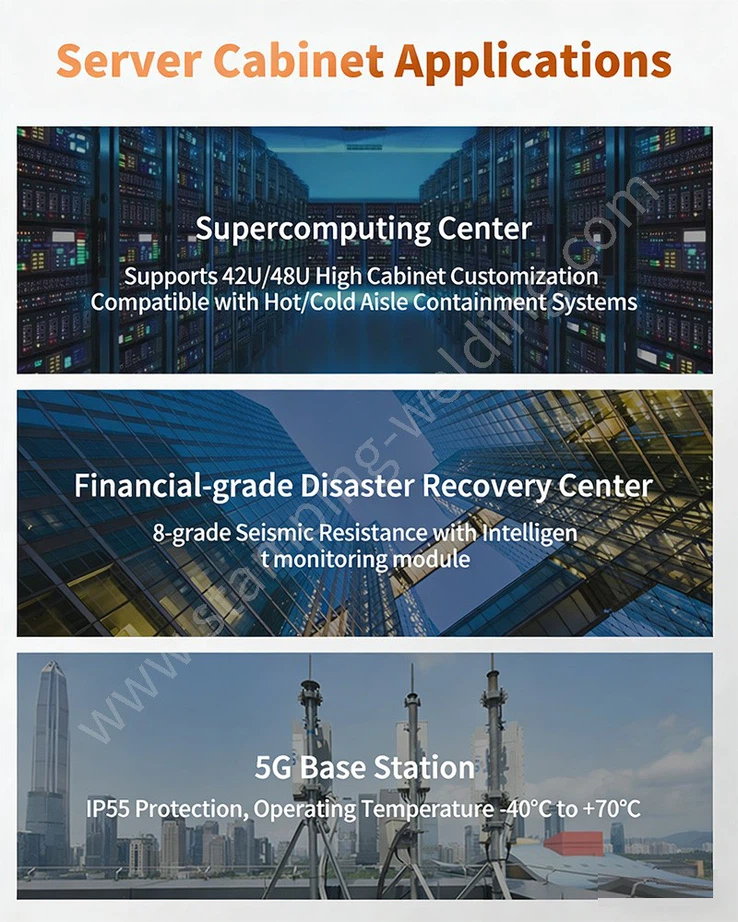
4U servers and supporting cabinets are mainly used in enterprise-level core businesses, including key deployments such as large-scale relational databases, server virtualization platforms, and enterprise resource planning (ERP) systems. In the field of scientific research and development, it is widely used in high-performance scientific computing tasks such as molecular dynamics simulation, climate modeling, and genome analysis. In the digital industry, 4U devices are usually deployed in scenarios that require a large number of expansion cards, high cooling capabilities, and sufficient storage space, such as video rendering farms, offline data mining, and artificial intelligence model training. Although space is limited in embedded installation scenarios such as in-wall network racks, in computer room wiring rooms or edge nodes, low U specification cabinets and 4U specification servers also need to follow unified EIA installation hole spacing standards to ensure physical compatibility during hybrid deployment.
contact us
Engineering customers who have purchasing needs for 4u data cabinet, network racks and communication equipment casings are welcome to contact system integrators to discuss and obtain detailed technical specifications and customized solutions.