Popularization of professional knowledge in the industrial and commercial energy storage industry
May 29, 2026
Industrial and commercial energy storage refers to energy storage systems deployed on the industrial or commercial end-user side and is an important part of the user-side subdivision in electrochemical energy storage applications. According to different application scenarios, electrochemical energy storage can be divided into three major categories: power supply side, grid side and user side. The user side can be further subdivided into two sub-scenarios: industrial and commercial energy storage and household energy storage. Commercial Energy Storage and Industrial Energy Storage respectively correspond to two types of application entities: commercial buildings, retail stores, hotels and other commercial facilities, and industrial facilities such as factories, parks, and mines. Modular energy storage for C&I represents the mainstream form of industrial and commercial energy storage products - using a modular design concept, the system voltage level and capacity configuration can be flexibly adjusted according to the user's actual load characteristics and transformer capacity, ranging from small cabinet systems of tens of kilowatt hours to container systems of several megawatt hours. Energy storage power station usually refers to a larger centralized energy storage power station, which can be deployed on both the grid side and the user side. Its capacity is generally above the MWh level. The core goal of industrial and commercial energy storage is not to participate in auxiliary services such as power grid frequency and peak regulation (although it can also participate when conditions permit), but to reduce the user's own electricity costs as the primary demand, and to achieve investment returns through peak and valley electricity price arbitrage, demand management and increasing the self-consumption rate of photovoltaics.
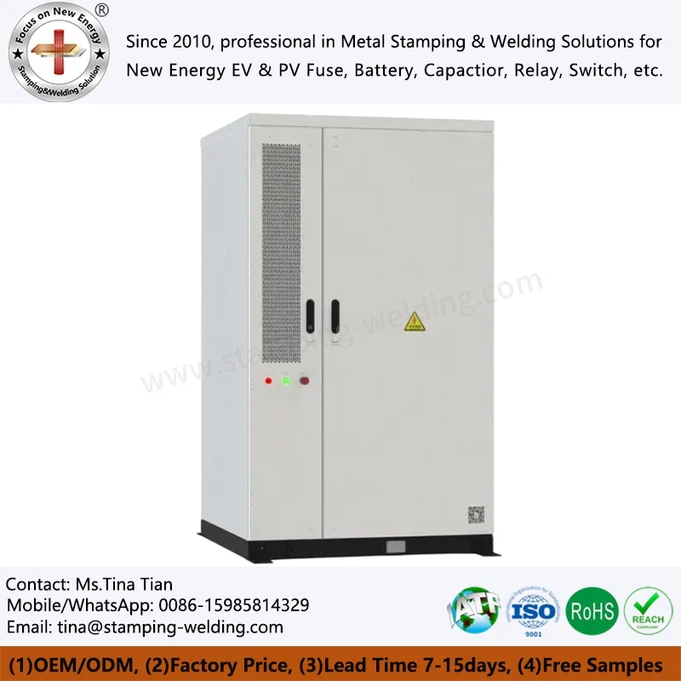
Detailed display
In the selection and procurement process of industrial and commercial energy storage systems, in addition to paying attention to macro parameters such as nominal capacity, cycle life, and system efficiency, the following engineering details are often the key dividing line that distinguishes the supplier's true manufacturing level and quality control capabilities. First, the quality of battery tab welding. The connection between the tabs and the cover of the square aluminum-shell battery cell is usually laser welded. The welds of high-quality products should be continuous, uniform, without spatter, and the penetration depth should be controlled between 0.3 and 0.6 mm. The shape of the molten pool can be observed through metallographic section sampling - qualified welds should present a full crescent-shaped molten pool without pores, cracks or unfusion defects. Inferior soldering may desolder during long-term vibration or thermal cycling, causing the battery to open circuit or abnormally increase contact resistance.
Second, module bus design. The busbar is a key conductive component that connects multiple cells and carries charging and discharging currents. In engineering, attention should be paid to whether the cross-sectional area of the busbar matches the maximum continuous current of the system (usually designed according to a current density of 2-3A/mm²), whether the material is T2 copper (conductivity ≥98% IACS), and whether the surface is nickel-plated or tin-plated to prevent oxidation. Multi-layer flexible busbars (laminated copper structures) have better resistance to vibration and thermal expansion than single-layer hard connections, making them a better choice in the power and energy storage fields.
Third, the protection level of the connector between modules. Industrial and commercial energy storage systems usually use quick-plug connectors to connect modules in series or parallel. A high-quality connector should have the following characteristics: the shell material is engineering plastic with flame-retardant grade V-0; the contacts are silver- or gold-plated copper alloy; it has a secondary locking mechanism to prevent vibration loosening; the sealing ring is intact and the protection level reaches IP67. When purchasing, you can ask the supplier to provide the connector's plugging and unplugging life test report (usually required ≥ 100 times) and temperature rise test data (the temperature rise does not exceed 45K at rated current).
Fourth, the voltage sampling accuracy and synchronization of the BMS. The sampling accuracy of the series-connected cell voltage by the battery management system directly affects the accuracy of SOC estimation and the reliability of overcharge and over-discharge protection. Professional products should have a sampling error of < ±5 mV per channel (full temperature range, full life cycle), and the sampling synchronization deviation of all channels should not exceed 10ms. Suppliers can be asked to provide third-party measurement calibration certificates and multi-channel synchronous sampling waveforms.

Manufacturing process
The manufacturing quality of industrial and Battery-based energy storage is not only determined by the assembly link, but also runs through the complete process chain of cell production, module welding, battery pack integration and whole cabinet joint debugging. The following describes the core process points from the five key manufacturing stages. Process control in the battery manufacturing stage. The battery core is the smallest energy storage unit of the energy storage system, and its manufacturing accuracy directly determines the consistency, lifespan and safety of the system. In the electrode coating process, the positive and negative electrode slurries need to be evenly coated on the aluminum foil or copper foil current collector. The coating thickness tolerance needs to be controlled within ±1.5μm, and the surface density tolerance should be ≤±1.5%. The coated pole piece needs to go through a rolling process to compact the active material to the target density - the compacted density of lithium iron phosphate cathode is usually between 2.2-2.4g/cm³. Too high a compaction will reduce the porosity and affect the rate of performance, and too low a compaction will reduce the volumetric energy density. During the slitting process, the height of the burrs on the edge of the pole piece must be controlled below 12 μm (copper foil) and below 15 μm (aluminum foil). Too long burrs may pierce the diaphragm and cause micro short circuits. The winding or lamination process requires that the alignment deviation of the positive and negative electrodes does not exceed 0.5mm, and the separator must completely cover the edges of the electrodes to prevent short circuits.
Module welding and assembly process. Connecting multiple battery cells into modules through busbars is one of the most difficult processes in manufacturing the entire system. The mainstream process uses laser welding, and the welding objects are aluminum poles and copper bus bars (or aluminum bus bars). Due to the large difference in melting points between aluminum and copper and the tendency to produce brittle intermetallic compounds during welding, the process window is extremely narrow. The project requires precise control of laser power (usually 2000-4000W), welding speed (50-150mm/s), defocus amount and protective gas flow (argon or nitrogen, flow 15-25L/min). The weld must meet the following requirements: penetration depth ≥ 0.5mm, penetration width ≥ 1.5mm, and no penetrating pores after X-ray or ultrasonic testing. The tensile test value of each weld should not be less than 200N (for batteries above 50Ah). After welding is completed, the module needs to undergo polarity detection, insulation resistance testing (positive and negative electrodes to the shell ≥100MΩ@1000V) and open-circuit voltage consistency screening (voltage difference between cells in the module ≤20mV).

Application scenarios
The main application scenarios of industrial and commercial energy storage can be summarized into three types: separate energy storage, integrated light storage and charging, and microgrid. Separate configuration of energy storage is the most basic application form. Industrial and commercial users independently install energy storage systems for two main reasons: first, to save electricity costs for enterprises through peak shaving and valley filling. Taking the peak electricity price of 1.0 yuan/kWh and the low valley electricity price as 0.3 yuan/kWh as an example, enterprises can charge energy storage during off-peak hours and use energy storage to supply power during peak hours. The actual electricity cost is reduced from 1.0 yuan/kWh to 0.3 yuan/kWh; second, energy storage can be used as a backup power source to ensure continuous power supply for key loads during grid outages or power restrictions.
Integration of photovoltaic storage and charging refers to a comprehensive energy system that integrates photovoltaic power generation systems, energy storage systems and electric vehicle charging piles. Photovoltaic power generation is given priority to charging piles and building loads, and excess power is stored in the energy storage system; when the photovoltaic output is insufficient, the energy storage system discharges to supplement; only when neither photovoltaics nor energy storage can meet the demand, power is taken from the grid. This model realizes the efficient utilization and on-site consumption of clean energy. At the same time, the energy storage system can alleviate the instantaneous impact of high-current fast charging at charging piles on the regional power grid and reduce the need for expansion of distribution transformers.
Microgrid energy storage for industries is an energy storage application in industrial microgrids. A microgrid is a localized small-scale power generation and distribution system with its own power generation capacity. It is usually based on distributed power sources (such as photovoltaics, small wind power, gas turbines, etc.). It uses energy storage and control devices for real-time adjustment to achieve a balance between power supply and demand within the network. Microgrids can operate independently of the main grid (off-grid mode) or in conjunction with the main grid (on-grid mode). For off-grid microgrids that operate independently of the main grid, energy storage plays the dual role of smoothing fluctuations in new energy power generation and serving as the main and backup power supply; for grid-connected microgrids, energy storage is mainly used to optimize energy dispatch, reduce electricity costs, and achieve energy conservation and emission reduction. Grid-connected industrial storage systems, as the core components of grid-connected microgrids, need to have the ability to quickly respond to dispatching instructions and good grid support functions.

contact us
If you need to customize a set of C&I storage systems with dual functions of peak and valley arbitrage and demand management for your high-energy-consuming factory or business park, our senior engineers can provide detailed investment return calculations and system configuration lists to ensure that the technical solution is highly consistent with your business goals.