Quick fuse industry knowledge analysis
May 21, 2026
The fast-acting fuse is a type of fuse specially used for short-circuit protection of semiconductor rectifying components or rectifying devices. Since semiconductor components have extremely low overload capabilities and can usually only withstand large overload currents in a very short time, stringent requirements for fast fuses are imposed on short-circuit protection devices. The overall structure of a fast-acting fuse is similar to that of a filled sealed fuse, but there are significant differences in the melt material and shape design: the melt is usually stamped from silver sheets and processed into a variable cross-section structure with a V-shaped deep groove. In addition to the metal wire of a specific shape, the fuse of the fast-acting fuse is often provided with solder joints at key parts to promote the fuse to quickly open in the event of overload. In practical applications, fast fuses highlight the word "fast" and have high sensitivity. When the circuit current is overloaded, the fuse quickly heats up and breaks under the action of the solder joints. It is especially suitable for protecting silicon-controlled thyristors and other electronic power components. In fuse components, the performance of key conductive components such as Fuse Blade Contact and Blade Contact directly affects the response speed and reliability of the fuse.

structural composition
From the perspective of structural composition, standard fast fuses usually include six functional modules: magnetic shell, conductive plate, melt, quartz sand filler, arc extinguishing agent and fuse indicator. As an external package, the magnetic shell not only provides mechanical support and insulation protection, but also forms a sealed arc-extinguishing cavity inside; the conductive plate is responsible for the current-bridging function between the external circuit and the melt, and its material and surface treatment process directly affect the overall temperature rise performance. As the functional core of the entire device, the melt is made of pure silver material with extremely low resistivity, excellent ductility and outstanding oxidation resistance. It is processed into a rectangular sheet shape, and a round hole and narrow neck structure are formed on the sheet body through a precision blanking process. These narrow neck areas are well-designed current bottlenecks, and their cross-sectional area is much smaller than the main body of the melt.
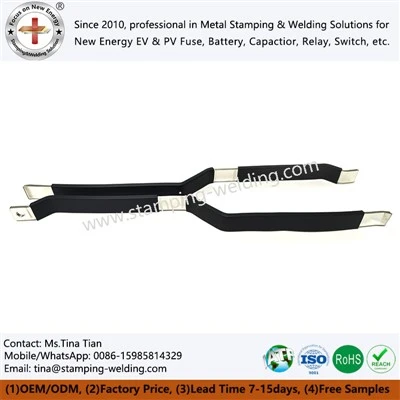
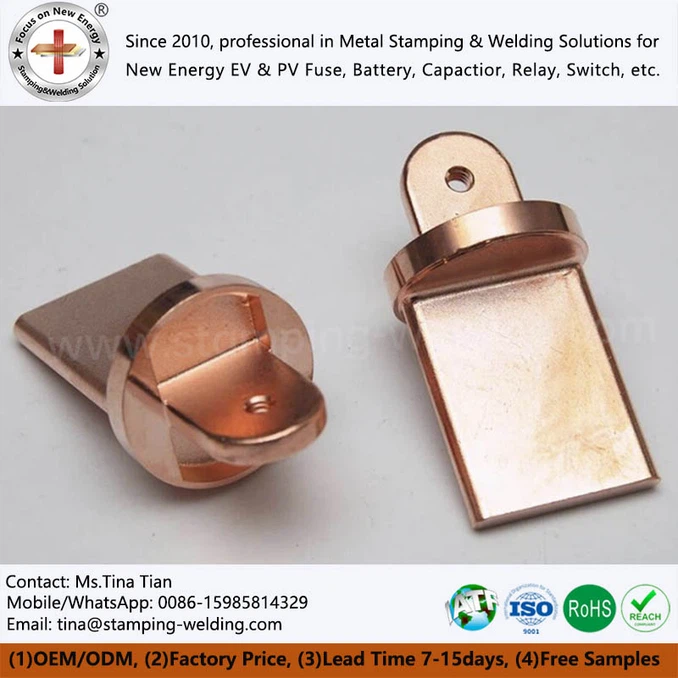
When the fault current passes through, according to Joule's law and the principle of current heating effect, the narrow neck area quickly accumulates heat due to a sudden increase in resistance, becoming the starting point of fusing. The Fuse Terminal at both ends of the fuse not only assumes the mechanical connection function of the external circuit, but also ensures that the contact resistance is maintained at an extremely low level under high current conditions through highly conductive copper materials and optimized contact interface design. In addition, the connection interface between the melt and the conductive plate usually adopts the Metal Copper Blade structure. This design significantly reduces the contact resistance and temperature rise in long-term operation by increasing the effective contact area and optimizing the pressure distribution. Some models are equipped with a Blade Contact plug-in structure at the input and output ends to meet the urgent need for rapid replacement and maintenance of modular power electronic equipment.
manufacturing process
The fuse manufacturing process of fast-acting fuses combines precision metallurgy and micro-molding technology. In addition to silver-based sheets with specific geometric profiles as the main body, modern high-end products also set low-melting-point alloy solder joints at key nodes on the melt surface. These solder joint materials form a precise metallurgical eutectic system with the silver matrix. When the circuit current exceeds the set threshold, the solder joint first enters the molten state. Through the diffusion and penetration of liquid metal, the effective melting point of the adjacent silver matrix is significantly reduced, thereby triggering the melt to complete fracture separation in a very short time.
This "solder point trigger" mechanism not only improves the time consistency of the fusing action but also effectively solves the technical problem of dispersed fusing time of pure silver melt in the critical overload range. At the component level manufacturing level, the Fuse Blade Contact structure is widely used in the electrical connections at both ends of the melt. This design significantly reduces contact resistance and temperature rise in long-term operation by increasing the effective contact area and optimizing pressure distribution, and provides a reliable electrical connection guarantee for high-frequency switching or continuous high-current conditions. At the same time, some high-power models are equipped with a Fuse Contact Blade plug-in structure at the input and output ends to meet the urgent need for rapid replacement and maintenance of modular power electronic equipment.

Application fields
This type of fuse is widely used in industrial automation, variable frequency drives, rail transit and new energy equipment, especially in scenarios where precision power devices such as IGBTs and thyristors need to be protected. In these applications, the stable contact performance of Brass/Copper Contact ensures long-term operational reliability and low maintenance costs. The fast fuse has obvious inverse time current protection characteristics, that is, the shorter the overload current, the longer the fusing time; the larger the overload current, the shorter the fusing time. Within a certain overload current and time range, the fuse will not blow and can be used continuously. Different types of fuses have different fusing characteristic curves and can be suitable for the needs of various protection objects. At the same time, the fast fuse also has outstanding current-limiting characteristics.
Because the melt adopts a rectangular sheet with a round hole and a narrow neck and is filled with quartz sand as the arc extinguishing medium, when a short-circuit fault occurs, the fault current is cut off before it reaches the expected peak value. The narrow neck melts first and the arc is separated by the quartz sand, which not only limits the growth of the short-circuit current but also accelerates the extinguishing of the arc. In this process, the conductive efficiency and thermal stability of metal conductive components such as Metal Copper Blade and Brass/Copper Contact play a key supporting role in the current limiting effect of the fuse.

contact us
We offer Fuse Knife full range of high-quality products. Our components are precision processed and strictly tested to ensure that they maintain excellent conductivity, mechanical strength and corrosion resistance in high current and high frequency environments, providing stable and reliable circuit protection solutions for customers' critical equipment.