Soft Copper Tinned Wires: A technical comparison between flexible connection solutions and traditional rigid busbars
Apr 26, 2026
In the field of electrical connections, rigid busbars (such as copper busbars) have long dominated, but they cannot absorb the mechanical stress generated by thermal expansion and contraction, easily leading to loosening or breakage of connection points. As a high-performance alternative, Soft Copper Tinned Wires is rapidly gaining popularity in switchgear, new energy battery connections, and high-power electronic equipment due to its unique braided structure and surface tin plating process. This article starts with the product characteristics and compares similar connection solutions to help industry users clarify the selection criteria.
Differences in structure and process
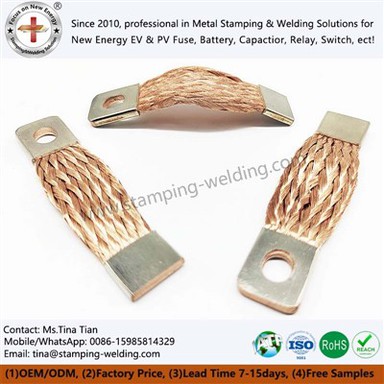
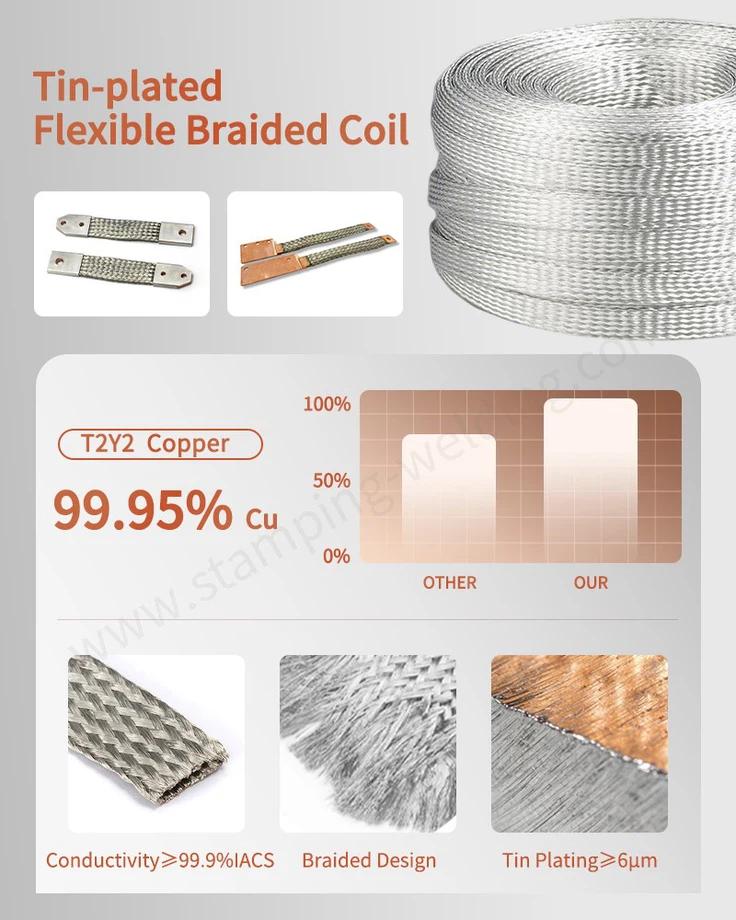
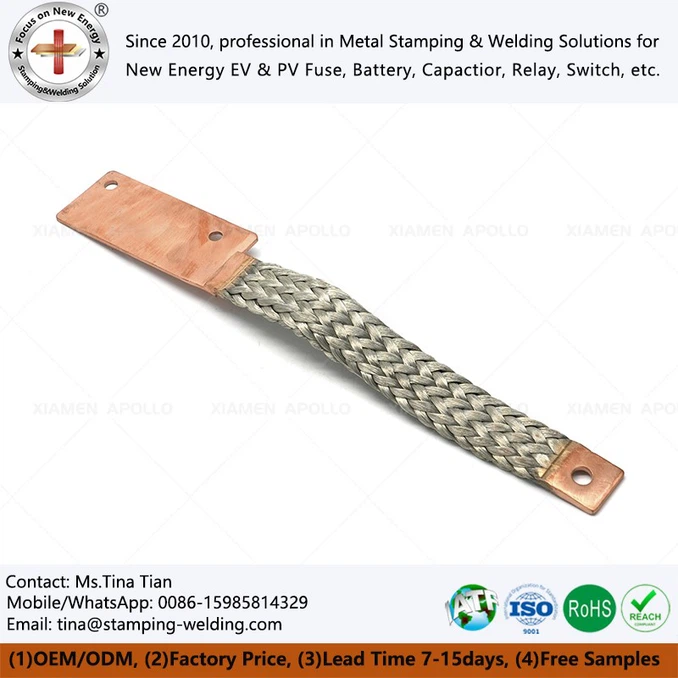
Unlike traditional solid copper busbars or copper stranded wire, flat braided bars use extremely fine copper wires (0.10–0.20 mm in diameter) braided into a flat strip structure, resulting in a higher surface area and more uniform current distribution. In contrast, while copper stranded flexible bars also possess flexibility, they are mostly twisted round strands, which are inferior to flat braided forms in terms of planar contact area and heat dissipation efficiency. Furthermore, ordinary twisted copper wire is primarily used for signal or low-current circuits and cannot handle power currents of hundreds of amperes. Tin plating involves immersing flat copper braided wire in a tin-based alloy, significantly improving its corrosion resistance and solderability compared to bare copper products (such as braided wire copper bus bars), making it particularly suitable for humid or sulfur-containing environments.
Flexibility and installation performance
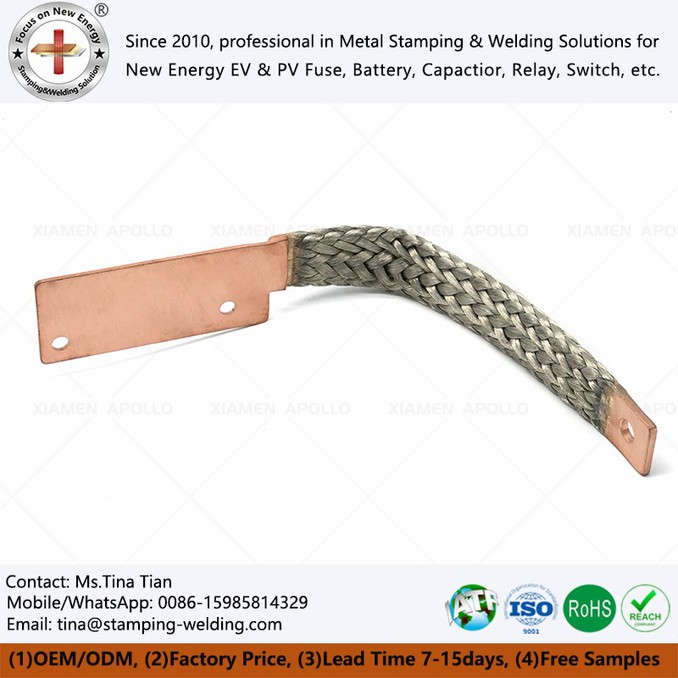
Rigid busbars cannot deform under equipment vibration or temperature changes, easily causing terminal cracking. Flexible braided bars, on the other hand, can be bent and twisted freely, absorbing thermal expansion displacement of components such as transformers and reactors, preventing mechanical damage. Compared to copper braided wire, the flat structure is thinner for the same cross-sectional area, making it suitable for stacked installations in confined spaces. In electric vehicle battery packs, tin-plated flat braided bars are commonly used in Lithium-ion Batteries Connectors, which can withstand driving vibrations while ensuring low contact resistance through the tin plating. For applications requiring insulation protection, Flexible Insulated Copper Bars or insulated flexible copper bars can be used, with PVC or heat-shrink tubing wrapped around the braid. The bare copper tin-plated version is suitable for subsequent impregnation or soldering processes.
Application scenario differentiation
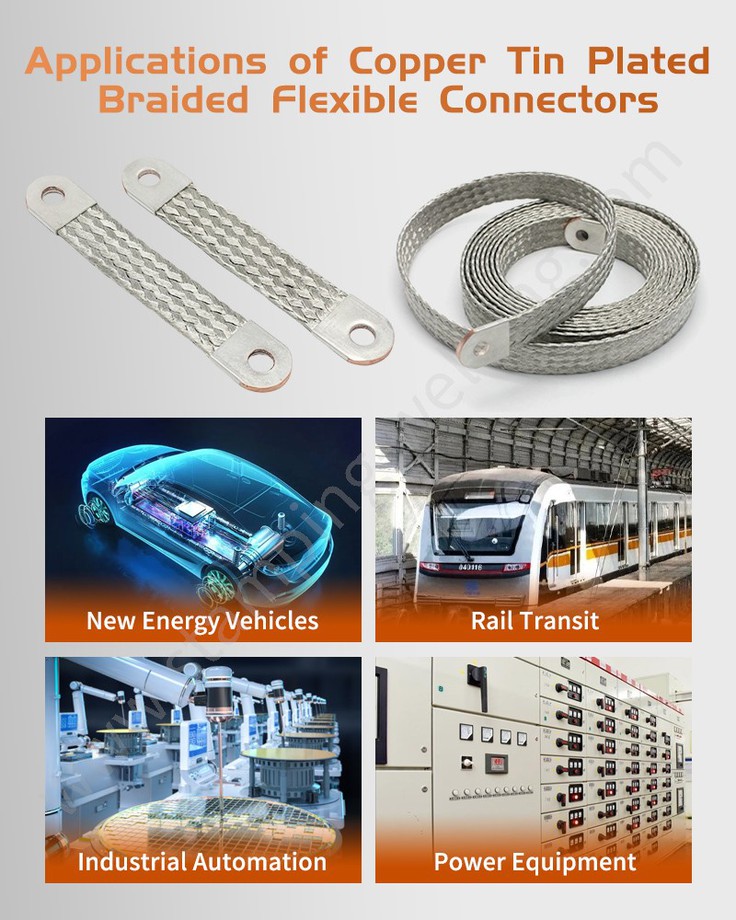
In grounding protection circuits, Tinned Copper Braid Earthing Tape and Tinned Copper Braid Wire Grounding Jumper are standard choices-tinned braided tape offers low impedance and high flexibility, bridging the switchgear door and cabinet. For power distribution systems, Copper Braided Bar for Power Distribution is commonly used for flexible bridging between the main busbar and circuit breaker, replacing multiple parallel cables and resulting in a cleaner cabinet interior. Furthermore, Braided Connectors are widely used in high-current moving parts such as industrial furnaces and electrolytic cells. Flexible Copper Braided Busbar Connectors, as pre-assembled parts, can be ordered directly with specified lengths and diameters, eliminating the need for bending during on-site installation.
Customization and Selection Recommendations
Flexible BusBar Manufacturers or Flexible Copper BusBar Manufacturers from different manufacturers differ in product specifications: key parameters include the number of copper wire strands, braiding density, tin plating thickness, and end crimping method. For high current transmission, Copper Braided Flexible Shunts are commonly used as shunts in current measurement circuits. Copper Stranded Flexible Connection Customization can be manufactured in any shape according to drawings, including integrated assemblies with positioning holes or insulating sleeves.
In contrast, "busbar flexible" and "flexible copper bar" are sometimes mistakenly considered synonyms, but the former refers to all flexible bars, while the latter emphasizes a thin copper laminate structure (non-braided). In engineering selection, if high bending radius and fatigue life are required, tin-plated flat braided bars (Flat Copper Braid Flexible) are superior to laminated flexible copper bars; if extremely low inductance is required, laminated bars are more suitable. Furthermore, Braided Copper Wire Connectors are often used interchangeably with Copper Braided Connector Flexible Earthing Tapes, but the former focuses on power connection, while the latter focuses on grounding protection.
Industry Trends
With the increasing demand for flexible connections in new energy power generation, energy storage systems, and rail transit, Soft Copper Tinned Wires are replacing traditional rigid bars as the preferred solution for high-reliability designs. When purchasing, users should prioritize products with complete tin plating processes and temperature resistance certifications, and can choose the flat braided type from the Copper Braided Flexible or Flexible Busbars series according to the actual installation space to achieve long-life, maintenance-free electrical connections.
Contact Us
For technical information, sample support, or customization options for the Soft Copper Tinned Wires products mentioned above, please feel free to contact us.