Understanding Fuse Knives: The First Line of Defense for Power Safety
Nov 15, 2025
In low-voltage distribution systems, power supply circuits of industrial equipment, and civil power lines, Fuse Knives are one of the core components ensuring circuit safety. Through their fusing characteristics, they quickly cut off current when faults such as overload or short circuit occur in the circuit, preventing safety accidents like equipment burnout and line fire. Just like "safety guards" of power systems, they build the first protective barrier for various electricity-consuming scenarios.
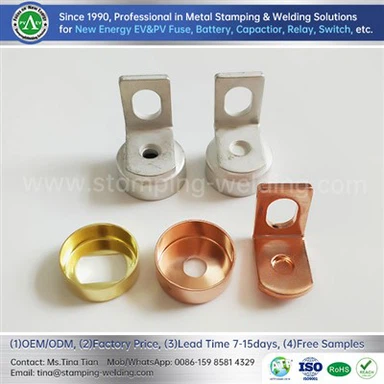
Compared with ordinary fuses, Cylindrical Body Contact Knife combine protective functions with operational convenience. Their knife-type structural design not only facilitates quick installation and replacement but also intuitively shows the on-off state, making them widely used in scenarios requiring frequent maintenance or temporary power supply. Notably, in some industrial power systems, NH Fuse Links Knife often work in coordination with other precision components such as Forged Copper Components to further enhance the overall stability of the power circuit.

Analysis of Core Structure
The performance of Fuse Contact is closely related to their structural design, and their core components need to work together to achieve safety protection functions, including:
Knife-Type Contact Terminals: Made of metal materials with excellent electrical conductivity, one end is connected to the incoming line of the circuit, and the other end is inserted into the fuse base to ensure stable current transmission; the surface of the terminals is specially treated to reduce contact resistance and minimize heat generation. In some high-demand applications, these terminals may be paired with Forged Copper Components to optimize conductive efficiency.
Fusible Element: As the "core protection unit" of Fuse Knife Contact, it encapsulates low-melting-point alloy wires or sheets inside; when the circuit current exceeds the rated value, the alloy wires melt quickly to cut off the circuit.
Insulating Shell: Wraps the fusible element and part of the contact terminals, made of insulating materials resistant to high temperature and electric arc, preventing the electric arc generated during fusing from leaking and avoiding electric shock caused by accidental touch.
Operating Handle: Mostly made of insulating materials, facilitating operators to plug and unplug Fuse Terminal manually and ensuring personal safety during replacement or maintenance.
A disassembled view of Fuse Knife structure, marking the name and position of each core component to intuitively show its composition logic.

Core Production Process
The production of Silver Plated Copper Knife Contacts requires multiple precision processes to ensure that each component meets performance standards and is accurately assembled, with the main processes including:
Component Processing: Contact terminals are made through stamping and cutting processes, while insulating shells and handles are formed through injection molding; for fusible elements, alloy wires are accurately cut and encapsulated according to the rated current specification.
Surface Treatment: Contact terminals undergo pickling, tin plating, or silver plating to remove surface oxide layers, improving electrical conductivity and corrosion resistance; insulating components undergo high-temperature curing to enhance structural strength. This process is similar to the surface treatment of Forged Copper Components, both focusing on optimizing material performance.
Assembly and Debugging: The fusible element, contact terminals, and insulating shell are accurately assembled to ensure tight cooperation between components; the plugging force of the contact terminals is debugged to avoid poor contact due to being too loose or difficult operation due to being too tight.
Performance Testing: Finished Forged Copper Components undergo on-off testing, overload fusing testing, and insulation performance testing to verify their protection performance and safety performance under different working conditions.
A schematic diagram of the Fuse Knife production process, showing the entire process from raw material processing to finished product testing in the form of a flow chart.

Typical Application Scenarios
With the characteristics of safety, reliability, and convenient operation,NH Fuse Links Knife are widely used in power systems in multiple fields:
Power Supply for Industrial Equipment: In the power supply circuits of industrial equipment such as machine tools, fans, and water pumps, they serve as short-circuit protection components; when a line short circuit occurs inside the equipment, Fuse Contact fuse quickly to protect the equipment motor and control components. In some complex industrial systems, they may be used in conjunction with Forged Copper Components to improve the stability of the power supply loop.
Low-Voltage Distribution Systems: In building distribution and distribution boxes/cabinets, they are used for overload protection of branch circuits; compared with circuit breakers, they have lower cost and more convenient replacement, making them suitable for scenarios sensitive to cost and with low fault frequency.
Temporary Power Supply Scenarios: In construction sites and temporarily built power lines, they serve as pluggable protection components; construction personnel can manually cut off or restore power according to work needs, while avoiding safety risks caused by circuit faults.

Summary
In the future, with the continuous development of power electronic technology, Fuse Knives will further integrate intelligent and environmental-friendly characteristics while maintaining their core safety protection functions, providing reliable guarantees for a wider range of electricity-consuming scenarios.
contact us