

Brass Stamped Components
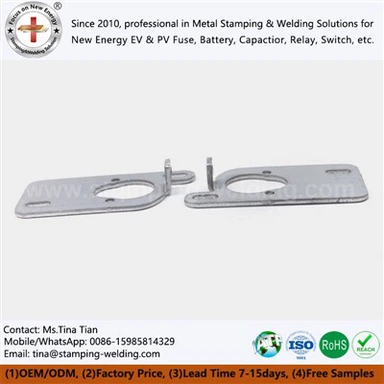
Brass Stamped Components are designed for EV fuse assemblies where four-hole geometry, conductive paths, forming stability and mounting interfaces must work together. Brass sheet supports punching, blanking, bending and forming for controlled component geometry and consistent assembly. Xiamen Apollo provides in-house stamping and tooling, with rapid samples and automotive production under IATF 16949 and ISO 9001 systems.
- Fast Delievery
- Quality Assurance
- 24/7 Customer Service
Product Introduction

Brass Stamped Components are precision-formed brass parts used as mechanical and electrical interfaces in EV fuse assemblies. The four-hole structure is produced through punching, blanking, forming and bending processes, with controlled hole positioning, profile accuracy and dimensional consistency to meet customer assembly requirements.The four-hole layout is designed around the fuse structure, mounting method and mating components. Hole diameter, center distance, profile dimensions and formed sections are defined according to the engineering drawing to support accurate positioning and repeatable assembly.
Material Properties of Brass Precision Stamping Parts
Brass Electrical Conductivity
The brass material provides a conductive base for EV fuse assemblies, supporting current transfer through the four-hole stamped structure. Material grade, thickness and surface condition should be specified according to the required electrical and mechanical performance.
Formability & Mechanical Stability
Brass sheet supports precision punching, blanking, bending and forming while maintaining the four-hole geometry. Material temper and thickness should be matched with die clearance and forming sequence to control deformation, hole position and assembly consistency for Electrical Metal Brass Stamping Parts.

Typical Integration Points of Brass Sheet Metal Stamping Parts
EV High-Voltage Fuse Assemblies
Provides a four-hole brass interface for electrical connection and mechanical mounting, supporting accurate alignment and stable assembly within EV high-voltage fuse structures for Brass Sheet Metal Stamping.
Battery Pack Protection Systems
Supports fuse positioning and conductive connection within high-voltage battery protection modules, maintaining defined mounting geometry and consistent electrical interfaces throughout battery pack assembly.
Power Distribution Units (PDU)
Connects with mating conductive components while maintaining defined hole spacing and assembly alignment, supporting stable electrical connection within power distribution units and related assemblies for Sheet Metal Brass Stamping.
Automotive Electrical Protection Modules
Used as a stamped brass component for fastening, positioning and current transfer, supporting controlled assembly interfaces within automotive electrical protection systems and EV platforms.


Frequently Asked Questions about Brass Sheet Metal Components
Q: What brass material properties are important for four-hole EV fuse components?
A: Brass grade, sheet thickness, temper and surface condition should be selected according to the required electrical conductivity and mechanical properties. These parameters affect current transfer, punching quality, forming behavior and dimensional stability of the four-hole stamped component.
Q: How does brass sheet form during precision stamping?
A: Brass sheet can undergo punching, blanking, bending and forming to produce the required four-hole geometry. Material temper and thickness should be matched with die clearance and forming sequence to control deformation, hole position and the final assembly interface.
Q: Why is hole positioning important in four-hole brass stamped components?
A: The four-hole layout determines mounting alignment and connection positioning within the EV fuse assembly. Hole diameter, center distance and profile dimensions are therefore controlled according to the customer drawing to maintain consistent fit with mating components.
Q: Where are four-hole brass stamping parts typically integrated?
A: These components can be integrated into EV high-voltage fuse assemblies, battery pack protection systems, power distribution units and automotive electrical protection modules. Their stamped geometry supports electrical connection, fastening and positioning within these assemblies.
Q: How are four-hole brass stamping parts inspected?
A: Finished components are checked for hole diameter, center distance, mounting profile and formed geometry. Gauges, optical measurement or CMM inspection can be applied to specified critical features according to the approved customer drawing and project inspection requirements.

Contact Us
Send your 2D/3D CAD drawings, brass grade, material thickness, four-hole dimensions, annual volume and electrical requirements for DFM review, tooling assessment and a factory-direct quotation.

Brass Stamped Components are specified by brass grade, material thickness, hole diameter, center distance, overall dimensions, forming geometry and dimensional tolerances according to customer drawings. Surface condition, inspection method and other electrical or mechanical requirements are defined according to the EV fuse assembly and project specifications.
Hot Tags: Brass Stamped Components,Brass Stamped Parts Manufacturer,Custom Brass Stamping Parts,Brass Sheet Metal Stamping,Precision Brass Stamping,Brass Sheet Stamping,Brass Strip Stamping,EV Fuse Brass Components,Brass Stamping Parts for EV Fuses,Automotive Brass Stamping Parts,Precision Punching and Blanking,Brass Bending and Forming,Custom OEM Brass Stamping,Brass Stamping Supplier,Brass Electrical Stamping Parts