



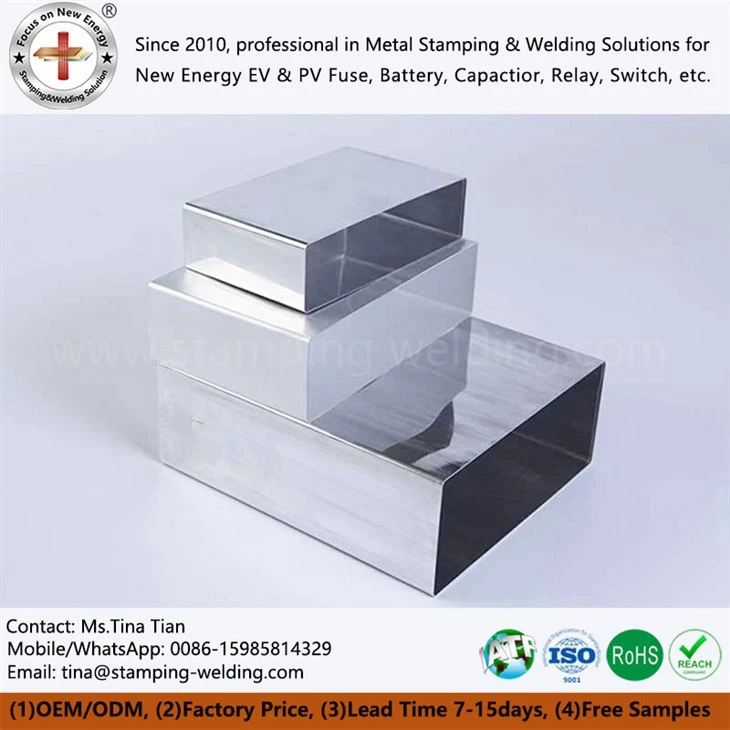
Lithium Ion Cell Aluminum Shell
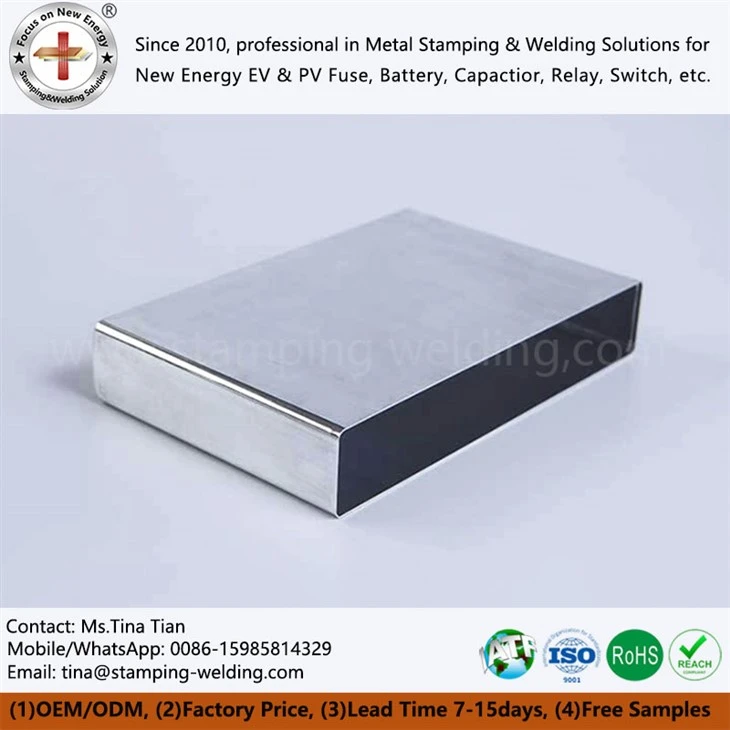
The Lithium Ion Cell Aluminum Shell is a precision aluminum alloy casing used to house prismatic lithium-ion cells, serving functions such as containing internal cell components, providing mechanical protection, ensuring sealing and isolation, and facilitating heat conduction. Unlike the packaging structure used for cylindrical batteries, prismatic cells utilize a rectangular casing to achieve a more compact spatial layout; consequently, factors such as dimensional consistency, wall thickness control, forming integrity, and the quality of subsequent welding and sealing directly impact cell assembly and the reliability of the battery system. These shells are typically manufactured from aluminum alloy sheet metal through processes including blanking, deep drawing, re-striking, trimming, and precision finishing, and are paired with a top cover and sealing process tailored to the specific cell structure and customer design requirements.
- Fast Delievery
- Quality Assurance
- 24/7 Customer Service
Product Introduction
The core function of an aluminum alloy casing for prismatic lithium batteries goes beyond merely forming a "box"; it establishes a stable foundation-within limited external dimensions-for the internal cell space, mechanical strength, and subsequent packaging processes.
Key Structural Features
Rectangular casing structure: Suited to the spatial layout of prismatic cells and customizable based on cell dimensions.
One-piece forming design: Utilizes precision forming to minimize unnecessary joining interfaces and enhance the structural integrity of the casing.
Thin-wall design capability: Optimizes material utilization while meeting structural requirements, thereby maximizing the design margin for usable internal space.
Manufacturing prismatic battery casings-through processes such as deep drawing, redrawing, and sizing-places high demands on material elongation properties and mold control capabilities; patent literature indicates that multi-stage forming processes can be employed to achieve target casing dimensions and wall thicknesses while reducing the risk of forming cracks.

Unique Design Features and Details for Customized Prismatic Battery Cell Casings
Stress-Dispersing Corner Design
Addressing the physical tendency of square battery cells to concentrate expansion forces at the mid-sidewalls and folded corners, the aluminum casing features topology-optimized corner radii. This design evenly distributes internal expansion forces, thereby mitigating cell thickness increase after assembly.
Integrated Safety Vent
The safety vent within the provided cover assembly utilizes high-precision annealed aluminum foil and laser micro-seam welding. It features a tightly controlled burst pressure range, ensuring millisecond-level, directional pressure relief during abnormal pressure events.
Anti-Creepage Terminal Structure
The terminal feed-through utilizes a dual-protection system combining injection molding and a polymer sealing ring. This effectively eliminates electrolyte leakage via capillary action along the terminal, preventing a drop in high-voltage system insulation resistance to ground.
Welding Lead-in Chamfer
The opening of the aluminum casing features a precision-engineered internal chamfer that guides the cover plate into position smoothly. This enhances lid-sealing efficiency on automated assembly lines and prevents edge-related scratches or damage.

Manufacturing Advantage for Lithium -ion Electric Bike Battery Pack: Countering "Batch-to-Batch Variability" with "Process Certainty"
| Die Life Management System | Since deep-drawing die wear is a gradual process, we utilize a die life database and a preventive maintenance mechanism to intervene proactively-addressing wear before it impacts product quality-rather than reacting only after defects appear. |
| Digitally Standardized Process Steps | Parameters such as drawing stages, thinning ratios, and annealing points for each shell type are locked in via process specifications; any changes undergo a formal review process, eliminating reliance on the subjective "craftsmanship" of individual veteran operators. |
| Defect Knowledge Base | Drawing on over a decade of accumulated data regarding defects-such as tearing, wrinkling, scratching, and pinholes-along with their root causes, we can rapidly identify anomalies during the new product trial phase and shorten the development ramp-up period. |
| Commitment to Low-Volume Orders | We support new projects and R&D-focused clients by offering low minimum order quantities and rapid changeover capabilities, ensuring that early-stage projects are not turned away due to high volume requirements. |

Frequently Asked Questions for Lithium-ion Battery Pack
1. What material is commonly used for a lithium-ion cell aluminum shell?
-
Aluminum shells for prismatic lithium batteries typically utilize aluminum alloys suitable for deep-drawing processes, such as the 3003 series; the specific alloy grade and temper are determined based on the shell structure, drawing depth, strength requirements, and subsequent welding processes.
2. Can the prismatic battery aluminum shell be customized?
-
Yes. Dimensions (length, width, height), wall thickness, corner radii, opening configurations, and specific design features can all be customized based on the client's cell structure and engineering drawings.
3. How is a prismatic lithium battery aluminum case manufactured?
-
The typical manufacturing process includes material inspection, blanking, deep drawing, multi-stage forming, sizing, trimming, cleaning, dimensional inspection, and preparation for subsequent welding. The specific process flow depends on the shell dimensions, material temper, and product structure.
4. Why is aluminum used for prismatic lithium battery cases?
-
Aluminum alloys offer a combination of low density, good thermal conductivity, corrosion resistance, and excellent formability; they meet cell packaging and structural requirements while enabling lightweight designs. Industry data indicates that aluminum alloy casings can achieve significant weight reductions compared to steel casings.
5. Can the aluminum shell be supplied according to our battery drawings?
-
Yes. For OEM/ODM projects, we conduct engineering evaluations based on client-provided 2D/3D drawings, material specifications, cell dimensions, and welding plans to finalize tooling and mass production processes.

contact us
This engineering-driven manufacturing approach is particularly well-suited for OEM projects involving new energy vehicles, energy storage systems, and other applications requiring high consistency in battery cell packaging.
If you are developing prismatic lithium battery cells and require custom aluminum alloy casings, please feel free to share your product drawings and technical specifications. We can provide engineering support and OEM manufacturing solutions covering material selection, forming processes, and welding compatibility.

Hot Tags: lithium ion cell aluminum shell, prismatic battery aluminum case, lithium battery aluminum shell, prismatic cell casing, aluminum battery case