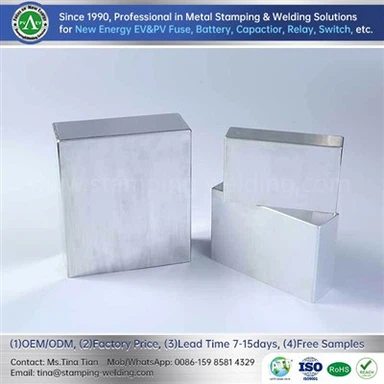


Power Battery Aluminum Square Housing
The Power Battery Aluminum Square Housing is a metal structural component designed to encase prismatic lithium-ion cells. Composed primarily of an aluminum alloy casing and a matching cover plate, it provides stable mechanical containment and external protection for the internal cell components, electrode sheets, and electrolyte. Unlike cylindrical or pouch cells, prismatic cells are arranged in a regular rectangular configuration, allowing them to align more directly with the structural layout of battery modules and packs. Consequently, the aluminum prismatic housing serves not merely as a "container" but must also meet rigorous engineering requirements regarding dimensional consistency, formability, structural strength, weldability, sealing reliability, and suitability for automated assembly.
- Fast Delievery
- Quality Assurance
- 24/7 Customer Service
Product Introduction
The prismatic aluminum alloy casing is a high-precision metal housing designed specifically for large-capacity prismatic lithium-ion cells (such as LiFePO4 and ternary NCM chemistries). Manufactured via a continuous multi-pass deep-drawing process using high-purity, corrosion-resistant aluminum alloy coils, it offers exceptional dimensional accuracy and mechanical consistency.
Lightweight Construction with High Specific Strength: For equivalent mechanical compressive strength, the aluminum alloy casing weighs only one-third as much as a traditional steel casing; this significantly reduces the cell's "dead weight," creating ample opportunity to enhance the battery pack's gravimetric energy density.
Isotropic Elongation and Welding Compatibility: The casing's microstructure is controlled through specific annealing temperature profiles to ensure highly uniform grain orientation; this facilitates stable weld pool solidification during laser penetration welding at the interface between the top cover and the casing, effectively preventing micro-hot cracking and porosity defects.
Electrochemical Inertness: The inner wall features a dense, stable natural oxide layer; combined with rigorous degreasing and cleaning processes, this ensures that no metal ion dissolution or secondary electrochemical reactions occur during long-term immersion in organic electrolytes.

Detail Showcase: A Quality Assessment from an Engineering Perspective
Lorem ipsum dolor sit amet consectetur adipisicing elit.
Micro-radius transition at the terminal post aperture
Sharp edges at the aperture have been eliminated, and precision forming ensures a uniform radius (R-angle). This guarantees even stress distribution on the sealing ring under pressure, preventing shear failure caused by localized stress concentration.
Micro-surface treatment of the laser-marking zone on the flange face
A zone with a specially treated micro-gloss finish is reserved at the bottom of the casing for marking. This ensures high-contrast, corrosion-resistant laser-engraved QR codes, enabling IATF 16949-compliant traceability across the entire lifecycle-from aluminum ingot to battery cell.
Uniformization of internal surface tension
Chemical treatment is employed to eliminate residual internal stresses generated during the deep-drawing process, preventing minute creep deformation of the casing during prolonged high-temperature operation.

Technical Characteristics and Key Functions
| Structural Load-Bearing | The casing must withstand internal gas pressure fluctuations within the cell, preload forces from module assembly, and vibrations or shocks during vehicle operation. Through optimized corner transitions, wall thickness distribution, and a reinforced top-cover structure, the thin-walled aluminum casing achieves a balance between lightweight design and deformation resistance. |
| Airtight Sealing | Electrolytes are highly sensitive to moisture and oxygen; thus, the casing's airtightness directly determines the cell's cycle life and safety performance. Laser welding, terminal sealing, and electrolyte fill-port sealing form three lines of defense against leakage; the failure of any one of these can lead to a decline in cell performance. |
| Thermal Management Path | The aluminum casing conducts heat from the cell core to the module cooling plate. Heat dissipation efficiency depends on the material's thermal conductivity, wall thickness, and the quality of the thermal interface between the casing and the cooling structure. While a thin-walled design helps reduce thermal resistance, it requires careful balancing with structural strength requirements. |
| Safety Protection | The explosion-proof valve is a critical component for cell pressure management; its rupture precision relies on material consistency and manufacturing process stability. The casing must also protect the internal cell core and separator against external impacts, thereby reducing the risk of thermal runaway propagation. |
| Electrical Insulation | Electrical isolation can be achieved on the casing surface through the use of blue PET film, anodizing, or insulating coatings. This prevents internal module short circuits while enhancing resistance to corrosion caused by electrolytes and condensation. |

Everything You Need to Know
Q1: What are the fundamental differences between aluminum and steel casings in power battery applications?
The core differences lie in three dimensions: weight, thermal conductivity, and corrosion resistance. Regarding weight, aluminum's density is only one-third that of steel, significantly contributing to higher energy density in battery systems. In terms of thermal conductivity, aluminum conducts heat about five times better than steel, facilitating rapid heat dissipation from the cells. Regarding corrosion resistance, the natural oxide film that forms on aluminum in air provides self-healing protection. While steel casings offer superior absolute strength-making them suitable for specialized conditions requiring extreme mechanical protection-aluminum casings have become the industry standard for mainstream power and energy storage applications.
Q2: What size specifications can your casings accommodate?
We offer full-range customization capabilities, spanning from small sizes for consumer electronics to large sizes for power and energy storage applications. External dimensions, wall thickness, rim structures, and internal features can all be customized based on client cell design drawings; we also support rapid prototyping and iterative validation for new products.
Q3: How do you ensure product consistency during mass production?
We employ a three-tier quality control system-comprising incoming material spectral analysis, in-line dimensional monitoring, and 100% airtightness testing for finished products-to ensure consistent wall thickness, dimensional accuracy, and sealing performance across mass-produced batches. All key process parameters are fully traceable, meeting the supply chain quality management audit requirements of automotive-grade clients.
Q4: How long does it take to develop a new aluminum casing model, from project initiation to the delivery of the first batch of samples?
The timeline depends on the complexity of the casing dimensions and the difficulty of mold development. Standard specifications allow for relatively quick mold development and sample delivery, whereas complex or irregular structures require a customized schedule based on the process review. We recommend submitting product drawings or technical specifications as early as possible so we can conduct a process feasibility assessment and plan the delivery schedule.

contact us
If you are seeking a supplier capable of developing aluminum prismatic housings for power batteries based on cell structures and engineering drawings, please send your drawings and project requirements to our engineering team. We will provide engineering solutions tailored to your project-focusing on material selection, forming, and welding process compatibility-rather than simply competing on price.

Aluminum battery housing has become the core component of the battery system of new energy vehicles with its excellent comprehensive performance. It has broad market prospects and continuous technological innovation, providing a solid material foundation for the sustainable development of electric vehicles.
Hot Tags: Power Battery Aluminum Square Housing, Square Lithium Battery Casing, Prismatic Aluminum Cell Can, Aluminum Enclosure for Battery Pack