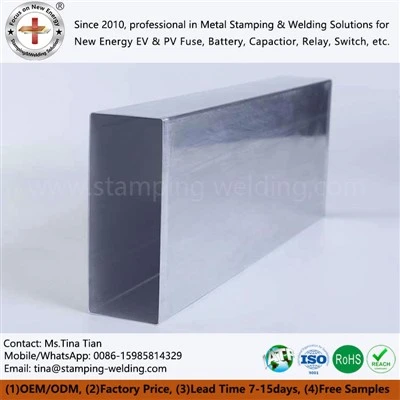


Power Battery Prismatic Aluminum Case
A Power Battery Prismatic Aluminum Case is a metal housing component designed for prismatic lithium-ion power cells and energy storage cells. It primarily consists of an aluminum alloy casing, a top cover (or lid), and associated sealing structures, providing a stable mechanical enclosure for the cell's internal components—such as electrode plates, separators, electrolyte, and current collectors. Unlike cylindrical cells, prismatic cells feature a rectangular cross-section that allows for more efficient utilization of space within the battery pack; consequently, they are widely used in power batteries for new energy vehicles, hybrid systems, energy storage cells, and other high-capacity electrochemical energy storage devices. Aluminum alloy is a common material for prismatic lithium battery casings due to its low weight, excellent formability, good corrosion resistance, and high thermal conductivity. Panasonic Energy also utilizes aluminum alloy for the external casings of its prismatic lithium-ion battery products to reduce weight compared to stainless steel casings.
- Fast Delievery
- Quality Assurance
- 24/7 Customer Service
Product Introduction
The primary function of the Power Battery Prismatic Aluminum Case is to provide a stable, sealable metal enclosure for the prismatic cell.
These products are customized based on cell architecture and customer specifications, with engineering designs and production processes tailored to specific requirements regarding:
Cell dimensions (length, width, and height)
Casing wall thickness
Opening and bottom configurations
Lid mounting methods
Electrolyte fill port location
Terminal and busbar layout
Explosion-proof/pressure relief mechanisms
Welding zones
Module assembly interfaces
Prismatic aluminum casings typically feature a thin-walled structure that minimizes weight while meeting mechanical strength and manufacturing requirements. Their rectangular shape facilitates the orderly arrangement of cells within the battery pack, thereby supporting the modular design of power battery and energy storage systems.

Application Scenarios for LiFePO4 Aluminum Case Battery Cell
New Energy Vehicle (NEV) Power Batteries
Prismatic aluminum-cased cells are the primary packaging format for BEV and PHEV powertrains; the casings must maintain structural integrity and sealing reliability under conditions involving vibration, impact, and wide temperature ranges.
Energy Storage Systems
Prismatic aluminum-cased batteries have become the mainstream choice for residential storage cabinets, commercial and industrial storage containers, and grid-side storage stations due to their high space utilization and mature manufacturing processes. Large-format casings are emerging as a key development trend for high-capacity cells.
Commercial Vehicles and Industrial Equipment
Power battery systems for electric buses, heavy-duty electric trucks, and industrial vehicles place higher demands on casing fatigue resistance and safety redundancy.

Analysis of Technical Features and Key Functions for Aluminum Laminate Pouch for Li-ion Batteries
Regarding the operational mechanics of the battery cell, the prismatic aluminum alloy casing serves several indispensable engineering functions:
High-Pressure Helium-Grade Sealing Barrier
It shields the cell's interior from external moisture ingress while preventing the evaporation of internal electrolyte and the premature leakage of gases associated with thermal runaway. The laser-welded seam between the casing and the cover plate undergoes rigorous helium leak testing, achieving a leak rate far superior to industry standards.
External Mechanical Impact Protection
During rigorous safety tests-such as nail penetration, crush, and drop tests-the high-strength aluminum casing effectively resists penetration by sharp external objects. This provides critical response time for the internal Current Interrupt Device (CID), preventing direct short circuits that could trigger uncontrollable thermal runaway.
Dimensional Stability Maintenance
The casing must maintain its rigidity and resist deformation under the high-pressure pre-load applied during module assembly. Our rigid casing design ensures cell consistency within the battery pack and prevents increased interfacial thermal resistance caused by casing deformation.

Frequently Asked Questions for EV Battery Pouch Cell Aluminum Case
1. What material is commonly used for prismatic battery aluminum cases?
-
Aluminum or aluminum alloys are typically used for prismatic lithium battery casings; the specific alloy grade is selected based on factors such as forming requirements, mechanical properties, welding characteristics, and cell design. Alloys such as 3003, 3004, and 5052 are commonly used in prismatic battery structures.
2. Can the prismatic aluminum case be customized according to battery cell dimensions?
-
Yes. Battery casings are highly customized structural components; OEM development can be tailored to specific customer requirements regarding cell length, width, height, wall thickness, opening configuration, cover plate design, and welding structure.
3. What manufacturing processes are used for prismatic battery cases?
-
Depending on the specific structure, processes such as stamping, deep drawing, trimming, sizing, cleaning, cover plate assembly, and laser welding may be employed. Complex, deep-cavity structures may require multiple forming stages.
4. Why is aluminum widely used for prismatic lithium battery cases?
-
Aluminum alloys offer low density, excellent formability, and good thermal conductivity, and are well-suited for the welding processes required in battery construction; additionally, they help reduce the overall weight of the cell packaging structure.
5. Can you develop battery cases based on customer drawings?
-
Yes. We can conduct DFM (Design for Manufacturability) analysis based on customer-provided 2D drawings, 3D models, or samples, and carry out engineering development covering materials, tooling, forming, welding, and mass production.

contact us
If you are developing new prismatic power battery or energy storage cells, please submit your 2D/3D drawings and engineering specifications. We will provide an engineered solution for prismatic aluminum battery cases-focusing on forming, welding, dimensional consistency, and mass-production manufacturability-rather than simply competing on price.

We use advanced continuous stamping technology to produce aluminum battery shells. Continuous stamping technology is an efficient and precise processing method that can greatly improve production efficiency, reduce production costs, and ensure product consistency and high quality.
Hot Tags: Power Battery Prismatic Aluminum Case, Lithium Battery Aluminum Enclosure, Deep Drawn Aluminum Battery Can