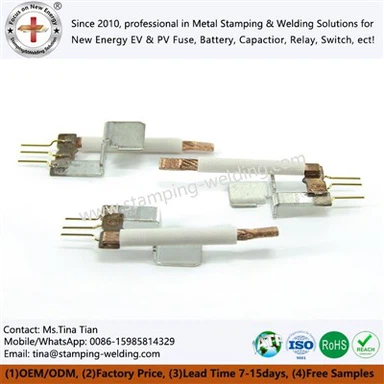
Fuse Contacts: The Unsung Guardians Of Electrical Systems
May 03, 2025
Introduction to Fuse Contacts
In the intricate world of electrical systems, fuse contacts play a crucial yet often overlooked role. Serving as the essential connection points within fuses, these components are vital for establishing and maintaining electrical pathways while also providing a critical line of defense against electrical faults. End Cap and Contact, commonly known as fuse blades or contact caps, are the interface between the fuse and the electrical circuit, ensuring that the fuse can effectively protect the system from overcurrent, short circuits, and other potentially hazardous conditions.

Working Principle of Fuse Contacts
The operation of the End Cap and Contact is closely intertwined with the overall function of a fuse. When an electrical circuit is operating normally, the fuse contacts provide a low-resistance pathway for the electric current to flow through the fuse and into the circuit. These contacts are designed to maintain a secure and stable connection, minimizing electrical resistance and preventing energy losses due to poor contact.
However, when an abnormal current condition occurs, such as an overload (where the current exceeds the rated capacity of the circuit) or a short-circuit (where electricity takes an unintended, low-resistance path), the fuse element inside the fuse heats up rapidly. As the temperature of the fuse element rises, it eventually reaches its melting point and melts, breaking the electrical circuit. During this process, the Fuse Cap and Contact play a crucial role in ensuring that the circuit is effectively interrupted. They must maintain their structural integrity while allowing the fuse element to separate cleanly, preventing arcing and ensuring that the fault is isolated from the rest of the electrical system.
Key Performance Advantages
Electrical Conductivity
One of the primary requirements for Fuse Cap and Contact is excellent electrical conductivity. Materials used for Copper Cap and Fuse Knife, such as copper, brass, or other conductive alloys, are chosen for their ability to allow electric current to flow with minimal resistance. High - conductivity contacts ensure that the fuse can operate efficiently, reducing the risk of overheating due to excessive resistance and enabling the fuse to respond quickly to abnormal current conditions.
Thermal Stability
End Cap and Contact must also exhibit good thermal stability. When a fuse blows, a significant amount of heat is generated in the vicinity of the contacts. They need to withstand these high temperatures without deforming, melting, or losing their electrical conductivity. This thermal stability is essential for maintaining the integrity of the contact connection and ensuring that the fuse can perform its protective function reliably, even under extreme conditions.
Mechanical Durability
Mechanical durability is another important characteristic of End Cap Contact. They are subjected to various mechanical stresses during the installation, operation, and replacement of fuses. These stresses include vibrations, shocks, and the force applied when inserting or removing the fuse. Copper Cap and Fuse Knife must be able to withstand these forces without breaking, bending, or becoming loose, as a compromised contact can lead to electrical failures and pose a safety risk.

Types of Fuse Contacts
Blade-Type Fuse Contacts
Blade-type caps and Contacts are one of the most common types. They have a flat, blade-like shape that fits into corresponding slots in the fuse holder. This design provides a secure and easy - to - use connection, making it convenient for installing and replacing fuses. Blade-type contacts are widely used in automotive electrical systems, as well as in many household and industrial applications where quick and simple fuse replacement is required.
Screw-In Fuse Contacts
Screw - in Cap and Contact, as the name implies, are inserted into the fuse holder by screwing them in place. This type of contact offers a more secure connection compared to some other designs, as the screw mechanism ensures a tight fit. Screw - in fuse contacts are often used in applications where a higher level of stability is needed, such as in electrical panels and some industrial equipment.
Bolt-Down Fuse Contacts
Bolt-down fuse contacts are attached to the fuse holder using bolts. This provides a very robust and reliable connection, capable of handling high currents and heavy-duty applications. Bolt-down contacts are commonly found in large-scale electrical systems, such as power plants, substations, and heavy industrial machinery, where the stability and reliability of the fuse connection are of utmost importance.
Applications of Fuse Contacts
Copper End Caps and End Cap Contact are used in a wide range of electrical applications. In the automotive industry, they are essential for protecting various electrical components, including the engine control unit, lighting systems, and entertainment devices. A faulty End Cap Contact in a car can lead to electrical malfunctions, such as a dead battery, non - working headlights, or a malfunctioning audio system.
In household electrical systems, Cap and Contact play a crucial role in safeguarding appliances and electrical circuits. They protect devices like refrigerators, washing machines, and televisions from power surges and electrical faults. In industrial settings, Copper Cap and Fuse Knife are used to protect expensive machinery, motors, and control systems, ensuring the continuous and safe operation of manufacturing processes.

Maintenance and Considerations
Regular maintenance of Cap and Contact is important to ensure their proper functioning. Periodic inspections should be carried out to check for signs of wear, corrosion, or loose connections. Corrosion can increase electrical resistance and reduce the performance of the contacts, so it's important to clean any corroded contacts using appropriate electrical contact cleaners.
When replacing fuses, it's essential to ensure that the new fuse has the correct type and size of contacts for the fuse holder. Using an incorrect fuse with incompatible contacts can lead to poor electrical connections, overheating, and potentially dangerous situations. Additionally, care should be taken during fuse installation and removal to avoid damaging the contacts, as even minor damage can affect their performance.
In conclusion, Copper Cap and L-Type Terminal are an essential and integral part of electrical systems. Their role in establishing reliable electrical connections and protecting circuits from faults cannot be overstated. Understanding the working principles, types, applications, and maintenance requirements of Cap and Contact is crucial for ensuring the safety, efficiency, and reliability of electrical systems in various settings.
contact us