Fuse Inner And Outer Caps: Precision Protective Components in The Field Of New Energy And Photovoltaics
Mar 23, 2025
In new energy vehicles (EV) and photovoltaic (PV) systems, fuses are the core guardians of circuit safety. The material selection and process design of their inner and outer cap components directly affect the reliability and life of the equipment. This article focuses on the Brass Inner Cap of EV Fuses, the Brass Inner Cap of PV Fuses, the Copper Outer Cap of EV Fuses, and the Nickel-plated Outer Cap of PV Fuses, and analyzes their technical characteristics and application scenarios.

1. Product classification and material characteristics
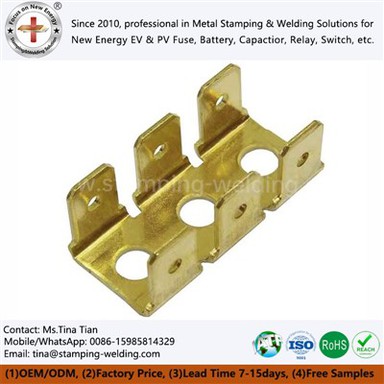
1. Brass Inner Cap
Material advantages: High-purity brass (CuZn37 or similar alloys) is used, which has excellent conductivity (conductivity ≈ 11.6 MS/m) and corrosion resistance, and is suitable for hot and humid environments.

Process design: Precision stamping, the surface roughness Ra ≤ 0.8μm, to ensure a close fit with the fuse tube, contact resistance < 5mΩ.
Application scenarios:
EV fuse: Suitable for 800V high-voltage platform, withstanding short-circuit current impact (100kA@1ms), in line with IATF 16949 certification.
PV fuse: Anti-ultraviolet aging (QUV test 5000 hours yellowing index <3), suitable for 1500V DC system, meeting UL 248-19 standard.
2. Copper Outer Cap
Material properties: T2 pure copper (purity> 99.95%), conductivity> 58 MS/m, thermal conductivity 401 W/(m·K), supporting large current transmission (above 300A).

Surface treatment: Chromium-free passivation process (RoHS 3.0 compliant), salt spray test> 720 hours, to prevent electrochemical corrosion.
Structural design: Thread interface accuracy ±0.02mm, suitable for IP67 protection level, supporting fast installation and maintenance.
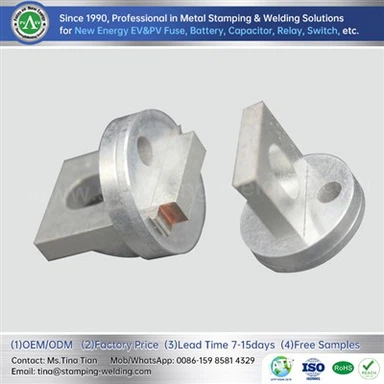
3. Nickel-plated Outer Cap
Process Advantage: Chemical nickel plating (thickness 5-15μm) forms a uniform protective layer, hardness HV 500-600, and wear resistance life is increased by 3 times.
Environmental adaptability: -40℃~+125℃ wide temperature range stability, anti-sulfurization pollution (ASTM B809 test passed), suitable for high corrosion scenarios such as seaside photovoltaic power stations.
Electrical performance: Contact impedance <10mΩ, fuse response time <10ms, in line with IEC 60269-6 photovoltaic special standard.

2. Application scenario analysis
| Component type | EV fuse application | PV fuse application |
| Brass inner cap | Battery pack overcurrent protection (200-500A) | String fuse (10-32A) |
| Copper outer cap | Motor controller short-circuit protection (800V platform) | Combiner box main fuse (100-300A) |
| Nickel-plated outer cap | On-board charger (OBC) protection | Photovoltaic inverter DC side (1500V system) |
EV field: The combination of brass inner cap and copper outer cap achieves lightweight (single cap weight <20g) and high reliability, and supports fast charging cycles of battery packs (more than 2000 times). A mass production solution shows that the thermal conductivity design of the copper outer cap reduces the temperature rise of the fuse by 15% and extends the service life by 20%.
PV field: The weather resistance of the nickel-plated outer cap solves the corrosion problem of long-term outdoor exposure of photovoltaic modules. Combined with the low impedance of the brass inner cap, it guarantees the system's 25-year design life. Data shows that the failure rate of nickel-plated outer caps in coastal power stations is 60% lower than that of ordinary materials.

3. Technology trends and innovation directions
1. Material upgrade
Composite coating: The surface of the brass inner cap is coated with a nano-silver coating (thickness 0.5-1μm), and the contact resistance is reduced by 30%, which is suitable for high-frequency switching scenarios.
Environmental protection process: Cyanide-free nickel plating technology (in compliance with SAE J2636), wastewater treatment costs are reduced by 40%, and meet EU REACH regulations.
2. Structural optimization
Three-dimensional simulation design: Through ANSYS electrothermal coupling analysis, the heat dissipation fin structure of the cap body is optimized, and the consistency of the fuse time is improved to ±5%.
Integrated design: The outer cap has a built-in temperature sensor (accuracy ±0.5℃) to achieve fault warning and adapt to the needs of smart grids.
3. Standardization and testing
Certification system: EV fuse caps must pass ISO 26262 functional safety certification, and PV caps must meet IEC 61646 photovoltaic module safety standards.
Extreme testing: Reliability tests such as high temperature and humidity (85℃/85%RH, 1000 hours) and low-temperature shock (-40℃~+125℃, 500 cycles) have become standard.

Conclusion: Small components, great safety
Although the inner and outer caps of fuses are small components, they are the "safety gates" of new energy and photovoltaic systems. From material selection to process innovation, from single function to intelligent integration, its technological evolution has always revolved around the core needs of "reliability, efficiency, and durability". In the future, with the continuous expansion of the new energy industry, the combination innovation of brass, copper, nickel plating, and other materials will be further deepened, promoting the development of fuse components towards high power density, long life, and intelligence.
contact us