Evolution Of Copper Busbar Technology: Power Transmission Innovation Driven By Material Innovation And Surface Treatment
Mar 22, 2025
In modern power systems, copper busbars are the core carrier of power distribution, and their performance directly affects equipment reliability and energy efficiency. This article focuses on four categories: Bare Copper Busbars, Riveted Nut Copper Busbars, Tinned Copper Busbars, and Nickel-plated Copper Busbars, analyzing their material properties, process advantages, and application scenarios, revealing the industry's technological development trends.

1. Bare copper busbars: basic conductive solutions
Bare Copper Busbars are based on T2 copper (purity ≥ 99.95%), retaining the natural conductivity of the metal. Its resistivity is as low as 0.017Ω·mm²/m, and its current carrying capacity is outstanding. It is suitable for dry and clean indoor environments, such as switch cabinets and transformer internal connections. Although bare copper is easily oxidized in the air, the mechanical seal formed by bolt tightening (torque control ±5%) in low-voltage complete sets of equipment can isolate the oxidizing medium, and the contact resistance is stable at <100μΩ. Studies have shown that the initial oxide layer (thickness <1μm) can improve the heat dissipation efficiency by 14%, and the radiation heat dissipation accounts for 15%, which has unique advantages in temperature rise control. Typical applications include distribution cabinet busbars and industrial equipment grounding systems, and the cost is 15%-20% lower than that of surface-treated products.

2. Riveted Nut Copper Busbar: Structural Optimization Integrated Design
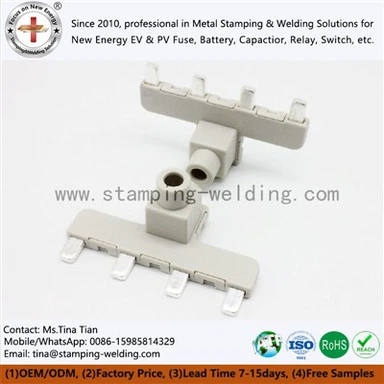
Riveted Nut Copper Busbar integrates the nut at the end of the busbar through a cold forming process to achieve "free welding + fast assembly". Its core advantages:
1. Standardized interface (M4-M12 specifications), assembly efficiency increased by 40%;
2. Thread shear strength >80MPa, loosening risk reduced by 70% in a vibration environment;
3. Adapt to a variety of installation scenarios and support vertical/horizontal fixation. The process uses CNC punching + hydraulic riveting, with a hole position accuracy of ±0.1mm and a surface roughness of Ra≤3.2μm.
It is mainly used in new energy storage cabinets and data center PDUs (power distribution units) to meet modular and rapid deployment requirements.

3. Tin-plated copper busbar: a balance between corrosion resistance and weldability
Tin-plated copper busbars use an electrochemical tinning process (tin layer thickness 5-15μm), and the salt spray test is >1000 hours. It is suitable for humid and salt spray environments (such as coastal substations and new energy vehicle battery compartments). The uniformity of the tin layer (CV value <5%) ensures welding consistency, the tinning time is shortened by 30%, and the contact resistance is <50μΩ. Technological breakthroughs include chromium-free passivation treatment (compliant with RoHS 3.0) to avoid electrochemical corrosion.
Typical applications: electric vehicle battery module connection (-40℃~+85℃ wide temperature range), photovoltaic inverter busbar, the current carrying capacity is increased by 10% compared with bare copper busbars, and the service life is extended to more than 15 years.

4. Nickel-plated copper busbar: Special application with high reliability
Nickel-plated copper busbar achieves triple performance improvement through electroplating nickel layer (thickness 8-20μm):
1. Hardness HV ≥ 180, wear resistance is 3 times that of bare copper, suitable for sliding connection scenarios (such as drawer cabinet connectors);
2. High-temperature oxidation resistance (stable below 300℃), meeting the temperature rise requirements of high-frequency switch equipment;
3. Electromagnetic shielding effectiveness> 60dB, adapted to the anti-interference requirements of precision electronic equipment. The bonding strength between the nickel layer and the copper substrate is> 5N/cm, and the salt spray test is> 1500 hours.
Main applications: rail transit traction systems, aerospace power distribution devices, and industrial equipment with strict requirements for wear resistance and corrosion resistance.

5. Application scenarios and process comparison
| Type | Core advantages | Typical application scenarios | Cost coefficient* | Temperature range (℃) |
| Bare copper busbar | High conductivity, low cost | Indoor distribution cabinet, transformer connection | 1.0 | -20~+100 |
| Riveted nut copper busbar | Quick assembly, stable structure | Energy storage cabinet, data center PDU | 1.2 | -40~+120 |
| Tinned copper busbar | Corrosion-resistant, easy to weld | New energy vehicles, coastal substations | 1.5 | -50~+150 |
| Nickel-plated copper busbar | High wear resistance, high-temperature oxidation resistance | Rail transit, aerospace | 2.0 | -60~+200 |
*Based on bare copper busbar, comprehensive material and process costs
contact us