Technical Innovation Of Flexible Busbars For New Energy Vehicles: A Connection Revolution Driven By High Voltage And Integration
Mar 22, 2025
Against the background of the rapid development of the new energy vehicle industry, flexible busbars, as the core carrier of power transmission, are undergoing a technological leap from traditional rigid connections to high flexibility and high integration. Its innovative application in battery systems, electric drive modules, and high-voltage power distribution has become a key factor in supporting the popularization of 800V platforms and the implementation of CTC (Cell to Chassis) technology. This article focuses on the material process, application scenario, and industry trends of flexible busbars, and analyzes how it reconstructs the electrical architecture of new energy vehicles.
1. Technological breakthrough: the coordinated evolution of materials and processes
The core advantage of Flexible Copper BusBars comes from the integration of multi-layer metal structures and insulation technologies:
1. Conductor material innovation
Adopting T2 pure copper foil (thickness 0.05-0.3mm) laminated design, metallurgical bonding is formed through vacuum diffusion welding, and the conductivity is >98%IACS. Surface treatment technology (such as chrome-free tin plating and nano-silver coating) improves corrosion resistance, salt spray test exceeds 1000 hours, and adapts to a wide temperature range of -40℃~+150℃.

2. Process upgrade
Die-cutting technology: Replaces traditional chemical etching, copper material recovery rate is increased to 98%, production efficiency is increased by 25%, and ultra-long size customization of more than 2 meters is supported, breaking through the length limit of traditional processes.
Three-dimensional weaving process: Ultra-fine copper wire (diameter 0.05mm) is woven into a mesh structure, with a bending radius of <3mm and a vibration fatigue life of more than 10⁶ times, solving the problem of complex space wiring and stress release.
3. Insulation and integrated design
Apply halogen-free silane cross-linked polyethylene (XLPE) or polyimide (PI) insulation layer (oxygen index > 34) to achieve a withstand voltage level of more than 10kV. Integrated solutions (such as busbar + capacitor + sensor) shorten the signal path, reduce the stray inductance to less than 10nH, and adapt to the high-frequency switching requirements of SiC devices.
2. Application scenarios: Deep penetration of new energy three-electric system
1. Battery pack interconnection (CCS module)
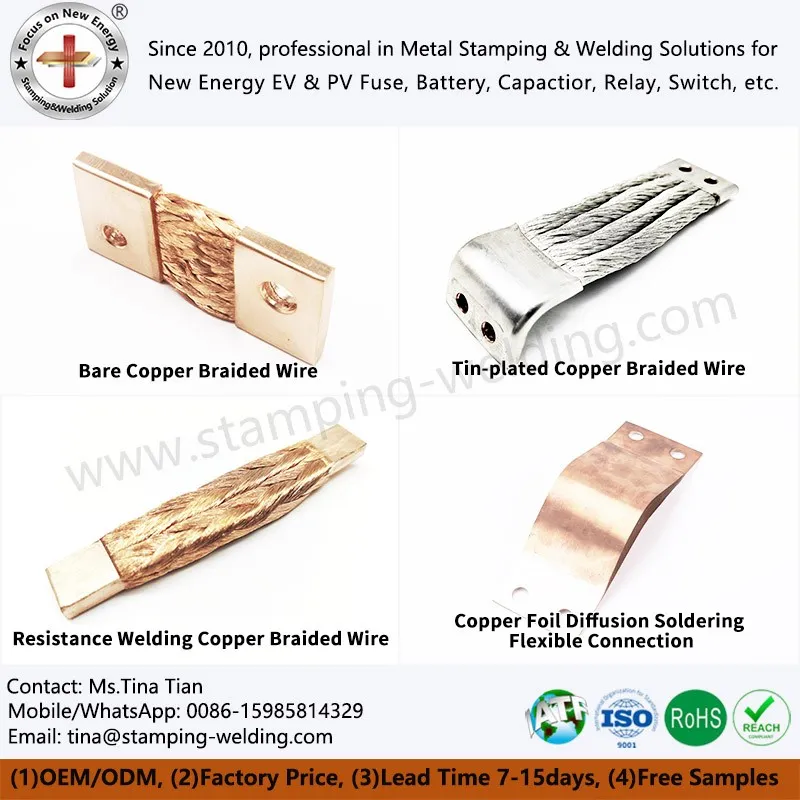
In cylindrical/square/soft-pack cells, Copper Foil Diffusion Soldering Flexible Connections realize series-parallel connection and voltage collection. The multi-layer copper foil structure reduces internal resistance (<2mΩ), supports 4C supercharging, and cooperates with die-cutting process optimization to increase space utilization by 35%. A mass production plan shows that the 1.8-meter ultra-long busbar is produced by roll-to-roll, and the cost is 20% lower than that of traditional FPC.
2. Electric drive system integration
Inverter busbar: The laminated design integrates DC input, IGBT module, and AC output, with a current carrying capacity of 1000A, a 40% reduction in inductance, and supports power transmission of more than 500kW. The insulation layer is temperature resistant to 125℃ and meets IP67 protection requirements.
Motor stator connection: The flexible phase-to-phase connector adapts to the deformation of the hairpin winding, and the vibration resistance level reaches 30m/s². With the resin support material, it ensures 10⁷ times fatigue life.
3. High-voltage power distribution (PDU)
The integrated Laminated Flexible BusBar integrates multi-circuit connections, integrates NTC temperature sensors and voltage sampling modules, and realizes 2-meter ultra-long distance high current transmission (>2000A). The weight is 40% lighter than the cable solution, and the assembly efficiency is increased by 50%.

3. Industry trends: market explosion and technology iteration in parallel
1. Market size
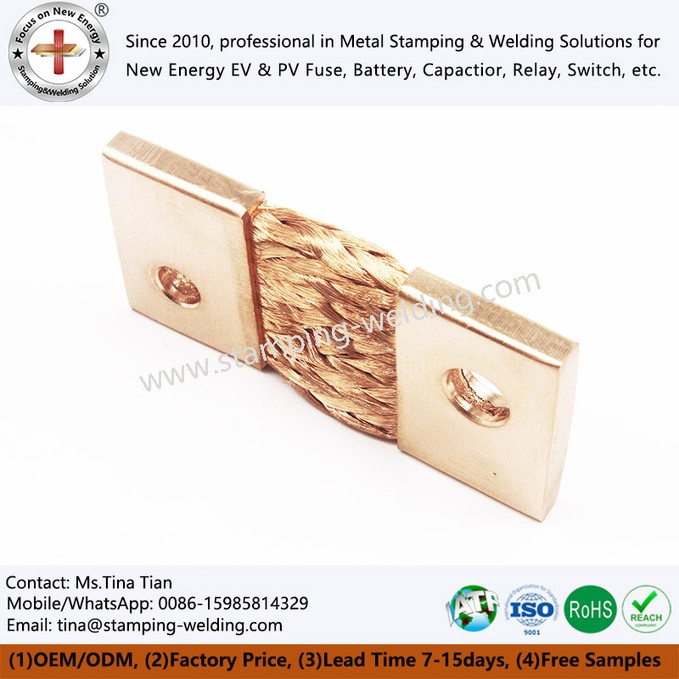
According to industry data, the global new energy vehicle Bare Copper Braided Wire market size will reach US$1.687 billion in 2024 and is expected to exceed US$6.2 billion in 2031, with an annual compound growth rate of 21%. China accounts for more than 40% of the global share, becoming a concentrated area of technological innovation and production capacity.
2. Process upgrade direction
Material composite: Copper-aluminum dissimilar metal welding technology (such as stir friction welding) reduces weight by 15% and costs by 12%, meeting lightweight requirements.
Smart manufacturing: Digital twin technology is applied to Resistance Welding Copper Braided Wire design, shortening the R&D cycle by 40%; AI visual inspection achieves a welding defect detection rate of 99.97%.
3. Sustainable development
Environmental protection processes such as chromium-free passivation and phytic acid treatment are popularized, and the busbar recycling rate exceeds 95%. Carbon footprint certification (ISO 14067) has become an export standard, and the circular economy model has gradually been implemented.
4. Future Outlook: Integration and scenario extension
1. Technology integration
Cooperation with energy storage system: Flexible busbar supports parallel connection of multiple modules in energy storage containers, adapts to extreme environments of -40℃~+60℃, and voltage uniformity error is less than 1.5%.
Vehicle-road collaborative application: 10Gbps Ethernet busbar connector realizes the integration of vehicle Ethernet and high-voltage system, supporting ADAS high-speed signal transmission.
2. Emerging Scenarios
Aerospace: Titanium alloy reinforced Bare Copper Braided Wire meets the vibration resistance (GJB 150.16A) and lightweight requirements of C919 large aircraft.
Deep-sea equipment: A 10MPa water pressure resistant busbar is used for submarine cable connection, and the insulation level reaches IEEE 45.
3. Standards and Ecosystem Construction
The national standard "Technical Specifications for Flexible Conductive Connections for Electric Vehicles" intends to clarify 12 indicators such as temperature rise and fatigue life to promote industry standardization. Enterprises are accelerating the layout of the "busbar + intelligent operation and maintenance" ecosystem, realizing predictive maintenance through digital platforms, and reducing the system failure rate by more than 30%.
Conclusion: The "flexible backbone" of new energy electrical architecture
The technical evolution of flexible Copper busbars is essentially a deep integration of material science, manufacturing technology, and automotive engineering. When 3D printed busbars achieve 0.03mm ultra-thin molding, and when copper-aluminum composite technology breaks through the weight and cost bottlenecks, this "invisible component" is becoming the core support for the performance upgrade of new energy vehicles. With the popularization of the 800V platform (penetration rate exceeding 30% in 2025) and the explosion of energy storage installed capacity (exceeding 100GWh in 2026), the flexible busbar industry will usher in a dual breakthrough in technology and market. In the future, building the full-chain competitiveness of "materials-processes-standards" and deepening automotive-grade certification and scenario innovation will be the key for companies to seize the global market. Under the guidance of the dual carbon goals, flexible busbars are reshaping the future of power connections in the new energy era with their "rigid and flexible" characteristics.
contact us