Key Considerations For Copper Foil Laminated Flexible BusBars Specification Selection
Jun 14, 2026
With the rapid development of the new energy industry, the performance requirements for conductive connectors in fields such as photovoltaic power generation, wind power energy storage, new energy vehicles, charging piles and battery energy storage systems continue to upgrade, and various types of flexible conductive copper bar products have become core accessories for electrical systems. Among them, Copper Foil Laminated Flexible BusBars are widely used in various new energy electrical equipment scenarios due to their excellent conductivity and adaptability. Scientific and reasonable specification selection is the key to ensuring the long-term safe, stable and efficient operation of electrical systems. Industry selection needs to comprehensively consider multiple core factors such as electrical load bearing, mechanical performance, heat dissipation and insulation, environmental adaptation and installation adaptation, and accurately match the corresponding product model based on actual working conditions.

Current carrying capacity
Current carrying capacity is a core indicator for selecting flexible copper busbars in the new energy sector, directly determining the safety and stability of equipment operation. The core function of flexible copper bars is to conduct current. When selecting a model, the load requirements must be accurately calculated based on the equipment's rated current, and the appropriate conductive cross-sectional area should be calculated using the industry-standard current density of 3-5 A/mm². This approach aims to prevent overheating and overload failures at the source. To accommodate the current fluctuations in new energy equipment operation, a 20%-30% safety margin should be reserved during selection to ensure stable output under peak current conditions. This selection logic also applies to high-current dedicated flexible copper busbar products such as those used for high current voltage, fully meeting the usage requirements of high-voltage, high-current new energy applications.
Mechanical flexibility
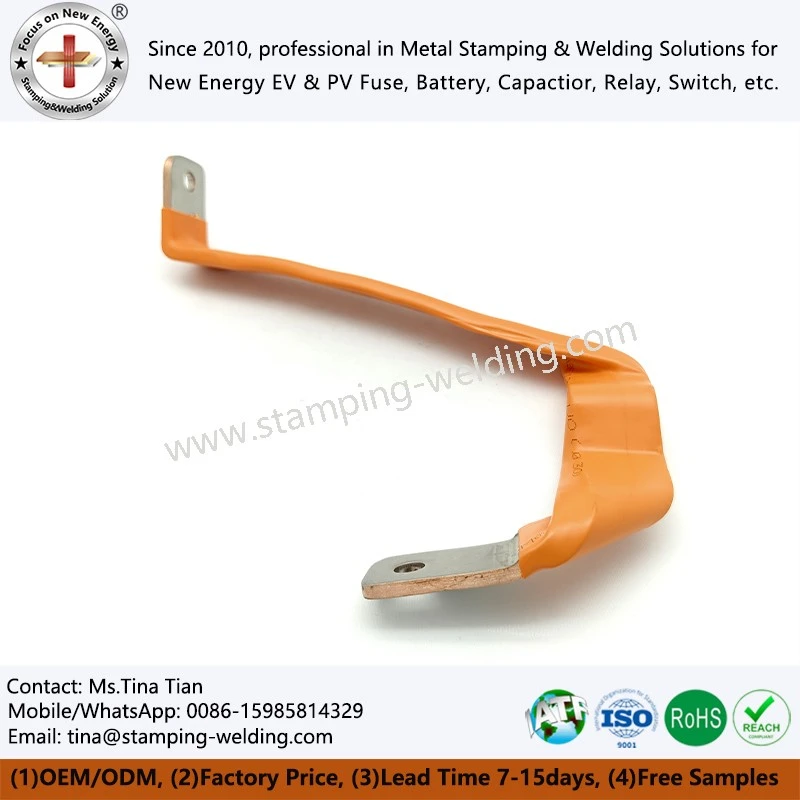
Mechanical strength and flexibility are crucial evaluation criteria for flexible copper busbar connections under new energy operating conditions. New energy equipment typically operates at high frequencies, experiences vibrations, and requires minor structural adjustments, placing high demands on the flexibility, tensile strength, and vibration resistance of copper bars. High-quality flexible copper bars optimize structural performance through multi-layer copper foil composites and multi-strand copper braiding processes. This allows them to adapt to displacement and bending adjustments during equipment operation, exhibiting excellent bending performance, while ensuring no deformation or breakage under high-intensity conditions. In the field of new energy vehicle power batteries, the Flexible Copper Foil Bus Bar for EV Battery Packs, with its flexibility to adapt to battery module vibrations and deformations, has become the preferred accessory for connecting vehicle power batteries, effectively adapting to complex dynamic operating conditions.

Heat dissipation and temperature rise control
Temperature rise control and heat dissipation performance are crucial for mitigating electrical faults and extending equipment lifespan. Copper busbars generate heat during conduction, and the higher the operating current and ambient temperature, the more critical temperature rise management becomes. When selecting a copper bar, the specifications must be matched to the equipment's long-term operating temperature and ambient ventilation conditions. Under high-current and high-temperature conditions, large-section, reinforced laminated copper bar structures should be prioritized to reduce temperature rise by increasing the heat dissipation area. In inverter equipment applications, Laminated Copper Bar for Inverter and Copper Inverter Laminated Busbar, with their optimized laminated heat dissipation structure, effectively adapt to the high-frequency heating conditions of inverters, ensuring continuous and stable equipment operation.
Insulation environment adaptation
Insulation protection and environmental adaptability determine the long-term service stability of copper busbar flexible connections. New energy equipment is often deployed in complex environments such as outdoors, humidity, and high temperatures, making the outer insulation structure of the copper bar crucial. Mainstream products in the industry use high-temperature and corrosion-resistant insulating materials such as PVC, silicone, and special rubber to achieve laminated copper insulation protection, effectively preventing safety hazards such as short circuits and leakage. Simultaneously, the protection level must be matched to the deployment environment; for outdoor humid and dusty scenarios, products with high protection levels such as IP67 and IP68 should be selected. For the corrosion and aging resistance requirements of outdoor scenarios such as photovoltaics and wind power, customized silver plated copper flexible busbars with surface treatments such as tin plating and silver plating can significantly improve the product's oxidation and corrosion resistance, resisting material aging and loss caused by ultraviolet radiation and high-temperature environments.
Overall Selection Summary
Overall, the selection of specifications for Copper Foil Laminated Flexible BusBars in new energy systems is not a simple matter of matching single parameters, but rather a comprehensive systemic approach that considers electrical requirements, mechanical conditions, environmental conditions, equipment compatibility, and cost control. From basic Copper Foil Laminated Bar Soft Connection products to specialized products adapted to specific scenarios such as motors, batteries, inverters, and vehicle power distribution, such as Copper Foil Flexible Bar for Motor Battery Accessories and Laminated Connector for Electrical Equipment, only by selecting products that closely align with actual application scenarios and strictly adhere to technical specifications can the performance advantages of flexible laminated copper busbars be fully realized, laying a solid foundation for the safe, stable, and efficient operation of new energy electrical systems.
Contact Us
If you need precise matching of the Copper Foil Laminated Flexible BusBars specifications according to actual working conditions, or to solve the problem of copper busbar selection and adaptation for new energy equipment, please feel free to consult us for professional customized selection and matching solutions.