


The Critical Role Of EV Fuse Contact Cap
May 14, 2025
As electric vehicles (EVs) continue to evolve, so too does the technology that supports their performance, safety, and reliability. One often overlooked but critical component in an EV's high-voltage system is the EV fuse contact cap, also referred to as the fuse end cap or fuse knife cap. This small component plays a significant role in ensuring safe and efficient operation of the vehicle's electrical protection system.
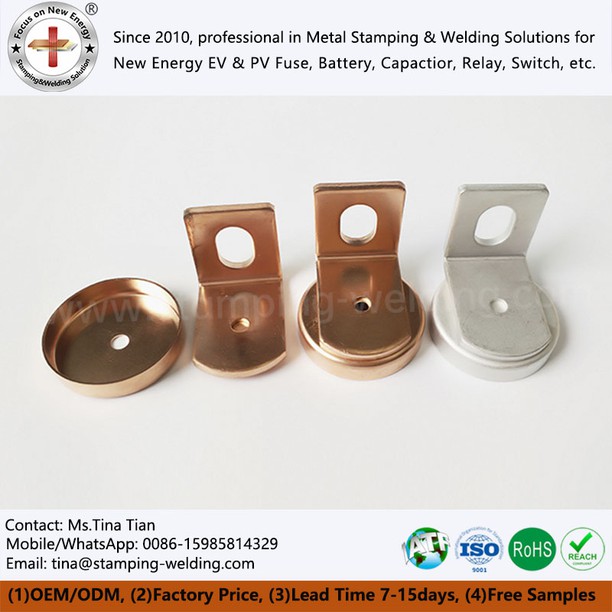
What is an EV Fuse Contact Cap?
The EV Fuse Contact Knife Cap is a metallic terminal piece typically found at both ends of a high-voltage fuse used in electric vehicles. Its primary function is to provide a secure electrical connection between the fuse element and the corresponding circuit terminals. It also facilitates effective heat dissipation and mechanical stability under demanding conditions.
Key Functions
Electrical Conduction
The contact cap ensures minimal resistance at the connection point, allowing high current to flow efficiently through the fuse. Good conductivity is essential to prevent localized heating or voltage drops.
Mechanical Stability
Designed to withstand vibrations and thermal expansion during vehicle operation, the cap secures the fuse body to prevent disconnection or misalignment.
Heat Dissipation
In high-current applications, managing temperature is crucial. The contact cap helps dissipate the heat generated within the fuse, reducing the risk of thermal damage or premature aging.
Material Considerations
EV fuse contact caps are generally made from high-conductivity metals such as:
Copper or Copper Alloys
Often used due to its excellent electrical conductivity. May be silver- or tin-plated to enhance corrosion resistance.
Nickel-Plated Materials
Provide improved durability and oxidation resistance, especially under high-temperature conditions.
Material selection is guided by the following factors
1. Electrical Conductivity
High electrical conductivity is essential to minimize resistive losses and prevent local overheating during operation. Materials with low resistivity, such as copper (Cu) and copper alloys, are commonly preferred. These materials ensure efficient current flow through the EV fuse contact caps, reducing power loss and enhancing the overall efficiency of the high-voltage system.
2. Thermal Conductivity
Efficient heat dissipation is crucial in high-current circuits, where fuses may experience elevated temperatures during normal or fault conditions. Materials with high thermal conductivity help distribute heat away from the fuse element, reducing thermal stress and extending service life.
3. Corrosion and Oxidation Resistance
EV environments often expose components to high humidity, temperature fluctuations, and potentially corrosive gases. The selected material must resist oxidation and surface corrosion to maintain electrical integrity over time.
4. Mechanical Strength and Formability
The contact cap must endure mechanical stress from assembly processes (e.g., crimping, welding), vibration during vehicle operation, and thermal expansion. Therefore, the base material should offer.

Design features
1. Surface Plating:
To improve corrosion resistance and contact reliability.
2. Crimping or Welding Zones:
Designed for integration with fuse bodies and terminals via crimping, laser welding, or resistance welding.
3. Dimensional Precision:
Tolerances must be tight to ensure compatibility with fuse holders and connectors, especially in automated assembly lines.

Application Scenarios in EVs
EV Fuse Cap and Contacts are used in high-voltage fuses that protect critical components such as:
Battery packs
The battery pack is the heart of an EV, storing and supplying the electrical energy needed for propulsion and other functions. High-voltage fuses protect the battery pack from overcurrent events that could damage the cells or cause thermal runaway.
A typical fuse used in a battery pack might have a rated voltage of 500V DC and a rated current of 100A. It ensures that in the event of a short circuit or overcurrent, the fuse will blow, disconnecting the battery pack from the circuit and preventing potential hazards such as overheating or fire.
On-Board Chargers (OBC)
The OBC allows the EV to be charged using AC power from an external charging infrastructure. It converts AC to DC and supplies it to the battery. Fuses with contact caps in this subsystem provide protection from Input surges during charging, Internal faults in the power conversion circuit.
Given the confined space and thermal constraints within OBCs, the contact cap must have compact dimensions, tight tolerance fit, and high reliability under repeated thermal cycling.
DC-DC converters
The electric drive system, including the inverter and the electric motor, converts electrical energy into mechanical energy to drive the vehicle. Fuses protect these components from overcurrent and short-circuit faults, preventing damage to the motor and inverter.
A fuse used in the electric drive system might have a rated current of 150A and a rated voltage of 600V DC. It ensures that the inverter and motor operate safely, even during high-power demands such as acceleration or hill climbing.
DC-DC converters
In each of these applications, fuses act as a safety device. When the current exceeds the rated value, the fuse element melts, breaking the circuit and preventing damage to expensive and critical components.
Short-Circuit Protection:
Fuses provide immediate protection in the event of a short circuit. By interrupting the current flow, they prevent excessive heating, potential fires, and damage to the vehicle's electrical system.
Compliance with Safety Standards:
The use of fuses ensures that the vehicle meets safety standards and regulations, providing a reliable and safe driving experience for the user.
In these circuits, a failure to isolate faults quickly and reliably could lead to equipment damage, fire hazards, or safety system failures. Therefore, the performance of the contact cap directly affects vehicle safety.
future trends
With the push toward higher voltage platforms (800V systems and beyond), the demand for fuse components that can withstand higher temperatures, currents, and switching stresses is increasing. Advancements in cap design focus on: Improved arc management, Better thermal performance, and Smaller form factors to support compact system integration.
Though small in size, the Fuse Cap and Contacts are a vital part of the electrical safety system in new energy vehicles. By ensuring reliable electrical connections, mechanical integrity, and thermal management it plays an essential role in protecting the high-voltage systems that drive modern EVs.
Contact us


