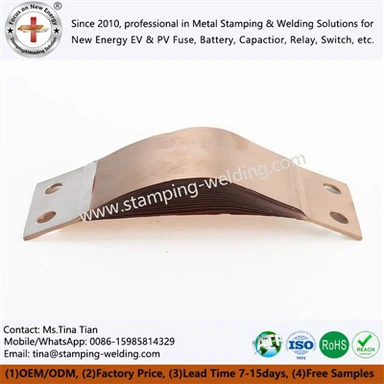


Copper Foil Flexible Busbar Connectors
Copper Foil Flexible Busbar Connectors are flexible conductive connectors made of multi-layer high-purity copper foil as the base material and using a diffusion welding process. They are mainly used in high-voltage, high-current electrical systems to connect rigid bars to terminals of various electrical equipment. This flexible busbar can compensate for installation deviations and buffer equipment vibration, and is widely used in new energy vehicles, energy storage systems, power distribution cabinets, and industrial power equipment to ensure safe and stable power transmission.
- Fast Delievery
- Quality Assurance
- 24/7 Customer Service
Product Introduction

Copper Foil Flexible Busbar Connectors are flexible conductive connectors made of multiple layers of high-purity copper foil laminated together using a diffusion bonding process. They are specifically designed for use in new energy battery systems, power electronic equipment, and high-power inverters where vibration and displacement absorption, thermal expansion compensation, or electrical connections in confined spaces are required. These connectors typically feature welded or crimped rigid copper terminals at both ends to ensure reliable connections to busbars, capacitors, or power modules.
Structural advantages
Layered Structure: Balancing Current Carrying Capacity and Flexibility
The Multi-Layer Bending Power Electrical Busbar utilizes 5-50 layers of high-purity copper foil, balancing high current transmission with bending capability. It buffers stress from vibration and thermal expansion, preventing copper foil fatigue fracture and adapting to dynamic operating conditions.
Diffusion Soldering for Enhanced Conductivity
The copper foil is molecularly fused using diffusion soldering, eliminating interlayer resistance, resulting in uniform conductivity, lower temperature rise, and effectively avoiding overheating and arcing issues, ensuring long-lasting and reliable operation for Copper Foil Flexible Busbar For Rail Transit.
Modular Terminals for Enhanced Adaptability
The Copper Foil Flexible Storage Energy Battery Busbar's terminal styles and sizes can be customized to match various equipment interfaces. The rigid-flexible structure provides ample strength and compensates for installation errors, offering excellent assembly compatibility.

Precautions for use
Correct Selection
Choose the appropriate number of layers and terminal treatment based on the system's maximum operating current, ambient temperature, and vibration level. Prolonged overload operation is strictly prohibited, as it will accelerate copper foil oxidation and increase resistance for Copper Foil Busbar.
01
Installation Specifications
Avoid applying torsional force to the flexible parts of the Copper Foil Flexible Busbar Connectors. Refer to the terminal specifications for bolt tightening torque: 8–10 N·m for M6 terminals and 15–18 N·m for M8 terminals. Use anti-loosening washers or thread-locking adhesive.
02
Regular Inspection
In applications with high vibration, check the Copper Flexible BusBars for Lithium Battery's terminal bolt torque and the copper foil surface for cracks every 6 months. Infrared thermal imaging can be used to monitor the temperature rise at the connection points (temperature difference should be ≤10℃ relative to the busbar).
03
Avoid Overheating
The upper limit of the operating temperature for copper foil flexible connectors is typically 125℃ (tin-plated terminals) or 200℃ (nickel-plated terminals). If the ambient temperature exceeds 85℃, reduce the Copper Foil Multi-Layer Welding Busbar's rated current or increase active cooling.
04

Frequently Asked Questions
Why are multi-layer copper foil used in flexible busbars instead of single-layer thick copper?
Single-layer thick copper sheets have extremely poor flexibility and are prone to metal fatigue and fracture under long-term vibration conditions. Multi-layer copper foil lamination structures balance high current carrying capacity with bending flexibility, adapting to dynamic conditions such as vibration and displacement.
How is the number of copper foil layers determined during project selection?
The number of copper foil layers is mainly determined by the system's long-term operating current, peak current, and ambient temperature. Higher current and higher ambient temperature require more copper foil layers to increase the conductive cross-sectional area and reduce temperature rise.
Can copper foil flexible busbars be used in high-temperature, humid, and corrosive environments?
Bare copper versions are suitable for normal dry conditions; for high humidity, salt spray, and corrosive environments, customized surface insulation and anti-corrosion treatments can be applied to improve environmental adaptability and service life.
What faults can improper installation cause?
Excessive bending and pulling can cause copper foil fatigue fracture; loose terminal fasteners can increase contact resistance and cause local overheating; unclean contact surfaces can lead to unstable power transmission, and in severe cases, can induce equipment overload and short circuit faults for Copper Laminated Flexible Busbars.

Contact Us
If you require customized specifications for Copper Foil Flexible Busbar Connectors based on your working conditions, or if you would like to consult on technical parameters and project requirements, we can provide a customized solution and quote. We look forward to your inquiry.

Hot Tags: copper foil flexible busbar connectors, China, manufacturers, suppliers, factory