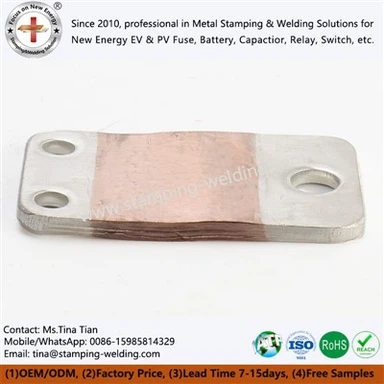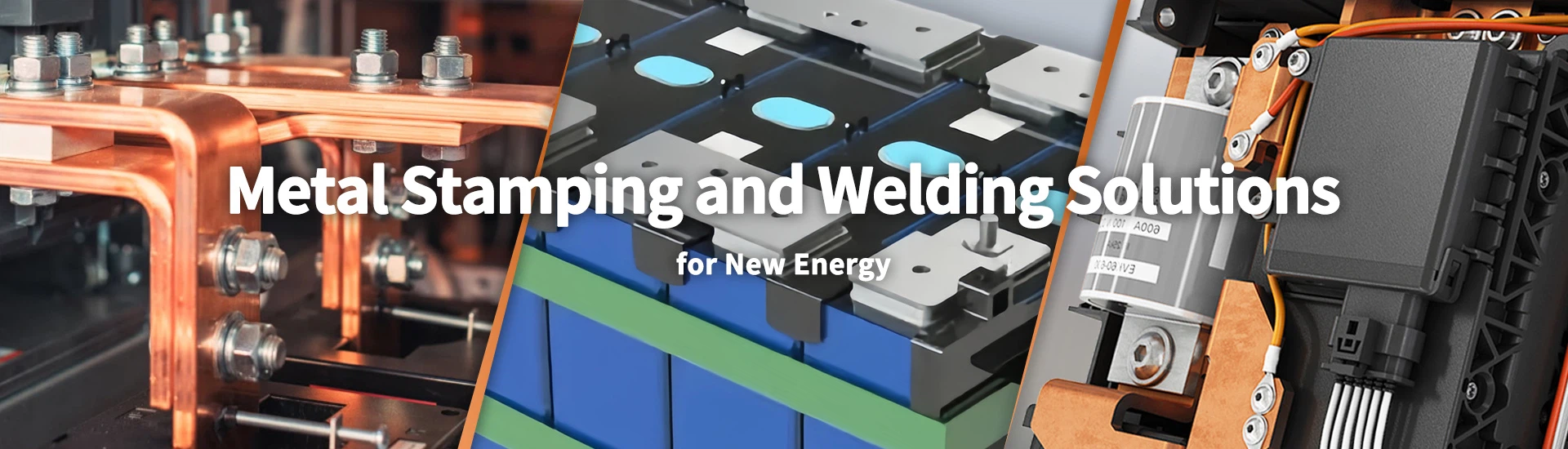


Flexible Copper Foil Bus Bar For EV Battery Packs
Flexible Copper Foil Bus bar for EV Battery Packs—also known in the industry as "copper foil flexible connectors" or "laminated copper foil busbars"—are highly flexible conductive components formed by bonding multiple layers of high-purity rolled copper foil using a diffusion welding process. Combining the high current-carrying capacity of rigid copper busbars with the flexible, compensatory properties of braided cables, these components serve as a critical element for electrical connections within new energy vehicle (NEV) power battery modules, as well as between battery packs, high-voltage power distribution units (PDUs), and electric drive systems.
- Fast Delievery
- Quality Assurance
- 24/7 Customer Service
Product Introduction
When selecting components for engineering projects, procurement and R&D teams often weigh the merits of three types of conductors:
Rigid copper busbars: These offer excellent electrical conductivity and current-carrying capacity, but lack flexibility. They cannot absorb vibrations or thermal expansion/contraction, require high assembly precision, and tend to transmit mechanical stress to battery cell terminals and weld joints.
Power cables: These are flexible and easy to route, but they occupy significant space, provide limited surface area for heat dissipation, exhibit higher parasitic loop inductance, and present challenges in ensuring reliable terminal connections.
Flexible copper foil busbars: Featuring a "thin and wide" design, these components balance electrical conductivity, flexibility, heat dissipation, and flatness. They serve as an optimal, well-rounded solution for applications-such as battery packs-that demand high current handling within compact, vibration-prone environments.
For battery packs, the true value of flexible busbars extends beyond mere current conduction; they function as stress buffers and tolerance-absorption units for the system. This is the fundamental reason for their widespread adoption.

Manufacturing Advantage: Diffusion Bonding as a Core Competitive Barrier
The primary challenge in producing flexible copper foil connectors lies not in the "stacking" process, but in the "welding" phase. We employ a solid-state diffusion bonding process, which facilitates the interdiffusion of atoms between multiple layers of copper foil under controlled pressure and at temperatures below the melting point of copper, resulting in a metallurgical-grade bond. The key advantages include:
Near-Zero Contact Resistance
Unlike brazing or riveting, diffusion bonding requires no filler materials and leaves no interfacial inclusions. The entire stack of copper foils functions as a single, monolithic unit, ensuring no heat generation or oxidation during long-term high-current operation.
No Spatter or Deformation
As a solid-state process, it involves no molten metal; the thickness of the copper foils and the flatness of the end surfaces remain intact, ensuring high precision during assembly and mating.
Integrated Terminal Formation
The welding zone and the terminal (whether a stamped copper terminal or one formed via direct rolling) are bonded in a single operation, reducing the number of assembly steps and potential points of failure.

Material Advantages for Copper Foil Laminated Flexible Bus Bars
Conductor Material
Made from high-conductivity annealed copper (T2 / C11000 grade). It features a fine grain structure and excellent ductility, ensuring resistance to cracking during bending and maintaining a stable temperature rise under long-term electrical load.
Foil Consistency
Incoming material is verified by batch for thickness tolerance, surface cleanliness, and oxidation status, preventing localized thin spots that could lead to excessive current density.
Surface Treatment
Options include bare copper passivation, tin plating, or nickel plating-balancing solderability and oxidation resistance while ensuring long-term stability of contact resistance during assembly.
Insulation Materials
Available options include PET wrapping, heat-shrink tubing, insulating spray coatings, or localized insulating sheets, meeting requirements for voltage withstand, creepage distance, and flame retardancy.

Frequently Asked Questions for Flexible Copper Foil Multi Layer Thin Sheet
Q1: How should one choose between flexible copper foil connectors, rigid copper busbars, and braided copper straps?
-
A: Rigid copper busbars are preferred for high-current applications where space is sufficient, and displacement is minimal. Flexible copper foil connectors are the better choice when dealing with assembly tolerances, thermal expansion, or vibration-induced displacement. While braided copper straps offer greater flexibility, their cross-sectional utilization and current-carrying density are generally lower than those of laminated foil structures. We recommend that your engineering team evaluate the selection based on current-carrying requirements, expected bending cycles, and available installation space.
Q2: How should a welding method be selected, and does it affect performance?
-
A: Ultrasonic metal welding is suitable for most thin-foil laminated structures, as it results in minimal heat-affected zones and stable electrical resistance. Resistance welding and diffusion welding offer advantages under specific thickness and current-carrying conditions. The choice depends on the total thickness of the laminate, the dimensions of the weld zone, and temperature-rise requirements. We establish standardized parameters for each product family and conduct spot checks on weld joint quality.
Q3: Can terminals and insulation configurations be customized according to my drawings?
-
A: Yes. Hole patterns, hole spacing, edge profiles, and terminal configurations can all be customized. We also offer insulation options such as PET wrapping, heat-shrink tubing, or spray-on coatings. During the drawing review phase, we provide feedback on manufacturability and potential assembly interference.
Q4: What inspections are performed before delivery?
-
A: Standard inspections include dimensional and geometric tolerance checks, visual inspection (including burr checks), and DC resistance testing. Upon request, we can also perform high-voltage withstand, tensile strength, temperature-rise, vibration, and salt-spray testing. Inspection records and batch traceability information are provided with every shipment.
Q5: What is the typical timeline for samples and mass production?
-
A: We generally begin with samples to verify dimensions and electrical performance. Once confirmed, we proceed to small-batch production and the ramp-up to full-scale mass production. The specific timeline depends on the complexity of the structure, surface treatment, and insulation requirements; these milestones can be confirmed during the inquiry stage.

contact us
If you are defining technical specifications for flexible copper busbars used in battery module interconnects or power distribution nodes, we prefer to begin by analyzing your vibration profiles, thermal cycling curves, installation envelopes, and interface plating requirements. Our engineering team will then design the optimal cross-section and flexible segment configuration, ensuring a robust process window that guarantees consistent quality across volume deliveries. This commitment to engineering collaboration-prioritizing technical alignment before providing a quote-is the clear distinction that sets us apart from suppliers who compete solely on price.

Hot Tags: Flexible Copper Foil Busbar for EV Battery Packs, Flexible Copper Foil Busbar, EV Battery Busbar, Copper Foil Flexible Connector, Flexible Copper Busbar Manufacturer, Custom Copper Foil Connector
No Information