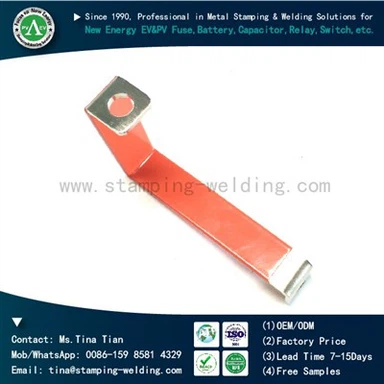


Epoxy Powder Coating Copper Busbars
While standard bare copper busbars offer excellent electrical conductivity, they are ill-suited for environments characterized by high humidity, dust, or vibration, and they fail to meet insulation requirements between adjacent conductors. Traditional solutions—such as heat-shrink tubing or dip-coating—often fall short in terms of coating uniformity, heat dissipation efficiency, and long-term aging performance. Epoxy Powder Coating Copper Busbars were developed specifically to address these challenges. By applying an epoxy insulating layer onto a high-conductivity copper substrate via electrostatic powder spraying followed by high-temperature curing, a dense and uniform coating is formed. This process preserves the copper’s inherent low impedance and mechanical strength while providing reliable electrical insulation, surface protection, and environmental resilience. Consequently, these busbars have become essential connection components in UPS systems, server power modules, and power distribution units within data centers.
- Fast Delievery
- Quality Assurance
- 24/7 Customer Service
Product Introduction
Epoxy powder-coated copper busbars consist of high-purity copper conductors uniformly coated with a thermosetting epoxy resin powder, which is then cured at high temperatures to form an insulated, conductive composite busbar.
Integrated, sleeve-free design: This approach eliminates the drawbacks associated with traditional heat-shrink tubing-such as wrinkling, cracking, or uneven thickness at complex bends-by providing comprehensive, seamless coverage.
Exceptional space adaptability: With a coating thickness precisely controlled at the scale of several hundred microns, this solution significantly increases the clearance and creepage distances between busbars without substantially increasing their overall physical footprint.
Superior thermal conductivity and heat dissipation: Despite providing robust electrical insulation, the epoxy powder coating maintains high thermal conductivity, ensuring efficient heat dissipation even during high-current operation.

Key Functions and Application Advantages: Why the UPS and Server Industries Prefer Copper Busbars at Coating
Space Optimization
By replacing heat-shrink tubing and insulating barriers, the coating allows for reduced spacing between busbars, providing structural engineers with more layout flexibility within compact enclosures.
01
Assembly Efficiency
Busbars arrive ready for installation, eliminating the labor-intensive tasks of applying sleeves or insulation sheets on-site and removing the inconsistencies inherent in manual assembly.
02
Safety Compliance
The coating functions as solid insulation within insulation coordination calculations, providing a traceable chain of evidence regarding materials and processes for full-system certification.
03
Reliability
The dense, seamless coating eliminates common failure modes associated with heat-shrink tubing-such as moisture ingress at the ends or cracking due to aging-making it ideal for power supply environments in data centers that require long-term, maintenance-free operation.
04
Consistency
The powder-coating process offers superior batch-to-batch consistency compared to manual insulation methods, making it well-suited for the high-volume, high-speed production requirements of the UPS and server power supply industries.
05

Key Technical Features
| Control of Coating Thickness and Uniformity | Through rigorous management of pre-treatment cleanliness and the precise alignment of electrostatic parameters with curing profiles, the coating thickness-across both flat surfaces and bent sections-is maintained within specified ranges. This prevents risks such as dielectric breakdown in overly thin areas, as well as defects like sagging or bubbling in areas where the coating is too thick. |
| Edge and Sharp-Corner Coverage | Since inner bend radii and punched edges are prone to thin coating, process parameters are optimized-supplemented by specific edge treatments-to ensure continuous coverage. This minimizes the risk of partial discharge and electrical breakdown. |
| Selective Masking of Contact Surfaces | Areas designated for bolting, crimping, or welding can be masked according to technical drawings. This keeps the metal exposed, ensuring proper contact resistance and assembly reliability, while also preventing the coating from fracturing under the pressure of mechanical fastening. |
| Bending Precision and Stress Management | Bend radii, angles, and spring-back are controlled in strict accordance with design specifications. Post-bending stress-relief treatments are applied to mitigate the risk of long-term deformation and potential cracking of the coating. |
| Verification of Insulation Performance | Prior to shipment, products undergo comprehensive testing-including withstand voltage, insulation resistance, adhesion (cross-cut/pull-off tests), coating thickness, and visual inspection-to meet project requirements. Additional environmental validation, such as salt spray, damp-heat, and thermal cycling tests, can also be performed upon customer request. |

Frequently Asked Questions for Powder Coated Bus Bars
1. What are the primary advantages of epoxy powder-coated copper busbars compared to those insulated with heat-shrink tubing?
-
Epoxy powder coating forms a continuous insulating layer that bonds tightly to the copper surface. It offers more uniform thickness and a more precise, consistent profile. In compact spaces, this solution typically outperforms heat-shrink tubing in terms of both routing efficiency and heat dissipation, while also providing superior resistance to moisture and mechanical damage.
2. Is this product suitable for high-power connections within UPS units?
-
Yes. This product is specifically optimized for UPS and server power supply applications. It provides reliable insulation while maintaining low-impedance electrical conductivity, making it well-suited for power distribution both within modules and at the cabinet level.
3. Will the coating crack or peel after the busbar is bent or drilled?
-
Through high-quality manufacturing processes-which carefully account for bend radii and the placement of holes-and by precisely controlling surface pretreatment, spraying parameters, and curing cycles, we ensure that the coating remains firmly adhered even after the busbar is shaped. Specific designs can be verified against your technical drawings.
4. Is it possible to leave specific areas of bare copper exposed for connections?
-
Yes. Depending on your assembly requirements-such as bolting, welding, or crimping-we can mask specific areas prior to the coating process. This ensures comprehensive insulation coverage while maintaining reliable, conductive contact surfaces.
5. How can I determine if the product is compatible with my existing UPS or server cabinet structure?
-
We recommend providing key parameters such as current rating, available installation space, connection methods, and environmental conditions. Based on this information, we can evaluate the cross-sectional design and coating specifications. We also provide samples for validation to ensure a seamless fit with your existing infrastructure.

contact us
If you are developing custom Copper Busbar Powder Coating or server power systems, please submit your product drawings and electrical requirements. The Apollo engineering team can provide manufacturing solutions covering busbar structure, machining precision, coating processes, and assembly compatibility.

Hot Tags: Epoxy Powder Coating Copper Busbars, Epoxy Coated Copper Busbar, Powder Coated Copper Busbar, Insulated Copper Busbar