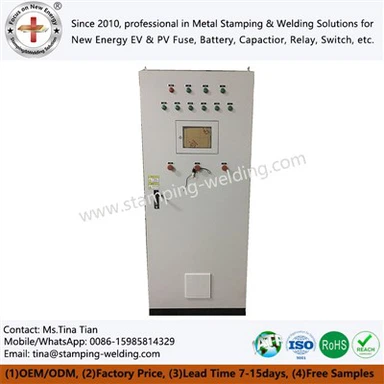


Modular Distribution Cabinets
Compared to traditional fixed-type power distribution cabinets, modular distribution cabinets place greater emphasis on the independent configuration of functional units, the rational allocation of internal space, and ease of future expansion. Different circuits can be arranged in designated zones based on load type, protection requirements, and control needs, which streamlines the installation, inspection, and maintenance of electrical systems. In industrial facilities, commercial buildings, data centers, new energy systems, and infrastructure projects, power distribution equipment often must handle multiple supply circuits while meeting specific protection, isolation, and management requirements for various loads. A modular design enables engineering teams to tailor cabinet dimensions, functional units, and internal electrical layouts to the specific needs of a given project—overcoming the limitations of rigid, fixed structures that often struggle to adapt to diverse project requirements.
- Fast Delievery
- Quality Assurance
- 24/7 Customer Service
Product Introduction
Modular distribution cabinets are a type of complete low-voltage power distribution equipment, characterized by a "standardized components + engineered assembly" approach:
Structural Standardization: Components such as uprights, crossbeams, door panels, side panels, and top/bottom covers are designed based on a unified modular system, ensuring high interchangeability and universal spare parts.
System Configurability: Busbar systems, incoming/outgoing feeder units, and protection units can be plugged in and combined according to specific requirements, allowing for flexible adjustment of the number of circuits.
Integrated Protection: The entire cabinet is built to a defined ingress protection (IP) rating, providing resistance against dust, splashes, and the entry of foreign objects, making it suitable for various installation environments.
Factory Pre-fabrication: The cabinet framework, busbars, and internal components are pre-assembled in a factory setting; on-site work is limited to wiring and final securing, which significantly reduces on-site installation time.
Positioned between "standardized cabinets" and "fully custom-built cabinets," this solution balances the efficiency gained through standardization with the adaptability offered by customization.

high distribution cabinet Features: Four Key Values of a Modular Architecture
Functional Unitization
Each drawer unit or fixed compartment handles an independent circuit. In the event of a fault, it can be isolated for maintenance while the system remains energized-ensuring that adjacent circuits continue to operate and significantly enhancing overall system availability.
Built-in Expandability
The cabinet structure is designed with reserved mounting slots and space for busbar extensions. Future capacity upgrades do not require replacing the entire cabinet; instead, new modules can simply be inserted-a highly advantageous feature for commercial and industrial projects with uncertain load requirements.
Standardized Interfaces
Electrical connections, communication interfaces, and mechanical positioning are all designed according to unified specifications. Every drawer unit is interchangeable and can serve as a backup, thereby reducing the burden of maintaining spare parts inventory.
Prefabricated Delivery
Before leaving the factory, each cabinet undergoes component installation, secondary wiring, and simulated power-on testing. Comprehensive test records are provided with the shipment, offering a reliable basis for on-site acceptance.

Design Advantages for Fiber Distribution Hub Cabinet
Thermal Design Integration
Airflow paths and ventilation zones are planned based on the placement of heat-generating components, preventing heat accumulation near protective devices.
01
Electromagnetic and Routing Design
Power and signal circuits are routed in separate zones to minimize coupling interference, while also providing pathways for future intelligent system expansions.
02
Ergonomics
Controls, viewing windows, and maintenance access areas are positioned to align with natural operational postures; frequently accessed circuits can be reached without the need to remove adjacent components.
03
Design for Manufacturability (DFM)
Bending processes, assembly sequences, and cumulative tolerances are considered during the design phase to ensure that what is feasible on paper is also practical to assemble.
04
Design Consistency
Standardized component definitions and documentation conventions are applied across a product series, ensuring uniformity in appearance, circuit layout, and labeling logic for multi-site deployments.
05

Frequently Asked Questions for Intelligent Distribution Cabinet
Q1: What are the main differences between Electrical Cable Distribution Box Cabinets and traditional fixed-type distribution cabinets?
-
A: Modular systems break down functions into standardized units that can be installed or replaced independently, allowing for flexible future expansion and rapid maintenance. In contrast, traditional fixed-type cabinets have relatively rigid configurations, often requiring extensive reconfiguration if modifications are needed.
Q2: Is it necessary to replace the entire cabinet for future expansion?
-
A: Generally, no. Provided there is available space for additional modules and sufficient busbar capacity, you can expand functionality by adding or replacing modules while continuing to use the existing cabinet frame.
Q3: How much does replacing a module affect other circuits?
-
A: A well-designed modular structure allows for the independent removal and installation of individual modules, minimizing the scope of any power outages. The actual impact depends on circuit interdependencies and operational procedures; it is advisable to define isolation and switching logic during the planning phase.
Q4: Are these cabinets suitable for high-humidity or dusty environments?
-
A: Cabinets can be selected with appropriate ingress protection (IP) ratings and sealing measures to suit the installation environment. The components housed within the modules must also be selected and protected in accordance with the overall environment; please specify your operating conditions when submitting an inquiry.
Q5: What should be prioritized when evaluating samples or small-batch units?
-
A: Focus on the ease of module insertion and the reliability of the locking mechanism, accessibility of terminals, clarity of labeling, continuity of grounding, and the adequacy of space for actual wiring and operation-all evaluated in the context of your specific installation environment.

contact us
If you are developing modular power distribution equipment that requires specific enclosure dimensions, internal mounting structures, and precision sheet metal components, we invite you to submit your engineering drawings and technical specifications. Leveraging our extensive experience in sheet metal fabrication, structural component manufacturing, and OEM project collaboration, Xiamen Apollo can provide comprehensive engineering support-from structural assessment to prototype development-for your products.

Hot Tags: Modular Distribution Cabinets, Modular Distribution Cabinet, Modular Electrical Distribution Cabinet, Modular Power Distribution Cabinet