Aluminum Busbar vs. Copper Busbar in EV Battery Modules: Weight Savings, Ampacity, and Cost Trade-offs
Oct 09, 2026
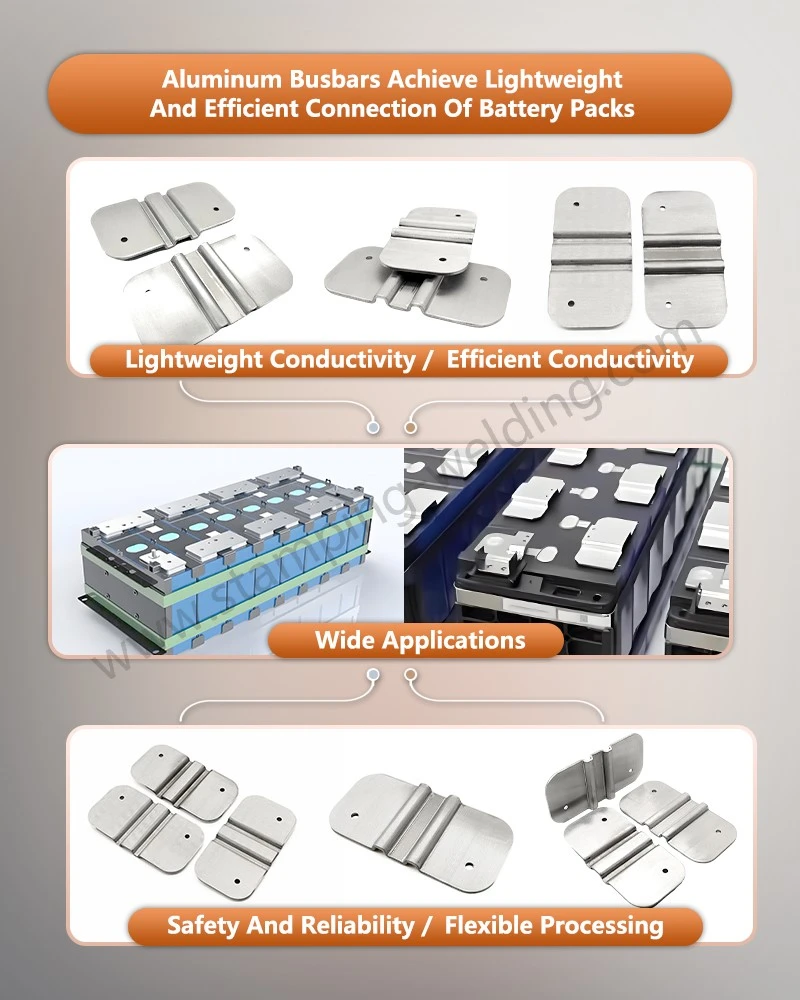
Aluminum Busbar can reduce conductor mass and material costs in electric vehicle (EV) battery modules, but require careful evaluation of conductivity, temperature rise, joint resistance, and corrosion protection. Commercially pure aluminum has approximately 61% IACS conductivity, compared with approximately 100% IACS for standard high-conductivity copper. The final choice depends on electrical performance, installation space, manufacturing requirements, and total component cost.
Aluminum vs. Copper Busbar: Key Material Differences
Material selection affects conductor dimensions, battery pack weight, forming processes, and connection reliability. C1100 copper, 1060 aluminum, and 6061 aluminum offer different combinations of conductivity, strength, and formability.
|
Property |
C1100 Copper | 1060 Aluminum | 6061 Aluminum |
|---|---|---|---|
| Density | Approx. 8.9 g/cm³ | Approx. 2.70 g/cm³ | Approx. 2.70 g/cm³ |
| Electrical conductivity | Approx. 100% IACS | Typically above 60% IACS | Generally lower than 1060 |
|
Main advantage |
High conductivity | Low mass and high conductivity among aluminum grades | Higher structural strength in suitable tempers |
| Main consideration | Higher density and material cost | Larger cross-section may be required | Conductivity and forming behavior depend on temper |
For equal conductor length and comparable DC resistance, aluminum may require approximately 1.6 times the copper cross-sectional area. Despite the larger area, its lower density can result in a conductor mass roughly 50% lower under simplified room-temperature assumptions.
Actual savings depend on geometry, operating temperature, joint design, and thermal conditions. Engineers must validate the complete assembly rather than compare materials by density alone.
Ampacity, Temperature Rise, and Battery Pack Weight
The current-carrying capacity of an EV battery busbar depends on conductor cross-section, current duty, ambient temperature, cooling conditions, insulation, and connection resistance.
For initial sizing, conductor resistance can be estimated using:
R=ρL/A
where R is resistance, ρ is electrical resistivity, L is conductor length, and A is cross-sectional area.
A larger aluminum cross-section can compensate for its higher resistivity, but engineers must also evaluate:
- Continuous and peak current requirements.
- Temperature rise under representative operating cycles.
- Joint resistance at bolted or welded interfaces.
- Available installation space and insulation clearances.
- Mechanical loads from vibration and thermal expansion.
Weight savings at battery pack level will be smaller than the percentage reduction in busbar mass. For example, if busbars account for 2% of pack mass and their mass is reduced by 50%, the total pack mass decreases by approximately 1%, assuming other components remain unchanged.
Aluminum Busbar Plating and Corrosion Protection
Aluminum naturally forms a stable oxide film that can interfere with electrical contact. For battery applications, surface preparation and interface design are important to maintaining low contact resistance.
A qualified plating process may include:
- Degreasing and surface cleaning.
- Controlled oxide removal and pretreatment.
- Zincate treatment where required by the selected process.
- Copper or nickel underplating where specified.
- Tin plating or another approved surface finish.
- Coating inspection and electrical contact validation.
The appropriate process depends on alloy, geometry, plating chemistry, and application requirements. Tin plating can support selected contact applications, but does not eliminate all corrosion risks. Aluminum-to-copper connections require assessment of galvanic corrosion, moisture exposure, contact pressure, and coating integrity.
Recommended validation may include coating-thickness measurement, adhesion testing where applicable, four-wire joint-resistance measurement, and temperature-rise testing under defined conditions.
Request an Aluminum Busbar Design Review
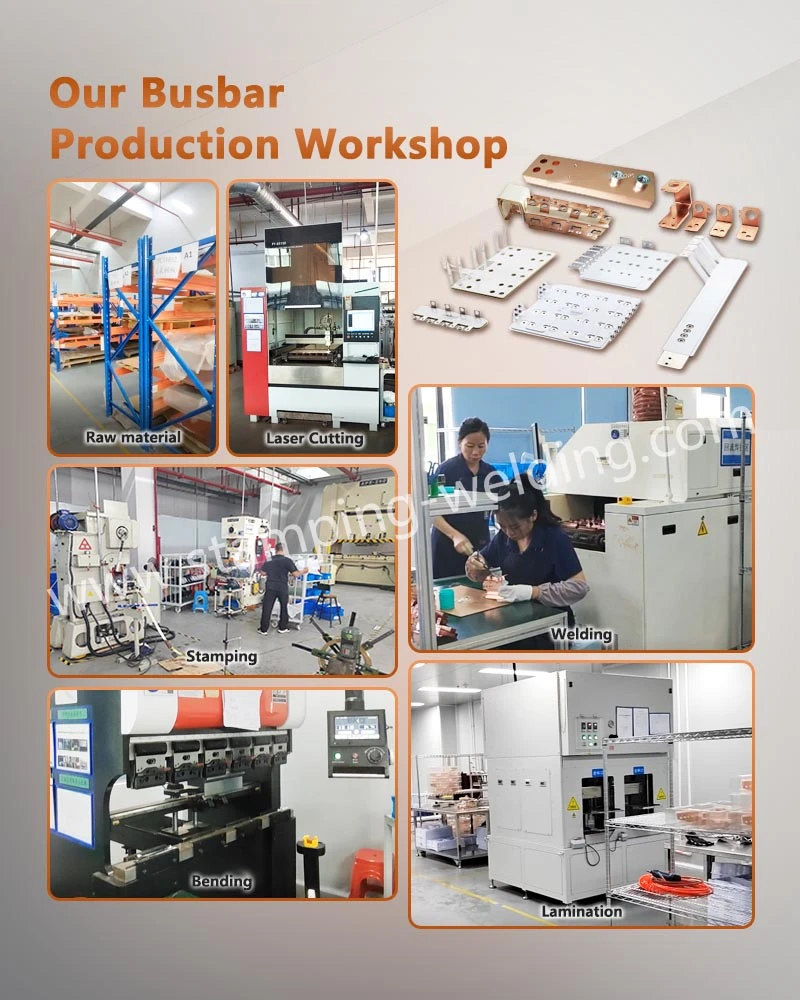
Stamping, Bending, and Welding for OEM Production
An Aluminum Busbar Manufacturer must control both electrical performance and manufacturing consistency. Stamping, CNC machining, bending, and joining processes affect dimensional accuracy, contact quality, and production yield.
Important design considerations include:
- Bend radius relative to material thickness.
- Burr height and direction near insulation or contact surfaces.
- Hole position, flatness, and terminal alignment.
- Cracking risk at formed edges.
- Tool wear and dimensional variation during production.
Laser welding and resistance welding may both be suitable, depending on the joint geometry and materials.
|
Factor |
Laser Welding | Resistance Welding |
|---|---|---|
| Heat input | Localized and controlled by laser parameters | Generated through current, resistance, and electrode force |
| Main process variables | Power, speed, focus, and joint fit-up | Current, force, weld time, and electrode condition |
| Typical risks | Porosity, lack of fusion, distortion | Inconsistent weld formation and electrode wear |
| Validation | Weld inspection, resistance, and mechanical testing | Weld monitoring, resistance, and mechanical testing |
Copper-to-aluminum laser welding requires particular attention to brittle intermetallic compounds, cracking, and joint resistance. The process must be qualified using representative parts and agreed acceptance criteria.
For automotive programs, production documentation may include process flow, PFMEA, control plans, dimensional inspection reports, and PPAP submissions where required. ISO 9001 or IATF 16949 certification should be verified against the supplier's actual certification scope and customer requirements.
How to Select the Right Busbar Supplier
A Custom Aluminum Busbar Supplier should evaluate the drawing, material grade, electrical duty, surface finish, and production volume before confirming feasibility and pricing.
Procurement and engineering teams should verify:
- Material control: Alloy, temper, thickness, and material traceability.
- Manufacturing capability: Stamping, bending, machining, joining, and plating.
- Inspection capability: Dimensional accuracy, coating quality, and electrical resistance testing.
- Quality documentation: Applicable ISO 9001, IATF 16949, and customer-specific requirements.
- Production readiness: Sample approval, process validation, change control, and PPAP where required.
The RFQ should include a 2D drawing or 3D model, current and voltage requirements, temperature limits, connection details, surface-finish specifications, annual volume, and required quality documents. Complete specifications help suppliers evaluate manufacturability and reduce design changes during production.
FAQ: Aluminum Busbars for EV Battery Modules
Q: How much lighter is an aluminum busbar than a copper busbar?
A: For equal length and comparable DC resistance, a simplified calculation suggests aluminum conductor mass may be approximately 50% lower. Actual results depend on geometry, operating temperature, joints, and thermal requirements.
Q: Can an aluminum busbar carry the same current as copper?
A: Yes, when conductor dimensions and thermal performance are properly engineered. Aluminum generally requires a larger cross-section, and the finished assembly must meet specified temperature-rise and electrical performance limits.
Q: Does every aluminum busbar require tin plating?
A: No. Surface treatment depends on the contact interface, operating environment, corrosion risk, and customer specification. Any selected coating system should be validated for adhesion, thickness, and electrical performance.
Q: What information is needed for an aluminum busbar quotation?
A: Provide drawings, alloy and temper requirements, current duty, voltage, temperature limits, connection details, surface finish, annual quantity, and applicable quality documentation.
Contact Us
Xiamen Apollo Stamping Welding Technology Co., Ltd. manufactures precision metal stamping and welded components for EV, energy storage, photovoltaic, and electrical applications. For aluminum busbar projects, provide your drawings, electrical requirements, surface-finish specifications, and estimated order volume for a manufacturing feasibility review.