Analysis of new energy vehicle capacitor bank copper busbar industry knowledge
Jun 02, 2026
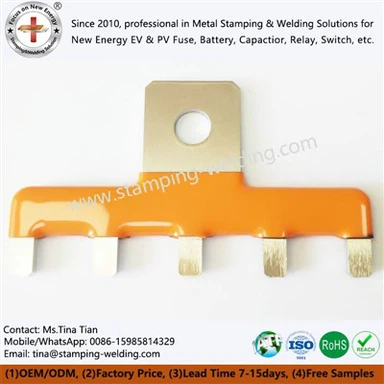
In the electric and electronic control system of new energy vehicles, the capacitor group connection busbar is an indispensable core conductive connector. It is mainly responsible for the power transmission and circuit connection between the vehicle battery pack, drive motor, electronic control system and vehicle-mounted capacitor components. The processing accuracy, electrical performance and structural stability of the product directly determine the operating efficiency, endurance stability and driving safety factor of the vehicle power system. As new energy vehicles iterate in the direction of high voltage, high current, and high integration, the adaptation requirements for core components such as vehicle-mounted film capacitors and DC link capacitors continue to upgrade. Copper Busbar for DC link EV Film Capacitor has become a core supporting component of the electronic control system of new energy passenger cars and commercial vehicles by virtue of its precise adaptability to working conditions. It has also made the production and manufacturing of capacitor group copper busbars a key segment in the manufacturing of new energy vehicle parts.
The first and core link in the high-quality production of new energy vehicle capacitor bank copper busbars is the screening and preprocessing of raw materials. The quality of raw materials fundamentally determines the conductive performance, mechanical strength and service life of the busbars. High-purity electrolytic copper is generally used as the main base material in the industry, and some lightweight design models are processed with high-quality aluminum. Both types of base materials have the core characteristics of low resistivity, excellent thermal conductivity, and strong ductility, which can meet the working conditions of continuous transmission of large currents in vehicles. After the raw materials are put into storage, a comprehensive quality inspection must be carried out to strictly test key indicators such as base material purity, thickness uniformity, tensile strength, and bending resistance. Unqualified raw materials with impurities, deformations, and cracks will be eliminated to avoid problems such as later circuit heating, uneven conductivity, and structural fractures from the source. This will lay a solid foundation for subsequent precision processing and adapt to the high-standard production requirements of Copper Busbar for Electric Vehicle Capacitors.

Material advantages
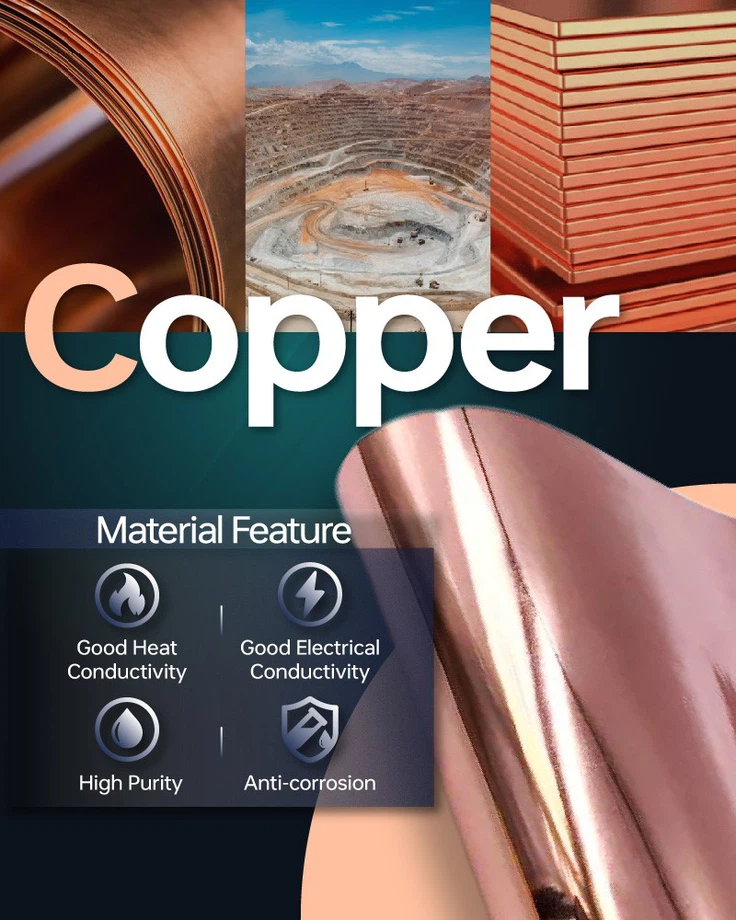
The conductor material of the new energy vehicle capacitor bank connection busbar is mainly made of high-purity oxygen-free copper (copper content ≥ 99.95%) or copper alloy to ensure excellent electrical conductivity, thermal conductivity and electrochemical corrosion resistance. In some situations where lightweight requirements are high, copper-aluminum composite panels or high-strength aluminum alloys can also be used. In terms of surface treatment, tin plating, nickel plating, silver plating or passivation process can be selected according to the application environment. In response to the application requirements of self-healing film capacitors, Copper Busbar for Self-healing Film Capacitor for EV and HEV Applications usually adopts tin-plated surface treatment to ensure solderability while providing good anti-corrosion and sulfuration resistance. In terms of insulation materials, commonly used ones include PET (polyester film), PI (polyimide) or flame-retardant epoxy prepreg, which must meet the UL94 V-0 flame retardant grade and ROHS environmental requirements. In special environments such as hydrogen fuel cell vehicles, Copper Busbar for DC Link Film Capacitor of Hydrogen Fueled Car may be treated with precious metals such as gold or silver plating to meet the requirements of extremely low contact resistance and resistance to chemical atmospheres.
The first step in producing capacitor bank connection busbars is reasonable material selection. Based on the requirements for high electrical conductivity and high thermal conductivity, high-purity oxygen-free copper or aluminum alloy is usually selected as the conductor base material to provide excellent current conductivity and heat dissipation capabilities. All incoming materials must undergo strict factory inspection, including conductivity testing, hardness testing and surface quality assessment to ensure that their purity and mechanical properties meet industry standards. For different application scenarios, the busbar can be designed as Copper Busbar for DC link EV Film Capacitor, emphasizing low impedance and low inductance matching; or Film Capacitor Copper Busbar for Electric Vehicles, emphasizing direct laminated connection with film capacitor terminals. In addition, Copper Busbar for Electric Vehicle Capacitors needs to consider the compatibility of subsequent coating processes at the material stage.
Manufacturing process
The manufacturing process of the new energy vehicle capacitor bank connection busbar directly affects its electrical performance and long-term reliability. The core process chain includes: precision blanking or laser cutting of high-purity copper sheets, CNC bending and forming (to achieve a three-dimensional structure), surface treatment (tin plating/nickel plating/silver plating), insulating film lamination (hot press lamination), edge sealing, high-precision punching or CNC drilling of connection holes, and final quality inspection. For Copper Busbar for DC link EV Film Capacitor, the temperature, pressure and vacuum control during the lamination process are particularly critical. The purpose is to ensure that there is no air gap remaining between the PET or PI insulating film and the copper conductor, thereby avoiding partial discharge. In the production of Copper Busbar for Self-healing Film Capacitor for EV and HEV Applications, the flatness and plating adhesion of the terminals need to be strictly controlled to ensure low contact resistance with the capacitor terminals. For Copper Busbar for DC Link Film Capacitor for Electric Car, an aging treatment process will be added during the manufacturing process to eliminate the internal stress generated by bending and prevent dimensional creep from occurring under vehicle vibration and thermal cycle conditions. Each batch of finished products must pass withstand voltage testing, insulation resistance testing, microohmmeter contact resistance testing and thermal shock cycle verification to ensure that it meets the stringent reliability standards of new energy vehicles.

Application industry
This type of busbar is mainly used in the new energy vehicle industry, covering pure electric vehicles (BEV), hybrid electric vehicles (HEV), plug-in hybrid electric vehicles (PHEV) and hydrogen fuel cell vehicles (FCEV) and other vehicle platforms. In pure electric drive systems, Copper Busbar for DC Link Film Capacitor for Electric Car (used for high-voltage DC connection between the battery and the inverter) is a key interconnection piece of the electric drive assembly. In hybrid models, Copper Busbar for Hybrid Electric Vehicles Film Capacitor needs to adapt to frequent power switching between the engine and motor and limited cabin space. For hydrogen fuel cell vehicles, Copper Busbar for DC Link Film Capacitor of Hydrogen Fueled Car is used for energy transfer between the output end of the fuel cell stack and the DC-DC converter. In addition, the Copper Busbar for DC Link Power Electronics Capacitor also has a wide range of applications in power conversion units of commercial buses, construction machinery and energy storage systems.
contact us
Our company has long been focused on the field of high-voltage interconnection of new energy vehicles. We have full-process capabilities from material selection, structural design to precision manufacturing, and can provide customized Insulated Busbar for EV Capacitor solutions that adapt to different electric drive architectures.