Analysis of the Structural Characteristics and Engineering Applications of Braided Copper Busbar Flexible Conductive Connectors
Jun 27, 2026
Braided flexible conductive connectors are a type of flexible conductive component made of highly conductive copper. They are commonly used in electrical connection systems to replace traditional rigid conductors, addressing stress issues caused by vibration, thermal expansion and contraction, and installation misalignment. Typical structural forms include multi-strand braided copper wire conductors, similar to Braided Wire Flexible Copper. These conductors are formed by braiding high-purity electrolytic copper wire into a stable mesh or braided conductive structure, thus improving mechanical flexibility while maintaining conductivity.
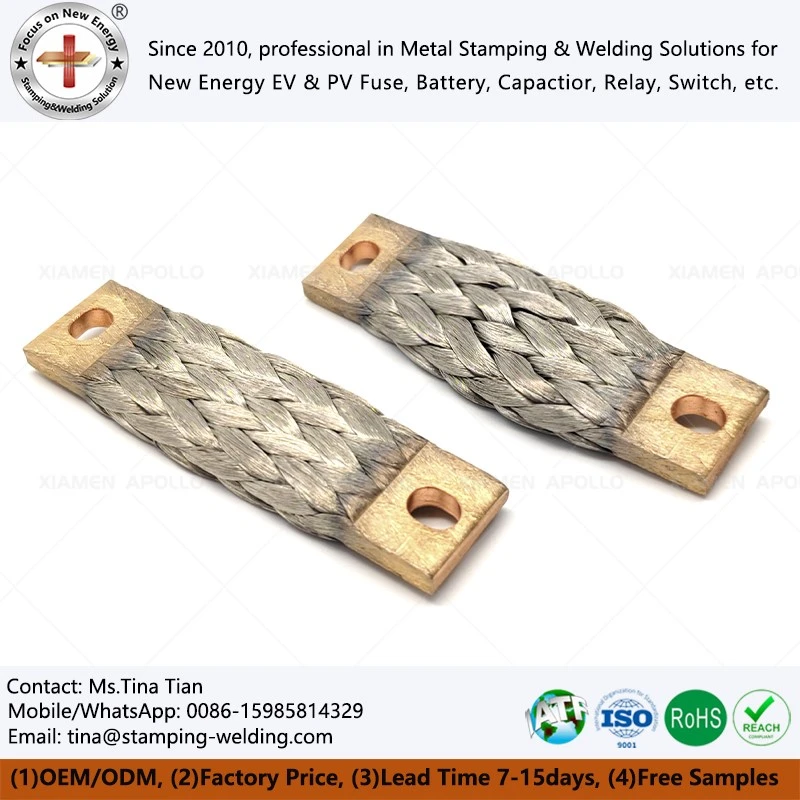
In engineering applications, these products are often designed with copper busbars or terminals crimped at both ends to form a stable conductive path. For example, in power distribution systems and electrical equipment connections, structures like Copper Stranded Flexible Connection effectively reduce contact resistance while adapting to complex installation spaces and dynamic operating conditions.
From a material composition perspective, the conductor typically uses high-purity copper wire and undergoes treatments such as tin plating to enhance oxidation resistance. In some high-reliability scenarios, structures such as Braided Tin Coated Copper Flexible Wire Connectors are also used to enhance long-term stability in humid or corrosive environments.
In terms of structural form, braided structures can be divided into two categories: circular and flat. Circular structures, such as Round Braided Flexible Cords or Round Stranded Flexible Cords, are more suitable for connection scenarios with limited space and requiring multi-directional bending; while flat structures, such as Flat Copper Braided Flexible Connectors, offer lower inductance and better heat dissipation in high-current busbar connections.

Regarding conductivity, these products are typical high-current flexible connection solutions, widely used in power system busbar connections, transformer outgoing lines, and internal connections in new energy battery systems. For example, in high-load scenarios, Flexible Copper Braided Electrical Connectors can effectively carry hundreds to thousands of amperes of current while maintaining low temperature rise characteristics.
One of their core advantages lies in their flexibility compensation capability. Due to the excellent deformability of the braided structure, Braided Copper Flexible Connectors can absorb vibrations and displacements during equipment operation, thereby avoiding breakage or loosening problems caused by stress concentration in rigid connections.
In the fields of new energy and industrial equipment, these products are often used to replace traditional copper busbar structures. For example, flexible busbars and copper jumpers can significantly improve the mechanical reliability and electrical stability of energy storage systems, electric vehicle battery packs, and frequency converters.
From a functional extension perspective, these conductive components not only provide conductive connections but also offer a certain degree of electromagnetic interference (EMI) suppression. Some structures, such as copper power braids, can form an equivalent shielding layer through multi-strand braiding, attenuating high-frequency EMI and improving system EMI compatibility.
In terms of installation and application, these flexible conductors can be customized according to the equipment structure. For example, flexible copper braid connectors can be bent at different angles and adapt to space, significantly reducing on-site processing complexity and improving installation efficiency.

Meanwhile, in standardized industrial applications, braided copper flexible wire connectors are commonly used for internal connections in motors, distribution cabinets, and rectifier equipment, maintaining stable electrical contact performance under high-frequency vibration environments.
In higher-level electrical systems, such as high-voltage switchgear or industrial busbar systems, braided tin-coated copper flexible connectors are often used in critical connection nodes to improve oxidation resistance and long-term operational reliability.
From a product form perspective, some high-end applications utilize Round Braided Stranded Flexible Cords structures to enhance their flexibility in three-dimensional space, adapting to complex equipment layout requirements.
At the system integration level, these conductive components can also serve as Flexible Copper Braided Connectors in modular electrical systems, enabling standardized connections and rapid maintenance.
Overall, these flexible conductive products have gradually become key connection components in modern power and new energy systems. Whether in traditional power distribution systems or high-power-density new energy equipment, their stability and flexibility make them an irreplaceable conductive solution.
contact us