Copper Foil Flexible Busbars: Industry Science Popularization and Application Analysis
Mar 29, 2026
In the fields of high-power power transmission and precision electrical connections, Copper Foil Flexible Busbars, with their unique structural and performance advantages, have gradually become core conductive components in high-voltage, high-current, and complex installation scenarios. Also known as Copper Foil Flexible Bars, they are a new type of flexible conductive component that replaces traditional rigid copper busbars and ordinary cables. These devices are made of multiple layers of high-purity thin copper foil, widely adaptable to various harsh operating conditions, and balance conductivity, mechanical flexibility, and ease of installation. Their applications are becoming increasingly widespread in power distribution, new energy, rail transportation, and industrial equipment.
Core structure and manufacturing process
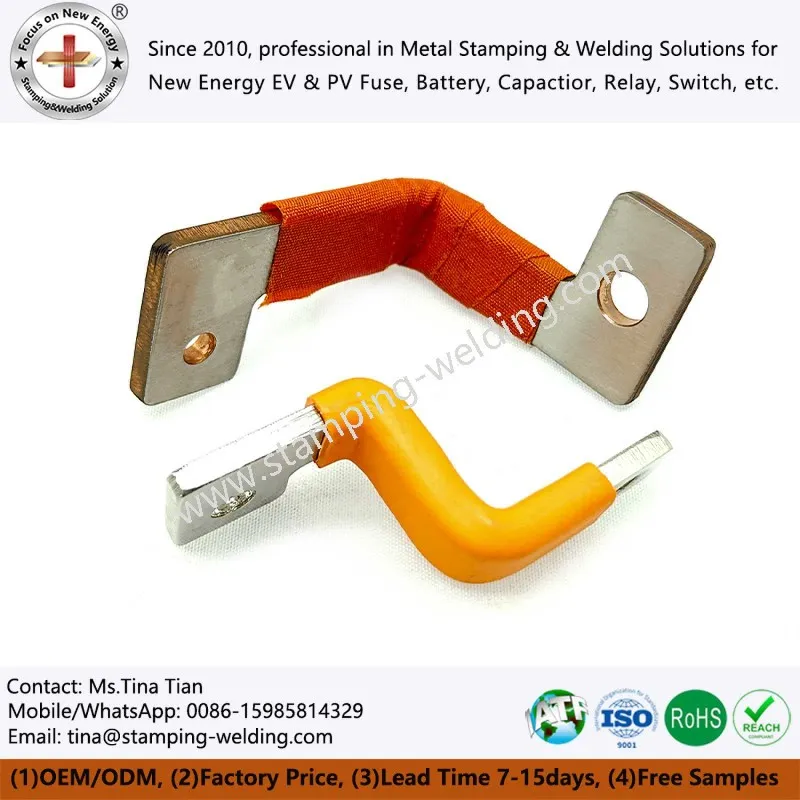
From a structural and manufacturing perspective, copper busbars follow a standardized molding logic. The conductor body is composed of multiple layers of stacked copper foil, commonly known as a Copper laminated foils connector. The core connection relies on the molecular diffusion bonding process corresponding to Press Welding Foil Bar, which melts and presses the two ends of the copper foil into a solid block structure, creating a stable and reliable conductive contact surface. The middle section retains a loose layer state to maintain the product's flexibility. The outer layer is usually covered with an insulating sleeve. The commonly seen Copper Foil Flexible Busbar with Insulated Tube on the market uses materials such as PVC, heat shrink tubing, and thermoplastic elastomers to achieve insulation protection and physical abrasion resistance, improving product safety.

Product Performance and Core Advantages
Copper foil flexible bars possess several irreplaceable performance characteristics, making them suitable for various complex power application scenarios. Compared to traditional rigid copper bars, the Flexible Laminated Copper Bus Bar boasts exceptional bending flexibility, allowing for flexible bending and shaping in three-dimensional space. This significantly reduces installation difficulty in confined spaces and complex layouts, which is the core advantage of the Multi-Layer Bending Power Electrical Busbar. The product exhibits excellent vibration damping and displacement compensation capabilities, effectively absorbing equipment operating vibrations, compensating for structural deformation caused by thermal expansion and contraction, and preventing joint loosening and failure. The multi-layer thin-film conductor design results in lower resistance and less temperature rise during operation, ensuring stable and outstanding conductivity under high current conditions. The flat structure also significantly saves internal space in cabinets and equipment compartments, optimizing the overall layout.
Product Categories and Sub-models
The market offers a wide variety of flexible copper foil busbars to meet customized needs in various scenarios. For example, tin-plated models like the Customized Tin Plating Copper Laminated and Tin Plating Copper Laminated Bar enhance oxidation and corrosion resistance. Laminated flexible foil connectors, Laminated Copper Electrical Shunts, and Copper Laminated Flexible Shunts focus on precise conductive connections. In addition, there are specialized models for specific equipment, such as the Multilayer Flexible Copper Busbar for Switchgear (suitable for high and low voltage switchgear), the Copper Foil Flexible Bar for Rail Transit (serving the rail transit sector), the Copper Foil Battery Bar Connector for power battery connections, and the Multi-Layer Copper Foil Bus Bar for Electricity System (covering all power system scenarios). Each model is tailored to the specific application standards of its respective field.

Main application areas and prospects
Currently, the application scenarios for copper flexible busbars continue to expand, covering multiple industries with stringent requirements for current carrying capacity and operational reliability. In the new energy field, copper foil bars are widely used for series and parallel connections of electric vehicle power batteries and for internal conductivity in photovoltaic inverters; in power distribution scenarios, they are commonly used for flexible connections in switchgear, transformers, and generator sets; in the industrial equipment and rail transportation sectors, various welding equipment, electrolysis equipment, and rail vehicle power leads also utilize compatible models of copper foil flexible busbars. With their stable performance and flexible adaptability, these products have become indispensable key conductive components in modern power systems and high-end equipment manufacturing.

Contact Us
In practical engineering applications, the technical principles of the aforementioned Copper Foil Flexible Busbars ultimately need to be realized through specific product design. Different combinations of structures and materials will directly affect the long-term stability of the system.