Copper foil soft connection diffusion welding technology: analysis of principles, processes and engineering applications
May 26, 2026
Basic definition
Copper foil soft connection diffusion welding is a welding method that uses multiple layers of thin copper foil or other metal foils to diffuse atoms at the contact interface through high temperature and pressure to form a strong metallurgical bond. This technology is mainly used in conductive connection scenarios that require high flexibility, large current-carrying capacity, and resistance to vibration, such as flexible transition connections in new energy battery systems, high-power electronic equipment, and power transmission and distribution devices. Unlike traditional brazing or fusion welding, diffusion welding does not require the addition of any solder or filler metal during the welding process. Instead, it relies on the atomic migration of the connected materials themselves in the solid state to achieve bonding. Therefore, the solder joint has engineering advantages such as uniform composition, no interface brittle phase, and stable resistance.
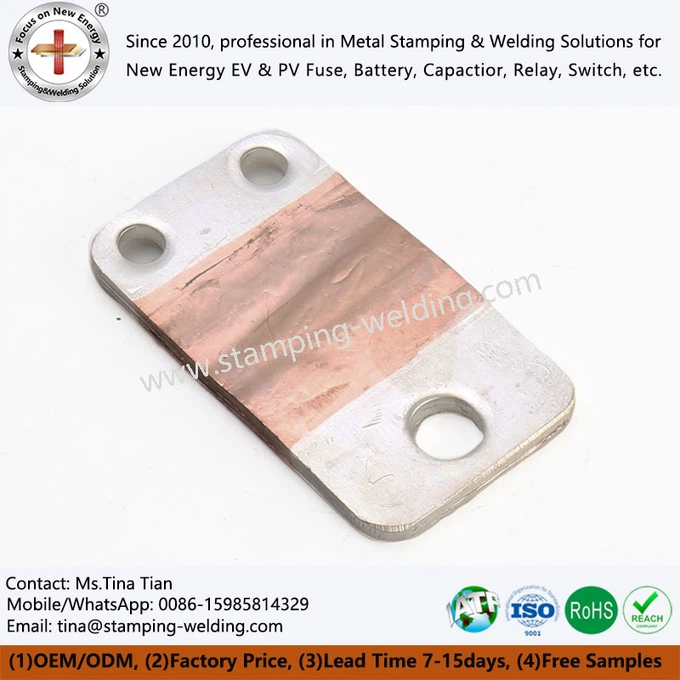
In the manufacture of Flexible Copper Bus Bars, the diffusion welding process can consolidate the ends of the multi-layer copper foil into a dense rigid connection area, while the middle part maintains a multi-layer separation structure to provide flexibility, thereby ensuring the current-carrying capacity and mechanical strength of the end joint and using the flexible area to absorb thermal expansion displacement and vibration during equipment operation. For new energy power battery modules, Flexible Busbars for Battery Connector and Copper Flexible BusBars for Lithium Battery are widely made using this process, which is used to establish low-resistance and high-flexibility electrical paths between the cell poles or between the battery pack and the main circuit. Copper Laminated Flexible Connectors are a typical product of diffusion welding technology. Their multi-layer laminated structure makes their bending life and fatigue resistance significantly better than that of a single copper bar.
Technical advantages
Compared with traditional welding methods, diffusion welding of copper foil soft connections exhibits several engineering advantages. First, no solder is required. By not relying on solder or flux, this technology essentially eliminates the risk of solder spatter, residual flux corrosion, and galvanic corrosion between dissimilar metals. The lack of solder layer also makes the joint resistance lower, especially for high-current transmission paths. Every micro-ohm resistance reduction will reduce Joule heating and improve system energy efficiency. Second, the welded joints are flat and smooth. Since there is no flow and solidification of molten metal during the welding process, the surface of the connection area after diffusion welding maintains the original foil lamination texture or forms a uniform recrystallized structure, with almost no visible weld bulges or depressions. This feature is particularly important for Tinned Foil Connector for Electrical Battery installed in a limited space, because uneven soldering areas may cause electric field concentration or poor adhesion of the insulation film. Third, the connection is strong and stable. The joint formed by diffusion welding is a metallurgical bonding type. Its tensile strength and shear fatigue resistance are better than mechanical connection methods such as crimping or riveting, and it is not prone to creep relaxation in long-term thermal cycles.
Copper Foil Flexible Storage Energy Battery Busbar needs to withstand the periodic expansion and contraction of the battery core during the charging and discharging process in the energy storage system. The ends of the diffusion welding connection can reliably transmit stress without contact resistance drift. Fourth, the range of applicable materials is wide. This technology is not only suitable for the same metal connection between copper and copper, but also can realize the diffusion connection of dissimilar metals such as copper and aluminum, copper and nickel through reasonable interface transition layer design, meeting the application needs of copper-aluminum composite terminals in battery packs. Fifth, environmental protection. The diffusion welding process does not require solder and flux, does not produce harmful smoke or waste liquid, and the heating method uses electric heating, which has no direct carbon emissions and meets the requirements of clean production.
application fields
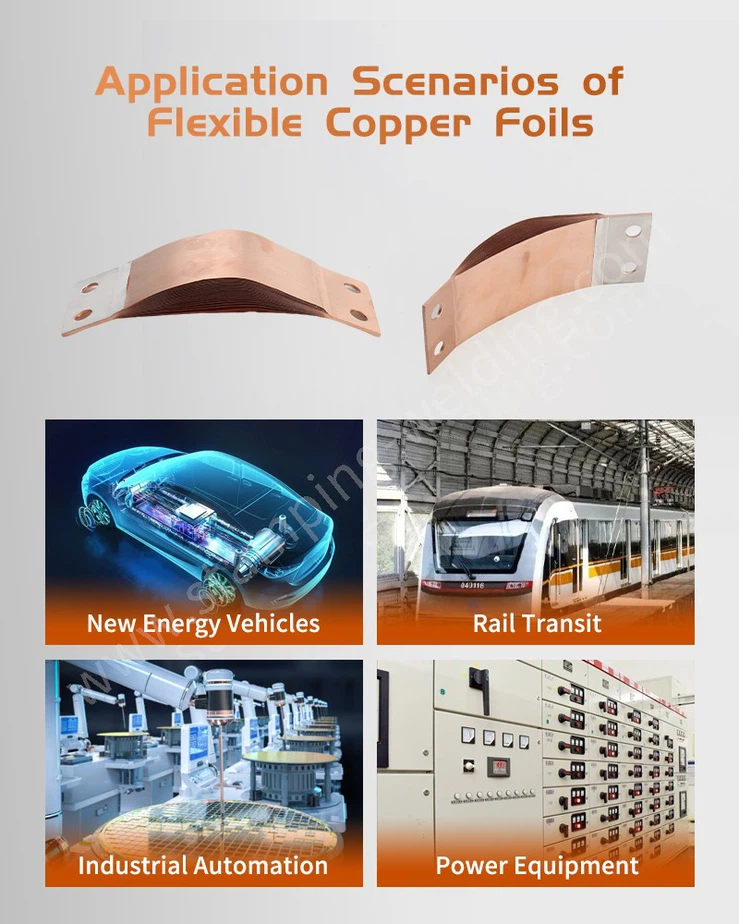
The application fields of copper foil soft connections have deeply expanded from the traditional power electronics industry to high-end manufacturing fields such as new energy vehicles, energy storage systems, aerospace and rail transportation. In the field of new energy vehicles, Copper Foil Bus Bar is widely used as the conductive medium for the series and parallel connections between the internal modules of the power battery pack, the flexible transition between the cells and the busbar, and the backbone connection between the battery pack and the high-voltage distribution box of the vehicle. Its lightweight and flexible characteristics are of great significance for improving the energy density of the battery pack and adapting to the space constraints of the vehicle chassis. In energy storage converters and photovoltaic inverters, the connection between the IGBT power module and the DC busbar needs to meet the requirements of low inductance, low resistance and high flexibility. The multi-layer copper foil integrated structure of Copper Laminated Flexible Connectors achieved through diffusion welding, effectively reduces voltage overshoot and electromagnetic interference during the switching process. In the aerospace field, satellite power systems and aircraft power distribution networks are extremely sensitive to the weight of connectors. Copper foil soft connections have become the preferred solution due to their high specific strength and conductive properties. In the rail transit traction system, the transition section of the power cable between the traction converter and the motor uses a large-section copper foil soft connection, which not only withstands the continuous vibration during vehicle operation but also ensures efficient transmission of megawatt-level power.
Process flow
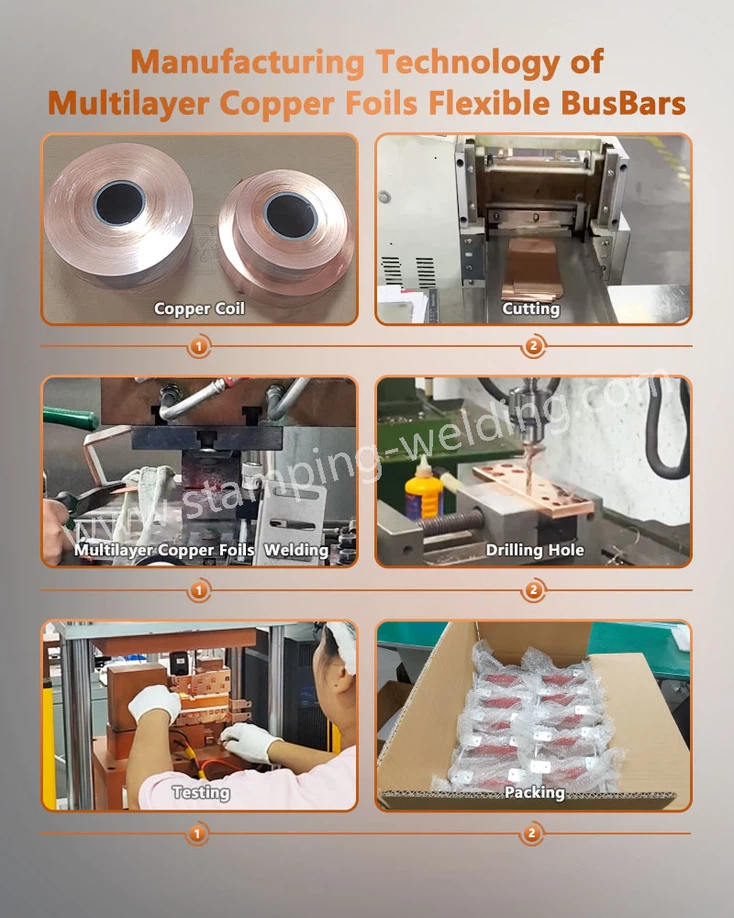
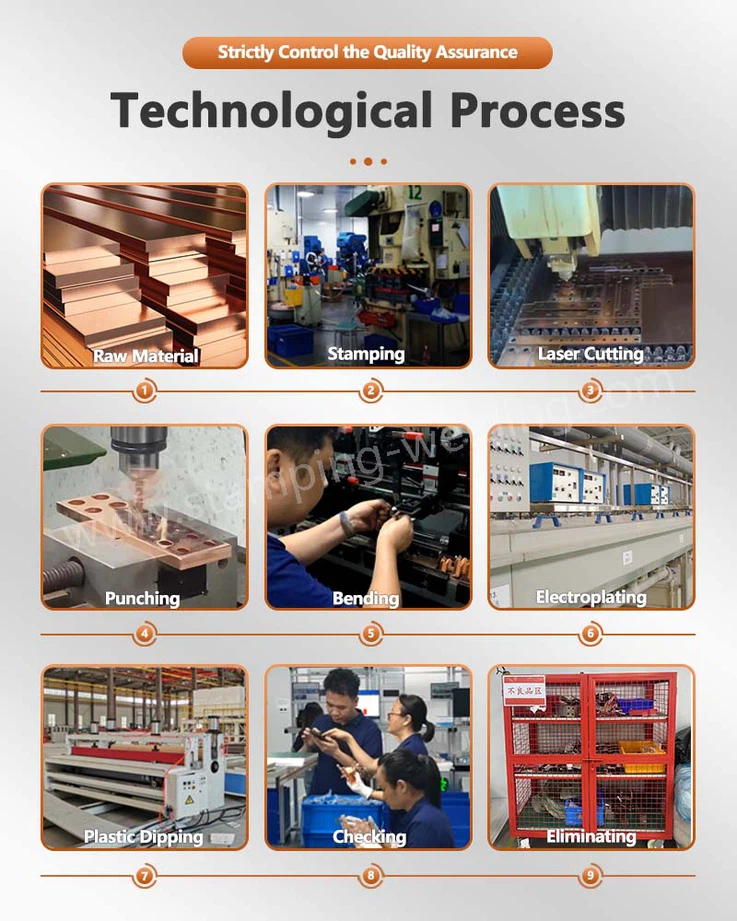
The manufacturing process of diffusion welding copper foil soft connections covers multiple precision links such as material preparation, stacked assembly, welding forming and post-processing. During the material preparation stage, the copper foil needs to undergo strict surface cleaning and degreasing to remove rolling oil, oxide film and dust particles. Any residual contaminants will form interface inclusions at high temperatures and degrade the welding quality. In the lamination assembly stage, the multiple layers of copper foil are accurately laminated in the designed order and direction through positioning fixtures. Nickel sheets or nickel plating layers can be inserted between the layers to improve the interface compatibility of dissimilar metal welding. The welding forming stage is completed in a vacuum diffusion welding furnace or a protective atmosphere welding machine. The temperature profile is usually set near the copper recrystallization temperature. The holding time ranges from minutes to hours, depending on the thickness of the stack and the size of the joint. The post-processing stage includes post-weld correction, deburring, surface cleaning and electrical performance sampling. For specifications that require surface coating, such as Tinned Foil Connector for Electrical Battery, tin plating or silver plating needs to be performed after diffusion welding to improve the oxidation resistance and weldability of subsequent assembly.
contact us
If you need to select a suitable Laminated Copper Foil Shunt model for your battery module, energy storage system or high-power power supply equipment, please contact our engineering and technical team to obtain samples and technical parameter sheets.