Knowledge analysis of copper braided soft connection industry
May 26, 2026
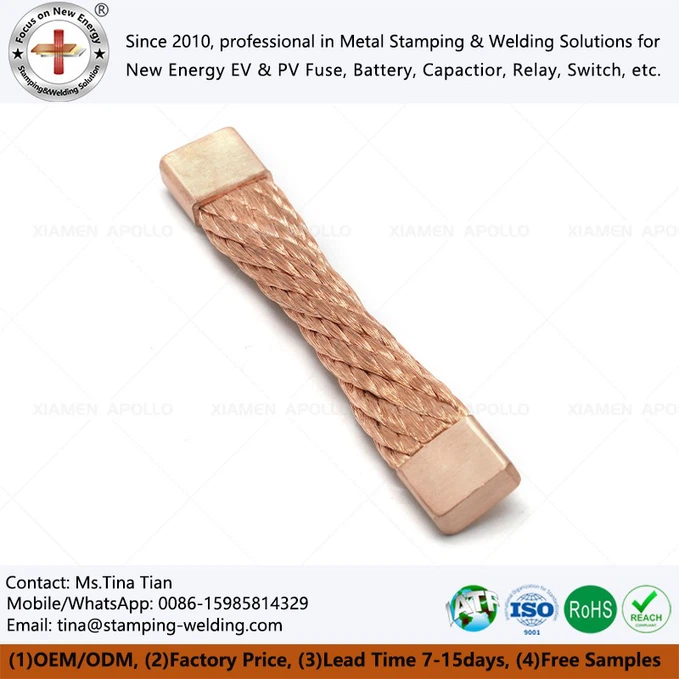
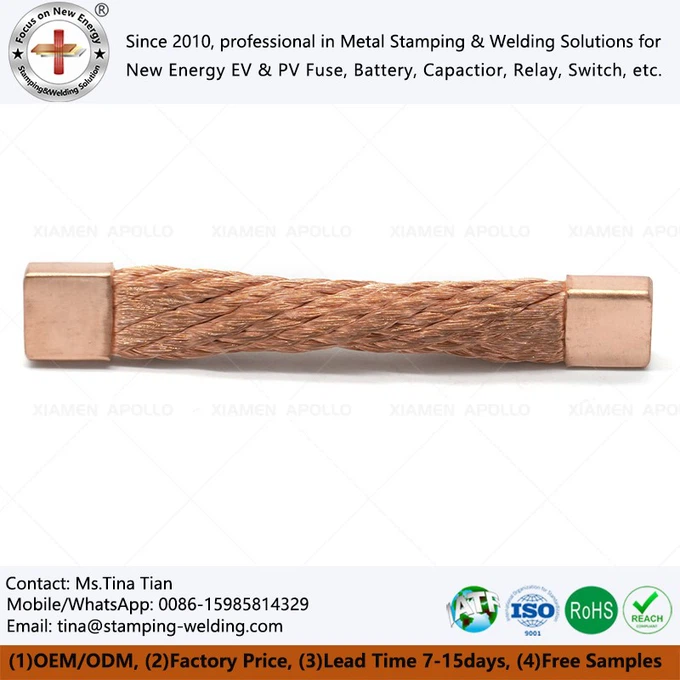
Braided soft connection is an electrical component made of multiple strands of fine copper wire or tinned copper wire made into a flat or circular strip shape through a specific braiding process, and is designed to have both flexible connection and conductive functions. Its existence is not driven by a single factor, but is the result of the joint action of material properties, electromagnetic physical effects, and engineering constraints. In electrical engineering and power electronics systems, rigid conductors (such as solid copper or aluminum bars) are often unable to absorb relative displacement when faced with equipment vibration, thermal expansion and contraction, and installation tolerances, resulting in stress concentration or fatigue failure at the connection points. Through its unique fiber-like interlocking structure, braided soft connections provide necessary mechanical flexibility while maintaining low-resistance current transmission capabilities, thus becoming a key component in the dynamic connection of high-power equipment. Flat Copper Braided Flexible Connectors and Braided Copper Flexible Connectors are the most common product forms in distribution cabinets, transformer outlets and high-power power supplies. For duct or seal penetration applications that require circular cross-sections, Round Braided Flexible Cords and Round Stranded Flexible Cords provide a more compact wiring solution. The engineering value of Flexible Copper Braided Electrical Connectors lies in integrating the two functions of electrical conduction and mechanical decoupling, which fundamentally changes the failure mode of rigid connections under vibration conditions.
Material advantages
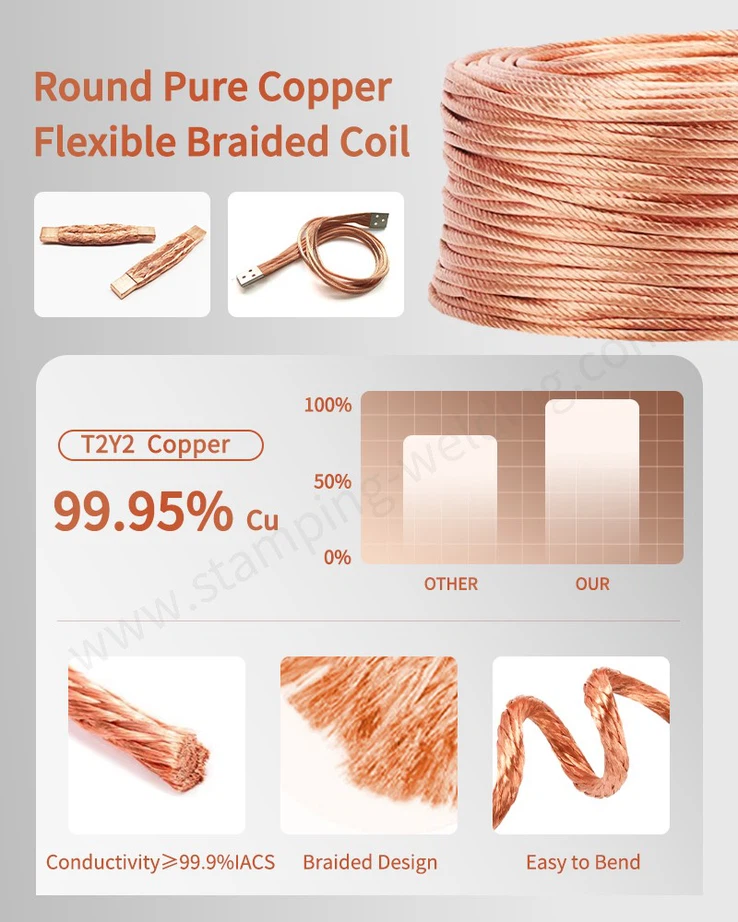
The core material of the braided soft connection is industrial pure copper or tinned copper wire. Pure copper (copper content ≥99.90%) has excellent electrical conductivity (≥98% IACS) and good ductility and is the most basic material choice for braided soft connections. However, bare copper is prone to patina or copper sulfide surface film in humid, sulfur-containing or salt spray environments, causing a significant increase in contact resistance. Braided Tin Coated Copper Flexible Connectors isolate the copper matrix from the external environment by continuously electroplating or hot-plating a layer of tin on the surface of the copper wire. Tin plating has good corrosion resistance, and the intermetallic compound formed by tin and copper can maintain low contact resistance. In situations where direct overlapping with aluminum terminals is required, the tin plating layer can be used as a buffer layer for the copper-aluminum transition to slow down the rate of galvanic corrosion. In addition, depending on the special requirements of the application environment, woven soft connections can also be surface-treated with nickel or silver plating. Nickel plating is suitable for high-temperature environments (such as around furnaces), while silver plating is suitable for high-end radio frequency or precision measurement equipment that requires extremely low contact resistance.
Application scenarios
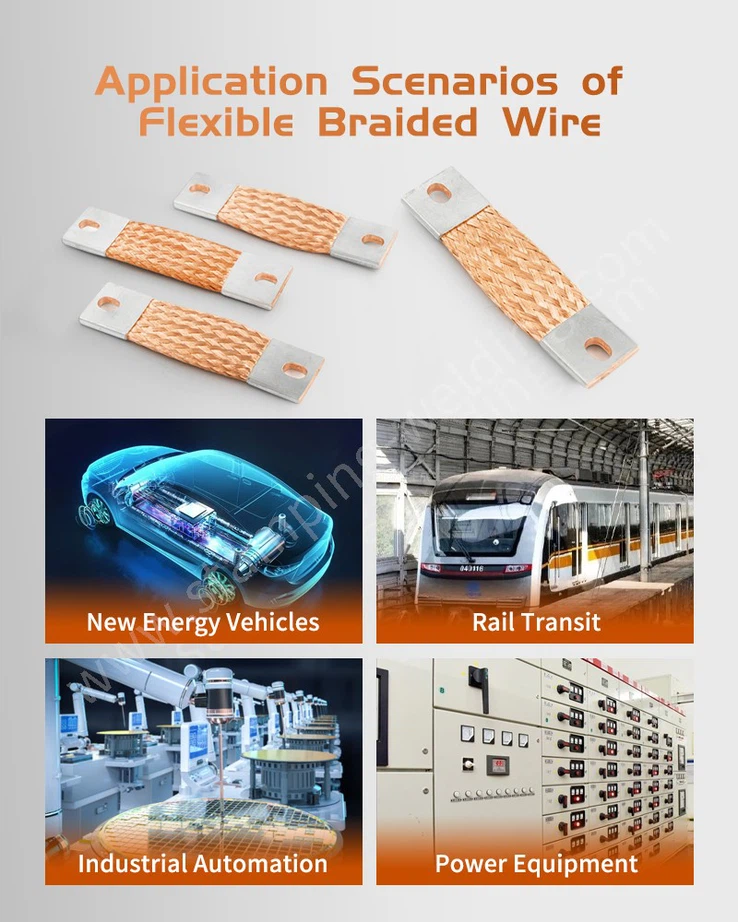
In the field of power transmission and distribution and new energy equipment, the electrical connections between the converter and transformer inside the wind turbine tower, as well as between the nacelle and the bottom of the tower, need to withstand continuous low-frequency swings and impact vibrations when the wind turbine starts and stops. Flexible Copper Braided Electrical Connectors replace rigid busbars in such applications, effectively isolating vibration transmission and preventing loosening of bolted connections. In photovoltaic inverters and energy storage converters, the connection distance between the power module and the DC bus is short and the space is compact. The braided soft connection makes the layout design more flexible because of its ability to be bent and formed at will.
In new energy electric vehicles and battery energy storage systems, large-section Flat Copper Braided Flexible Connectors are used to connect battery modules and high-voltage distribution boxes. During the charging and discharging process of the battery pack, the battery core will undergo slight thickness expansion and contraction; at the same time, random vibration during vehicle driving also puts forward flexibility requirements for the connectors. The braided soft connection absorbs these displacements through its own micro deformation and avoids alternating stress at solder joints or bolted connections. Inside the charging pile, Round Braided Flexible Cords are used to connect the charging gun cable to the internal main circuit, which needs to withstand frequent plugging, pulling, twisting and dragging. The round cross-section design makes it consistent in any bending direction and makes it easier to mate with the waterproof connector of the round cable.
In the field of rail transit and heavy-duty machinery, the ground return device between the electric locomotive wheelset and bogie, the high-current collector ring connection of mining excavators, etc. all require conductive components to maintain stable conduction under severe vibration and large-angle relative rotation. The multi-strand flexible structure of braided soft links can remain intact after hundreds of thousands of swings, while solid copper bars may experience root fractures after only thousands of swings.
Development trend
Relying on continuous material iteration and process upgrades, the copper braided soft connection industry is continuing to develop in the direction of high precision, high durability, strong adaptability, and multifunctionality, adapting to the stringent standards of high-end equipment manufacturing. Traditional general-purpose woven products are no longer able to meet the needs of high-end fields such as new energy storage, smart equipment, and aerospace. The industry has gradually popularized new processes such as fine weaving, precision tin plating, and multi-layer composite protection, which have greatly improved the corrosion resistance, high-temperature resistance, and anti-aging performance of products. Among them, Braided Tin Coated Copper Flexible Connectors use high-quality tin plating technology to effectively isolate air and corrosive media, solve the pain point of easy oxidation of copper materials, and are suitable for high-end complex working conditions such as outdoor, energy storage, and chemical industries. At the same time, customized production models are gradually becoming popular, and products with exclusive specifications can be customized according to equipment structure, working condition parameters, and installation requirements, further broadening the application boundaries of flexible conductive connection products.
contact us
If you need to select a CU Flex Busbar model for your power distribution equipment, new energy system or industrial automation project, please contact our engineering and technical team to obtain a selection manual and sample support.