Selection Guide for Copper Foil and Copper Braided Flexible Connectors: Structural Characteristics, Performance Differences, and Application Analysis
Jul 08, 2026
In electrical connection systems, soft connection components are mainly used to solve connection problems between rigid conductors caused by vibration, thermal expansion, installation errors, and movement displacement. Compared with traditional fixed copper bus connections, soft connections have better flexibility and stress relief capabilities, so they are widely used in new energy vehicles, power equipment, energy storage systems, switch cabinets, rail transit, and industrial electrical equipment.
At present, common soft connection forms mainly include copper foil soft connections and copper braided soft connections. Although both are made of high-conductivity copper materials, due to differences in structural forms, processing techniques, and mechanical properties, there are obvious differences in their advantages in practical applications. The correct choice of soft connection type requires comprehensive consideration of current capacity, installation space, movement mode, environmental conditions, and long-term reliability requirements.

Copper foil soft connections: a combination of high conductivity and structural stability
Copper foil soft connections usually use multi-layer ultra-thin copper foil laminations as the conductive body. Through processes such as high-temperature diffusion welding, molecular welding, or pressure welding, a stable connection structure is formed between copper foil layers. The thickness of commonly used copper foil is generally in the range of 0.05mm to 0.5mm, which can be adjusted according to the rated current and space requirements.
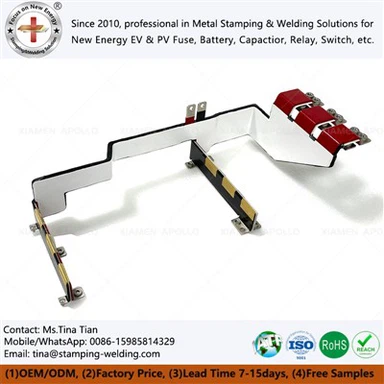
Because the copper foil adopts a layered superposition structure, its overall cross-sectional area is large, and the current transmission path is short, so it has low resistance and high current-carrying capacity. In high-current electrical systems, the Copper Foil Laminated Busbar Welding process can ensure reliable bonding between copper foil layers and improve the mechanical strength and conductive stability of the connection area.
In practical applications, copper foil soft connections are usually used for internal connections in battery systems, power conversion equipment, power distribution systems, and high-power electrical equipment. For example, in high-voltage switchgear, Copper Foil Busbar can be used as a flexible conductive connector to compensate for thermal expansion, contraction, and mechanical vibration generated during the operation of the equipment.
The biggest advantage of the copper foil structure is stability. Because it is integrally welded and formed with multiple layers of copper foil, the connection area has good impact resistance and long-term fatigue resistance, and can maintain low contact resistance even in a continuous high-current working environment.
At the same time, Copper Foil Flexible Busbars can meet different voltage levels and installation space requirements by adjusting the number of copper foil layers, length, and end processing method. For example, within new energy equipment, flexible connection solutions of different sizes can be designed according to the battery module layout.
Structural characteristics and application limitations of copper foil soft connections
Although the copper foil soft connection has excellent electrical conductivity, due to its layered structure, the flexibility is mainly concentrated in the bending deformation in the up and down directions. In application scenarios that require large-scale rotation, multi-directional adjustment, or frequent movement, its installation freedom is relatively limited.
For example, in some dynamic equipment or space-constrained equipment, if there is a large angle change requirement at the connection position, it may be difficult to meet the long-term mechanical movement requirements by relying solely on the copper foil structure.
Therefore, it is necessary to fully evaluate the operating status of the equipment during the design stage to avoid material fatigue caused by excessive bending.
In addition, the manufacturing process of copper foil soft connections has high requirements on the welding process, copper foil cleanliness, and pressure control. Especially in multi-layer structural products, it is necessary to ensure that the layers of copper foil are evenly bonded, the overall current-carrying capacity and heat dissipation performance may be affected.
For high-reliability applications, some products currently adopt the Copper Laminated Flexible Busbars structure, which improves the balance between flexibility and electrical performance by optimizing the copper foil arrangement and welding area design.

Copper braided soft connection: advantages of high flexibility and dynamic adaptability
Copper braided soft connections are braided with multiple fine copper wires to form a conductive body, usually using high-purity oxygen-free copper as the raw material. During the production process, the copper rods are processed into fine copper wires through a drawing process, and then automatically woven to form a mesh structure. Finally, the product manufacturing is completed through end crimping, welding, or plating treatment.
Compared with a copper foil structure, the biggest feature of copper braid is higher flexibility. Because the interior is composed of a large number of independent copper wires, the whole body can bend and rotate in multiple directions, so it is especially suitable for situations where mechanical displacement, vibration, and installation angle changes exist.
In industrial equipment, electrical cabinets and mobile power supply systems, flexible connection structures such as Multilayer Flexible Copper Bus bar for Switchgear can effectively reduce mechanical stress and improve equipment operation reliability.
Copper braided soft connections have the following main advantages:
First, it is more flexible. Its mesh structure allows the connector to be adjusted at multiple angles and can adapt to complex installation environments.
Secondly, the heat dissipation performance is better. There is a certain air gap between the copper wires, which helps to release heat and can reduce local temperature rise under continuous working conditions.
Thirdly, the installation adaptability is stronger. For connection locations where there is slight displacement or vibration during equipment operation, the copper braid can absorb mechanical stress and reduce the force on the connection end.
In addition, according to different environmental requirements, the soft connection of copper braided tape can also be tin-plated, nickel-plated, or silver-plated to improve oxidation resistance and environmental adaptability. For example, Tin Plating Copper Laminated Busbar can improve the corrosion resistance of the connection area through surface coating.
Differences in selection between copper foil soft connections and copper braided soft connections
In actual engineering applications, there is no absolute advantage or disadvantage between the two soft connections, but their advantages are based on different usage conditions.
If the application scenario pays more attention to high current transmission capability, low resistance, and structural stability, such as energy storage battery systems, power conversion equipment, busbar connection systems, etc., copper foil soft connections are usually more suitable.
If the equipment requires frequent movement, multi-directional adjustment, or significant mechanical vibration, the copper braided soft connection has better adaptability.
For example, in rail transit, electric equipment, and industrial automation systems, Copper Foil Flexible Busbar For Rail Transit can meet the needs of highly reliable current connections, while the flexible braided structure is more suitable for dynamic connection environments.
In addition, in the field of new energy, as the power of battery systems continues to increase, soft connections not only need to meet current carrying requirements, but also need to take into account space utilization, heat dissipation capacity, and assembly efficiency.
Therefore, engineering designers usually need to select an appropriate structure based on specific working conditions.
The impact of the manufacturing process on the performance of soft connections
The final performance of soft-connected products depends not only on material selection, but also on the manufacturing process.
Copper foil soft connections mainly focus on copper foil lamination consistency, welding quality, and end processing accuracy. A high-quality Laminated flexible foil connector needs to ensure that there are no obvious defects in the welding area while maintaining a stable current transmission path.
Copper braided soft connections pay more attention to copper wire diameter, braiding density, end crimping quality, and surface treatment process. A reasonable braided structure can improve flexibility while preventing excessive looseness of copper wire from affecting resistance performance.
For special application environments, customized designs can also be adopted, such as Customized Tin Plating Copper Laminated Busbar, which can meet the needs of different equipment by adjusting the size, plating, and connection methods.

Future development trends in new energy and high-power equipment
With the development of new energy vehicles, energy storage systems, and smart grid technology, electrical connection components are developing towards high current, high reliability, and miniaturization.
In the future, soft connection products will not only need to have excellent electrical conductivity, but also need to meet lightweight design, higher levels of automated manufacturing, and the ability to adapt to complex environments.
In high-power electrical systems, structures such as Multi-Layer Copper Foil Bus Bar for Electricity System are becoming important solutions to improve system reliability. At the same time, combined with insulation protection, precision molding, and automated manufacturing technology, soft connection products will play a more important role in new energy vehicles, power electronic equipment, and industrial energy systems.
Copper foil soft connections and copper braided soft connections represent the two technical directions of stable connections and highly flexible connections, respectively. During the engineering design process, comprehensive judgment should be made based on equipment operating conditions, current requirements, spatial layout, and mechanical requirements, and the most suitable connection solution should be selected to ensure long-term stable operation of the entire electrical system.
contact us