Copper stamped components: Industrial processes and application guidelines
Apr 27, 2026
Advantages of core material selection
The reason why copper has become the preferred substrate for Copper stamped components is due to its multiple irreplaceable comprehensive properties, which can fully adapt to various harsh working conditions. Copper has industry benchmark level conductivity and thermal conductivity, which can meet core needs such as electronic connections, power transmission, and heat source evacuation. It is a key material for micro connectors, distribution busbars, and high-power conductive components. At the same time, copper material has excellent ductility and plasticity, and can be processed through multiple processes such as bending, stretching, and complex shaping, making it less prone to cracking and deformation. It is suitable for high-speed continuous modulus production technology, making it easy to achieve integrated molding of small tolerances and irregular structural parts.
Copper itself has natural antioxidant and corrosion-resistant properties, which can maintain stable performance in humid and complex industrial environments for a long time, effectively extending the service life of Copper sheet stamping. By combining different copper alloy formulas to adjust material strength and fatigue resistance, it is also possible to customize the production of load-bearing components such as spring contacts and elastic terminals, balancing flexibility and structural stability, further expanding the applicable boundaries of precision copper stamping parts.

Complete industrial production process
Copper stamped components have the production characteristics of high precision, high repeatability, and high efficiency, and can produce standardized parts with micrometer level tolerances in bulk. The entire production process is standardized and rigorous. Starting from structural design and engineering optimization in the early stage, manufacturability optimization is carried out based on product usage scenarios, simplifying process structure and controlling production costs without affecting performance. The core process is the customized development of precision molds, relying on professional design software and CNC machining technology to create specialized progressive molds. The accuracy of the mold directly determines the size, appearance, and assembly adaptability of the finished product.
After the mold is finalized, raw material screening and pretreatment are carried out. According to the performance requirements of the Electrical copper stamping parts, compliant substrates such as pure copper and various copper alloys are selected and uniformly processed before being put into the production line. Finally, batch forming is completed through high-speed continuous stamping, and copper strip material is automatically fed. A single stroke synchronously completes composite processes such as punching, stamping, bending, and shaping. The entire process is automated, ensuring high uniformity of batch products and greatly improving production efficiency, suitable for large-scale industrial order production.

Mainstream industry application areas
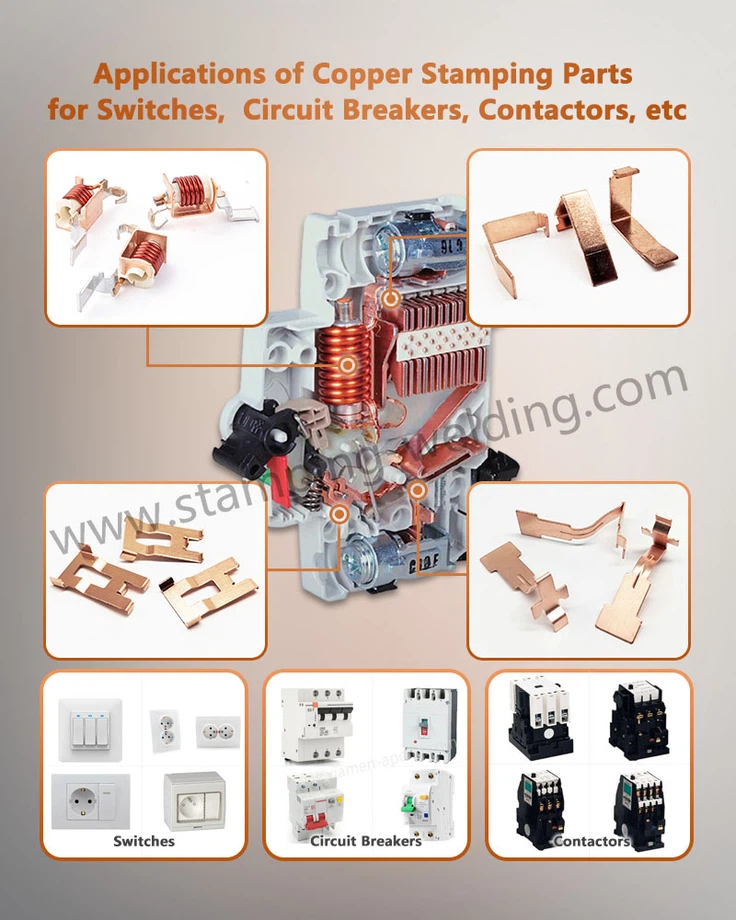
Relying on stable conductivity, precision molding ability, and durability, Metal stamping parts electric copper has deeply penetrated multiple high-end manufacturing industries and become the fundamental core component for stable equipment operation. In the field of electronic communication, it is widely used for connecting terminals, lead frames, signal shielding components and other accessories, relying on high conductivity to ensure stable signal transmission and safe power transmission. The field of automobile manufacturing covers both traditional fuel vehicles and new energy vehicles, mainly used for battery connection terminals, distribution busbars, sensor conductive components, and supporting the stable operation of the vehicle's power system.
With the characteristics of material safety and stable performance, special Copper strip stamping can be applied to internal connection components of medical diagnostic equipment, meeting medical grade usage standards. In the renewable energy industry, solar inverters, wind power generation equipment, and energy storage and distribution systems all rely on precision copper stamping parts to complete energy collection, transmission, and distribution, which is an important guarantee for the efficient operation of new energy equipment.
Subsequent precision machining and supporting processing services
After the basic stamping forming is completed, diversified post-processing and matching assembly services can be provided according to the functional requirements of OEM factory customized copper metal stamping parts, further improving the comprehensive performance and adaptability of the product. For different requirements such as conductivity, corrosion resistance, and wear resistance, surface polishing, deburring, electroplating, passivation and other treatment processes can be carried out to optimize surface texture, reduce contact resistance, and enhance environmental tolerance.
For structurally complex composite Pressing copper stamping bending connecting parts, we can also provide supporting solutions such as precision assembly and customized processing in the later stage, achieving integrated delivery from single parts to integrated components, better meeting the practical needs of modular assembly and customized engineering selection, and providing complete precision copper component solutions for customers in various industries.

Contact us
If you need to learn about Copper stamped components process customization, material selection, and component processing solutions, please feel free to consult and communicate at any time. We can provide you with high-precision and highly adaptable one-stop copper stamping processing support based on the requirements of different industry working conditions.