Evolution analysis of Aluminum cover plate for batteries laser welding technology
Mar 16, 2026
Technical overview and development background
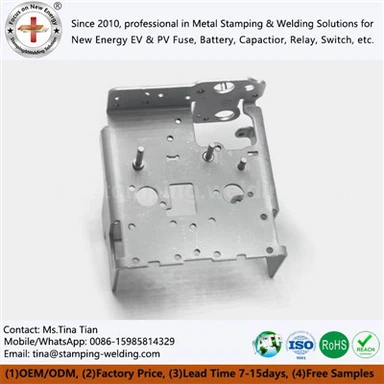
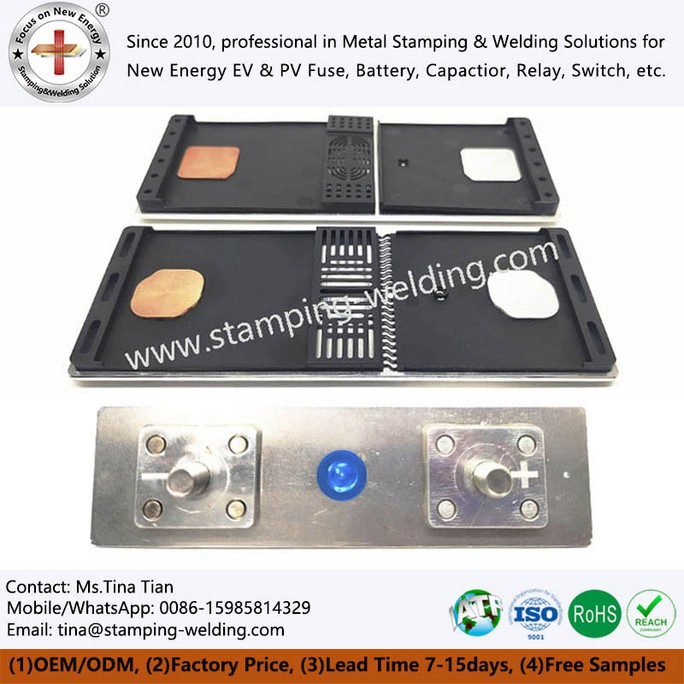
Square Aluminum cover plate for batteries have become the mainstream technology route for lithium battery manufacturing due to their compact structure, strong impact resistance, high energy density, and large single cell capacity, and their market share remains stable. Laser welding is one of the core processes in the manufacturing process of square aluminum shell batteries, widely used in key links such as cell soft connection and cover plate welding, Lithium battery top caps sealing, and sealing nail welding.
Laser welding has become the preferred solution for sealing and welding Battery aluminum safety cover sets due to its high energy density, excellent power stability, high welding accuracy, and ease of automation integration. It directly determines the sealing, structural strength, and operational safety of the battery.
With the large-scale expansion of lithium battery production capacity, the sealing weld of Power battery cover plate, as the longest and most time-consuming key weld, has become a core focus of the industry in terms of welding efficiency and quality. The development of industry technology revolves around the upgrading of welding speed for Copper and aluminum bimetal bipolar plates, gradually divided into three eras: 1.0 era (2015-2017, speed<100mm/s), 2.0 era (2017-2018, speed 100-200mm/s), and 3.0 era (2019 present, speed 200-300mm/s). Technological iteration continues to promote the improvement of production efficiency and yield.
1.0 Era: Low speed start and technological foundation
In the early stages of industry development, driven by new energy vehicle policies, production capacity rapidly expanded, but manufacturing processes and equipment were still in their infancy and the degree of automation was relatively low.
At this stage, the welding speed of Aluminum cover plate for batteries is in the range of 50-100mm/s, corresponding to a production efficiency of about 6-10PPM. The equipment scheme often uses a 1kW fiber laser combined with conventional welding heads, driven by servo platforms or linear motors. Due to the relatively slow welding speed and long thermal cycle time of the Power battery cover plate, the molten pool has sufficient time to flow and solidify, and the protective gas coverage is sufficient, making it easy to obtain high-quality welds with smooth and consistent surfaces.
The simple structure, low cost, and good stability of the equipment in this era laid the foundation for the development of Prismatic lithium battery lid welding technology in the future. But its limitations are also significant, and the low-speed mode is difficult to adapt to future production capacity increase needs; Simply increasing power and speed to speed up can lead to shortened thermal cycles, intense splashing of the melt pool, and increased porosity and voids.

2.0 Era: High speed Breakthrough and Technological Innovation
Faced with the explosive growth of installed capacity and the demand for increasing single line production capacity, the industry urgently needs to push the Prismatic lithium battery canopy welding speed to 150-200mm/s, corresponding to an increase in production capacity to 15-20PPM. Upgrade the drive system to a linear motor platform to meet the high-speed welding requirements for the top cover.
To ensure the quality of Prismatic lithium battery annexe welds under high-speed welding, the industry is exploring technology around three core requirements: weld formation, smooth surface, consistency, and low porosity. In the early days, the idea of multi laser composite welding was adopted, which achieved both deep penetration and wide welding through the synergistic effect of different wavelength lasers. With the maturity of fiber laser technology, the composite scheme has evolved into coaxial output of fiber laser+LD semiconductor laser, which can achieve stable Top lid for prismatic battery cell welding at 200mm/s.
At the same time, high-frequency swing laser welding technology has emerged. This solution only requires a single fiber laser and a swinging welding head, which is driven by a motor to reflect the lens and cause the laser to swing at a high frequency along a specific trajectory, forming a dynamic keyhole. Swing welding can effectively stir the molten pool, promote gas escape, repair the pinhole of the explosion point, and obtain a regular fish scale pattern Aluminum battery cover weld.
3.0 Era: Ultra high speed advancement and technological upgrading
Entering the industry reshuffle period, "improving quality, reducing costs, and increasing efficiency" has become the main theme, and the Aluminum battery box cover welding technology with speeds of 300mm/s and higher has become a research and development focus. At this stage, technological breakthroughs revolve around two main directions: efficient stability and system simplification.
Overall, the 3.0 era technology solution combines ultra high speed Lithium-ion battery cover plates welding, high stability, and equipment simplification, further promoting the improvement of lithium battery manufacturing efficiency. Provide technical support for the large-scale development of the industry, and ensure that the top cover welding maintains excellent forming quality in high-speed production.
contact us
If you need to learn about the laser welding process plan, equipment selection, and technical docking of the Aluminum cover plate for batteries, please feel free to consult and communicate at any time. We will rely on our professional technical accumulation to provide you with efficient welding solutions, and look forward to working together to promote the upgrading of lithium battery manufacturing technology.